



Trump-Xi summit delivers trade deals and North Korea pledge
May 18, 2026, 08:14 am


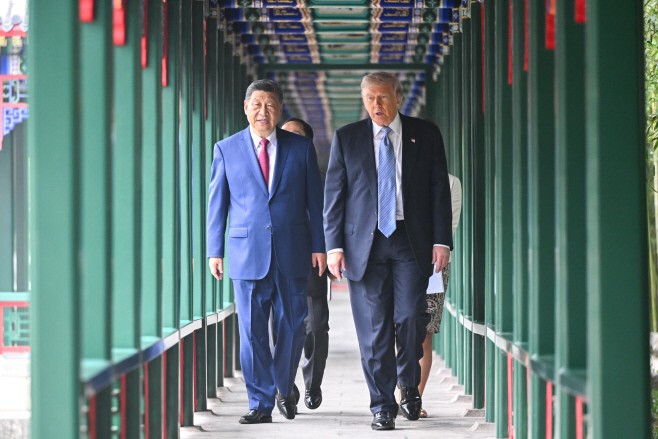 |
| Chinese President Xi Jinping (left) guides U.S. President Donald Trump during a visit to Zhongnanhai in Beijing on May 15. /Xinhua-Yonhap |
Donald Trump and Xi Jinping reaffirmed their shared goal of denuclearizing North Korea during their summit in Beijing on May 14 and follow-up meetings on May 15, according to a White House fact sheet released on May 17.
The White House also announced a broad package of economic and trade agreements, including the creation of new U.S.-China trade and investment boards and China’s commitment to purchase at least $17 billion worth of American agricultural products annually.
However, the two sides stopped short of announcing concrete Chinese concessions on rare earth exports and critical minerals, with the White House fact sheet stating only that China would “address U.S. concerns” regarding supply chain shortages.
White House confirms North Korea denuclearization goal
The White House said Trump and Xi “confirmed their shared goal of denuclearizing North Korea.”
Jamieson Greer, head of the Office of the U.S. Trade Representative (USTR), also said in an interview with ABC News that both leaders agreed to maintain the goal of denuclearization on the Korean Peninsula.
Chinese state media had previously reported only that the two leaders exchanged views on major international and regional issues, including the Korean Peninsula, without specifically mentioning denuclearization.
The White House also said Trump and Xi agreed that Iran must not possess nuclear weapons and called for the reopening of the Strait of Hormuz, while opposing the imposition of transit fees by any country or organization.
Greer said Trump did not ask China to take direct action in the Strait of Hormuz but focused on ensuring that China would not provide material support to Iran.
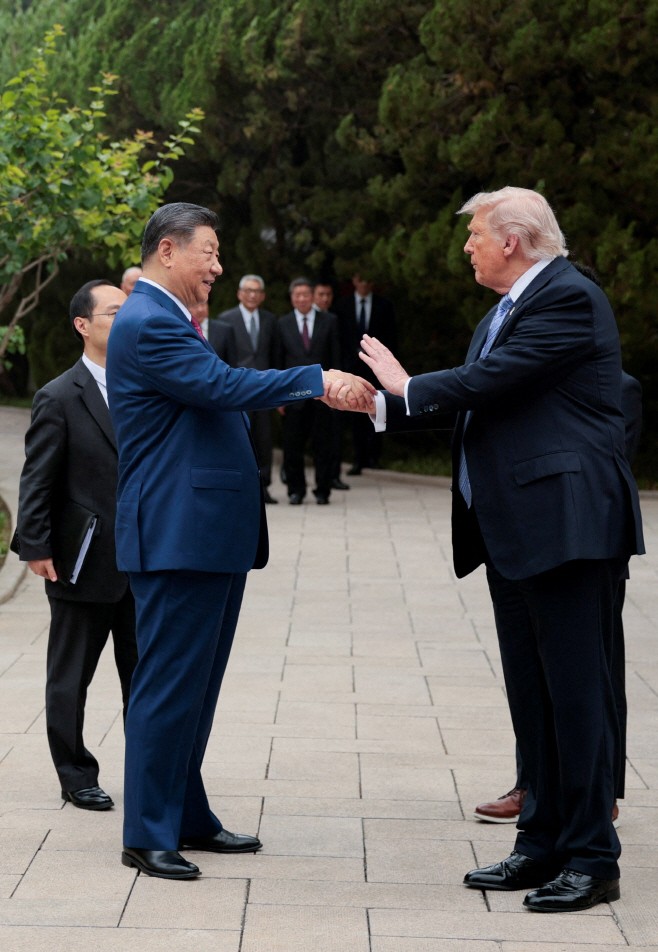 |
| Donald Trump (right) shakes hands with Xi Jinping after visiting the Zhongnanhai gardens in Beijing on May 15. /Reuters-Yonhap |
New trade and investment boards established
The White House described the creation of a U.S.-China Board of Trade and Board of Investment as the “cornerstone” of the agreement.
According to Greer, the trade board will oversee commerce involving “non-sensitive goods,” including agricultural products, energy, Boeing aircraft, medical devices, Chinese consumer goods and low-tech products. Advanced technologies with military applications will remain outside the framework for national security reasons.
The investment board will serve as a government-level forum to manage investment disputes and broader bilateral investment issues.
The White House also said both countries agreed to support each other as hosts of upcoming major international meetings, including the G20 summit and the APEC summit later this year.
Trump is expected to welcome Xi to Washington later this fall, and both leaders agreed to pursue a “constructive U.S.-China relationship of strategic stability” based on fairness and reciprocity.
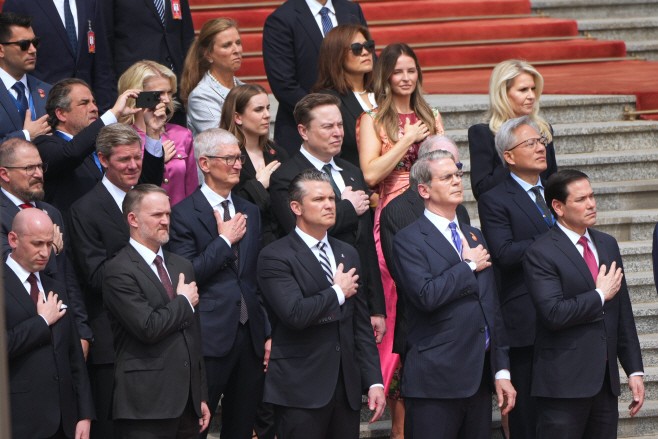 |
| (Front row, from left) Stephen Miller, Jamieson Greer, Pete Hegseth, Scott Bessent and Marco Rubio, along with U.S. Ambassador to China David Perdue (not visible), and (back row, third from left) Tim Cook, Elon Musk and Jensen Huang attend a national anthem ceremony during a welcome event for U.S. President Donald Trump at the Great Hall of the People in Beijing on May 14. /AP-Yonhap |
China to buy Boeing aircraft and US farm products
Under the agreement, China pledged to purchase 200 Boeing aircraft for Chinese airlines, marking its first major Boeing purchase commitment since 2017.
Greer said the initial order for 200 aircraft was confirmed and noted there could be additional purchases if Boeing fulfills deliveries successfully.
China also agreed to buy at least $17 billion worth of additional U.S. agricultural products annually in 2027 and 2028, along with prorated purchases for 2026.
The new purchases will include soybeans, beef, grains and dairy products, in addition to existing soybean agreements.
According to the White House, China will renew export approvals for more than 400 U.S. beef facilities whose licenses had expired and cooperate with U.S. regulators to remove remaining restrictions. China will also resume poultry imports from U.S. states designated free of highly pathogenic avian influenza by the U.S. Department of Agriculture.
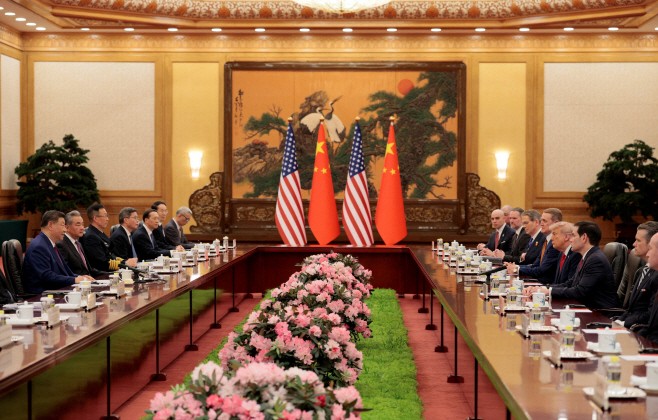 |
| Donald Trump (right) and Xi Jinping hold a summit meeting at the Great Hall of the People in Beijing on May 14. /Reuters-Yonhap |
Rare earths and Taiwan remain unresolved issues
Despite the broad agreements, the summit produced no detailed breakthrough on rare earths and critical minerals, which had been a major concern for Washington.
The White House fact sheet listed materials such as yttrium, scandium, neodymium and indium, but stated only that China would address U.S. concerns regarding supply chain shortages and export restrictions.
Greer also said the United States could still impose tariffs, service fees or import quotas under Section 301 investigations if China’s industrial overcapacity remains a problem.
On Taiwan, Greer said arms sales to Taiwan have long been a contentious issue for Beijing and that Trump was considering how to approach the matter. However, he stressed that there had been no change in long-standing U.S. policy and emphasized the importance of maintaining the status quo in the Taiwan Strait.
#Donald Trump #Xi Jinping #North Korea denuclearization #US-China summit #Boeing
Copyright by Asiatoday
Most Read
-
1
Celltrion’s Omlyclo gains ground in major European..

-
2
Trump demands rates fall below 1% as Fed hikes for..

-
3
Trump makes $1 trillion bet ahead of midterm elect..

-
4
Iran resumes ballistic missile production, assembl..

-
5
Samsung Electronics, Mistral AI to jointly develop..

-
6
Trump warns countries not helping U.S. must pay re..

-
7
Apple launches first foldable, 1 million won prici..

PEOPLE






HEADLINE NEWS
- Trump to roll out ‘unprecedented welcome’ for Xi with B-2 bombers, F-22 fighters
- S. Korea, U.S., and Japan form united front on Taiwan and economic coercion..
- Trump administration moves to impose sweeping sanctions on International Cr..
- Xi to make state visit to U.S. Sept. 23-25, dispelling rumors over his heal..

-
Address : In-Young Bldg., 34, Uisadang-daero 1-gil, Yeongdeungpo-gu, Seoul
Copyright by ASIATODAY CO., LTD. All rights resereved