



Korea tourism shows growth but trails Japan in quality
May 15, 2026, 10:19 am


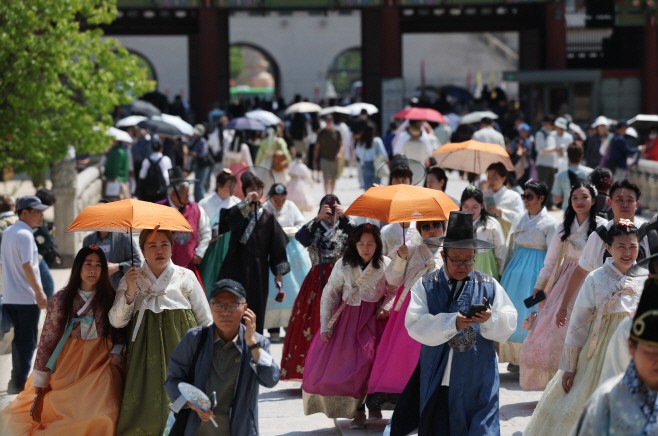 |
| Foreign tourists visit Gyeongbok Palace in central Seoul on May 13. /Yonhap |
South Korea’s tourism industry showed renewed momentum in the first quarter with a record number of foreign visitors, raising hopes for the government’s long-term goal of attracting 30 million annual tourists by 2029. However, industry experts say Korea still lags behind Japan in key qualitative indicators such as visitor spending and repeat travel rates.
According to data released by the Korea Tourism Organization, the number of inbound foreign tourists reached 4.74 million in the first quarter, marking the highest figure ever recorded for the January-March period. The total represented a 22.6 percent increase from a year earlier.
In March alone, inbound tourism rose 26.7 percent year-on-year. South Korea welcomed a total of 18.94 million foreign tourists last year, meaning the country would need an average annual growth rate of roughly 12.2 percent to achieve its 2029 target of 30 million visitors.
Compared with neighboring Japan, often viewed as a benchmark for tourism policy, Korea’s recent growth appears encouraging. According to the Japan Tourism Agency, Japan recorded 10.6 million foreign visitors in the first quarter, also a record high, but its growth rate slowed to around 6 percent from a year earlier.
Japan aims to attract 60 million foreign tourists annually by 2030, requiring yearly growth of roughly 7 percent.
For South Korea, increasing inbound tourism is considered essential to improving its chronic tourism account deficit. Last year, the country posted a tourism deficit of $10.76 billion, largely due to the imbalance between outbound and inbound travel.
The number of South Koreans traveling abroad reached 29.55 million in 2025, exceeding the number of foreign visitors by more than 10 million. Foreign tourists visiting Korea spent an average of $1,155 per person, slightly higher than the $1,104 spent by Koreans traveling overseas, suggesting that the imbalance in traveler volume remains the primary issue.
Japan, by contrast, recorded a record tourism surplus of about $60.1 billion last year, with 42.7 million inbound visitors compared with 14.73 million outbound Japanese travelers.
South Korea briefly returned to a tourism surplus in March for the first time since November 2014, helped by rising inbound tourism and slowing outbound travel among Koreans.
Still, experts point out that Korea continues to trail Japan in several qualitative measures. Average spending per foreign tourist in Korea last year stood at $1,155, well below Japan’s $1,560.
Research by Yanolja Research also showed that average spending per visitor in Korea remained below the 2019 level of $1,185 despite the recovery in tourist arrivals.
Tourism analysts say Japan’s strength lies in encouraging longer stays, regional travel and experience-based tourism. Beyond major cities such as Tokyo and Osaka, tourism in regional towns has expanded significantly, naturally increasing spending on accommodations, transportation and food.
Repeat visitor rates also highlight the gap. According to tourism authorities in both countries, Japan’s foreign tourist revisit rate stood at around 65 to 70 percent last year, compared with roughly 55 percent for South Korea.
Analysts often attribute Japan’s stronger revisit rates to experiential attractions such as traditional culture, local cuisine and hot springs.
South Korea has also been pursuing policies focused on regional tourism distribution, longer stays and high-value tourism experiences. During the first quarter, foreign visitor spending and regional tourism activity outside Seoul showed signs of improvement.
However, experts caution that Korea must focus more carefully on visitor satisfaction as inbound tourism enters a rapid growth phase.
Jang Kyung-jae, a professor at the Advanced Tourism Studies Center at Hokkaido University, said indicators such as spending per visitor and revisit rates demonstrate that Japan’s tourism industry has pursued qualitative growth alongside quantitative expansion over the past decade.
“Ultimately, qualitative growth comes from satisfaction with the travel experience,” Jang said. “Rather than simply attracting more visitors or dispersing them regionally, Korea needs to think more deeply about how to differentiate the experiences it offers.”
#South Korea tourism #Japan tourism #inbound tourism #tourism deficit #Gyeongbok Palace
Copyright by Asiatoday
Most Read
-
1
Celltrion’s Omlyclo gains ground in major European..

-
2
Trump demands rates fall below 1% as Fed hikes for..

-
3
Hyundai Motor Group breaks ground on integrated st..

-
4
U.S. strikes 3 Iranian oil tankers, Iran vows reta..

-
5
Trump makes $1 trillion bet ahead of midterm elect..

-
6
Iran resumes ballistic missile production, assembl..

-
7
Samsung Electronics, Mistral AI to jointly develop..

PEOPLE







-
Address : In-Young Bldg., 34, Uisadang-daero 1-gil, Yeongdeungpo-gu, Seoul
Copyright by ASIATODAY CO., LTD. All rights resereved