



Government downplays IMF debt warning
Apr 22, 2026, 09:05 pm


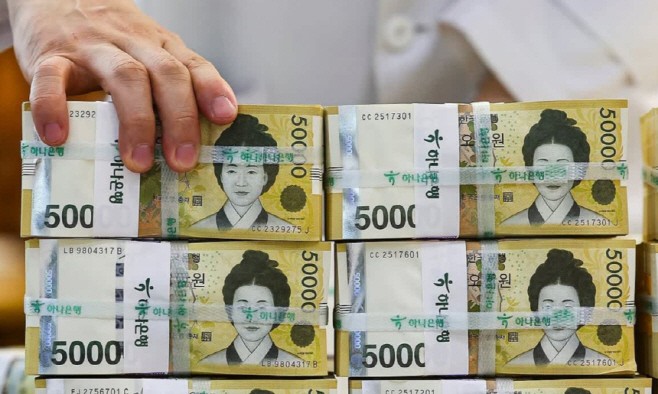 |
| An employee organizes 50,000-won banknotes at the anti-counterfeiting center of Hana Bank headquarters in Jung-gu, Seoul. / Yonhap |
The South Korean government has brushed aside concerns raised by the International Monetary Fund over rising national debt, expressing confidence in its fiscal management while economists call for more efficient public spending.
According to government agencies on April 22, the IMF recently projected that South Korea’s general government debt-to-GDP ratio (D2) could reach 61.7% by 2030, classifying the country among those expected to see “significant increases” in debt levels. The D2 measure includes both central and local government debt as well as liabilities of non-profit public institutions.
Despite the warning, officials argued that Korea’s debt level remains relatively stable compared to other advanced economies and can be managed through mid- to long-term fiscal planning.
Kim Yong-beom, presidential policy chief, said via social media on April 19 that while major economies such as the United States and France are running fiscal deficits of around 6% of GDP, Korea maintains a level near 3%. He added that the government’s medium-term fiscal plan reflects a cautious approach to spending.
Park Hong-keun also pushed back against the IMF outlook during a press briefing on April 21, stating that Korea’s debt ratio is significantly lower than that of peer countries and that IMF projections have often been overly pessimistic.
He cited a past case where the IMF forecast Korea’s debt ratio to reach 61.5% in 2024, while the actual figure came in at 49.7%.
The government further emphasized that proactive fiscal spending aimed at boosting economic growth could help stabilize debt levels. It pointed to examples such as the Netherlands and Sweden, where growth-oriented policies helped reduce debt ratios over time.
However, experts stress that improving growth alone is not sufficient. They argue that the efficiency and productivity of government spending must also be carefully managed.
Ahn Dong-hyun said, “Government expenditures vary in productivity. Policymakers need to carefully consider where and how funds are allocated, with a strong focus on efficiency.”
As the debate continues, the balance between growth-driven fiscal expansion and disciplined spending is expected to remain a key issue in Korea’s economic policy.
#IMF #South Korea debt ratio #GDP #fiscal policy #government debt
Copyright by Asiatoday
Most Read
-
1
Celltrion’s Omlyclo gains ground in major European..

-
2
Trump demands rates fall below 1% as Fed hikes for..

-
3
Trump makes $1 trillion bet ahead of midterm elect..

-
4
Iran resumes ballistic missile production, assembl..

-
5
Trump warns countries not helping U.S. must pay re..

-
6
Apple launches first foldable, 1 million won prici..

-
7
Turkish Airlines named main club partner of Liverp..

PEOPLE







-
Address : In-Young Bldg., 34, Uisadang-daero 1-gil, Yeongdeungpo-gu, Seoul
Copyright by ASIATODAY CO., LTD. All rights resereved