



Samsung’s Harman deal pays off as profit engine
Apr 22, 2026, 08:54 pm


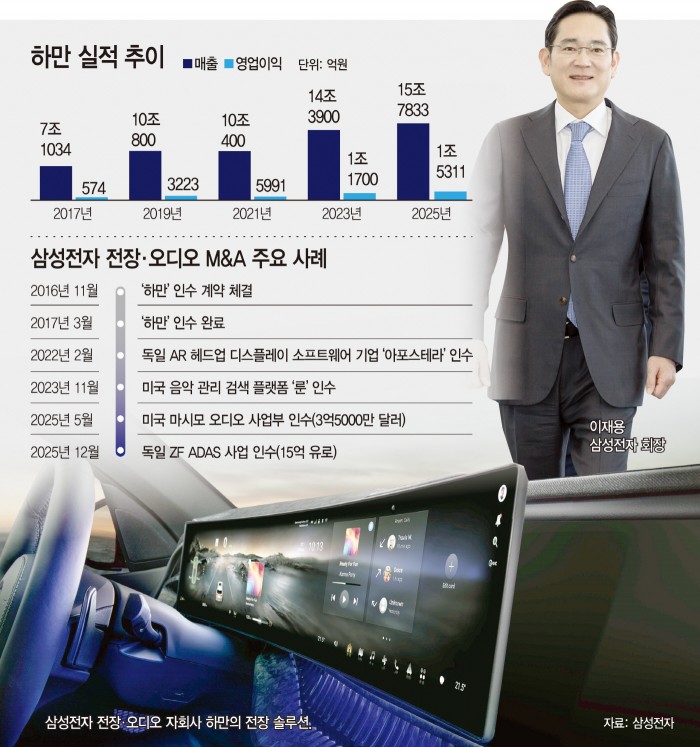 |
The acquisition of Jay Y. Lee has proven to be a strategic masterstroke, with Samsung Electronics’ automotive and audio subsidiary Harman International now generating more than 1 trillion won ($730 million) in annual operating profit.
According to Samsung Electronics on April 22, Harman posted 15.78 trillion won in revenue and 1.53 trillion won in operating profit last year, up 10.7% and 17.7% year-on-year, respectively. The operating profit marked a record high, with margins approaching 10%.
Compared to 2017, when Samsung completed the acquisition, Harman’s revenue has more than doubled while operating profit has surged over 20-fold—making it one of the most successful M&A cases in the company’s history.
Samsung first announced its $8 billion acquisition plan in November 2016 and finalized the deal in March 2017. The move drew significant attention as it was one of the largest overseas acquisitions by a Korean firm and the first major investment led by Lee after taking control of the company.
At the time, concerns were raised amid the Galaxy Note 7 recall and broader corporate uncertainties. However, industry observers now credit Lee’s early bet on automotive electronics as a key driver behind Harman’s rapid growth.
A company official said, “Samsung’s M&A strategy can be divided into before and after the Harman deal,” noting that the acquisition enabled faster technological advancement and more agile market responses.
Harman has also strengthened its global standing with Samsung’s technological backing. The company ranked No. 1 worldwide last year in both digital cockpit systems and car audio markets. Its portfolio of premium audio brands—including JBL, AKG, Harman Kardon, and Bang & Olufsen—has helped it outperform competitors such as Sony and Bose.
The company has continued to expand its capabilities through acquisitions. In 2022, it acquired Germany-based AR head-up display software firm Apostera. This was followed by the purchase of U.S. music platform Roon in 2023 and Masimo’s audio business in 2024, reinforcing its position in the premium audio segment.
Late last year, Harman acquired the ADAS (advanced driver-assistance systems) division of Germany’s ZF for 2.6 trillion won, securing key autonomous driving technologies. It also invested 230 billion won this year to expand its production base in Hungary.
Samsung said the deal aligned the company’s vision of integrating IT into automotive components with Harman’s expertise, adding that Harman’s decades-long audio technology has also enhanced Samsung’s TVs, home appliances, and mobile devices.
Meanwhile, the acquisition has recently resurfaced in discussions over labor disputes. Samsung’s labor union has demanded performance bonuses totaling 45 trillion won and warned of a general strike next month. Critics argue the demand is excessive, noting it is five times the cost of the Harman acquisition.
An industry official said, “Considering the scale of the Harman deal, the union’s demand appears unrealistic,” adding that investment in future growth remains a priority.
#Samsung Electronics #Jay Y. Lee #Harman #M&A #automotive electronics
Copyright by Asiatoday
Most Read
-
1
Kia Sportage outperforms Mazda CX-5 in German auto..

-
2
Houthis launch successive attacks on Saudi airport..

-
3
Saudi Arabia, Iran hold first diplomatic talks to..

-
4
U.S. deploys carrier, 10,000 more troops to Middle..

-
5
Saudi airport in Riyadh struck again, leaving at l..

-
6
Putin's ally visits China on the 8th ahead of APEC..

-
7
Chinese military support and training center opens..

PEOPLE






HEADLINE NEWS

-
Address : In-Young Bldg., 34, Uisadang-daero 1-gil, Yeongdeungpo-gu, Seoul
Copyright by ASIATODAY CO., LTD. All rights resereved