



Tensions rise as US deploys warships near Iran
Apr 14, 2026, 11:49 am


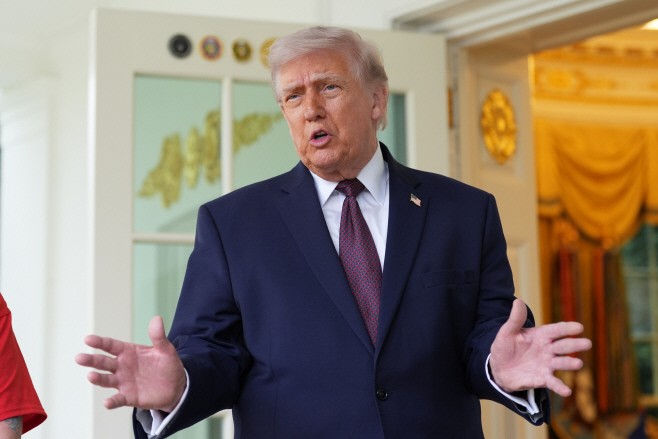 |
| Donald Trump speaks to reporters outside the White House in Washington, D.C., on April 13. / AP-Yonhap |
The United States has begun a maritime blockade targeting Iran in the strategically vital Strait of Hormuz, escalating tensions in the Middle East and raising the risk of a breakdown in the fragile ceasefire.
Donald Trump announced that the operation started at 10 a.m. Eastern Time on April 13, following the collapse of U.S.-Iran negotiations held in Islamabad over Tehran’s nuclear program. The talks failed after Iran refused to agree to abandon nuclear weapons development.
According to U.S. Central Command, the blockade targets vessels entering or leaving Iranian ports across the Persian Gulf and the Gulf of Oman. Ships attempting to access these ports without authorization may be intercepted, diverted, or seized. However, vessels transiting the strait to non-Iranian ports are not being restricted.
Reports from The Wall Street Journal indicate that more than 15 U.S. warships have been deployed to support the operation.
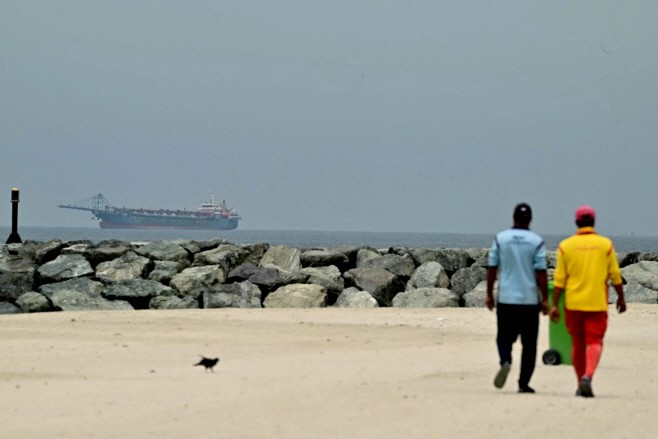 |
| A vessel is seen in the Persian Gulf off the coast of Sharjah, United Arab Emirates, on April 13. / AFP-Yonhap |
The move has already shaken global markets, with Brent crude oil prices surging more than 7% to exceed $102 per barrel.
Iran’s Islamic Revolutionary Guard Corps has warned of a strong military response, raising concerns that the current two-week ceasefire—set to expire on April 21—could collapse.
Trump also issued a stark warning via social media, saying Iranian naval vessels approaching the blockade zone could be “eliminated immediately” using tactics similar to those employed against suspected drug-trafficking ships.
Despite Washington’s stance, key European allies have distanced themselves from the blockade. Keir Starmer said the United Kingdom does not support the move and will focus on maintaining open sea lanes. Emmanuel Macron announced plans to coordinate a multinational defensive mission aimed at ensuring freedom of navigation, separate from U.S. operations.
Analysts warn that the operation could prove complex and risky. Experts note that enforcing such a blockade would require identifying and tracking vessels linked to Iranian ports in one of the world’s busiest and most politically sensitive waterways, increasing the potential for miscalculation and conflict escalation.
#Trump #Hormuz Strait #US Navy #Iran #IRGC
Copyright by Asiatoday
Most Read
-
1
Trump shares map on social media labeling Strait o..

-
2
Kia Sportage outperforms Mazda CX-5 in German auto..

-
3
Houthis launch successive attacks on Saudi airport..

-
4
U.S. deploys carrier, 10,000 more troops to Middle..

-
5
Trump rejects Iran's offer to open Strait of Hormu..

-
6
N. Korea conducts first swarm attack drill with dr..

-
7
U.S.-China summit falls short on substance as Trum..

PEOPLE






HEADLINE NEWS
- Seoul dismisses Ukraine's claim of 'S. Korean support for Russia' as "inaccurate and inappropriate"
- S. Korea, Japan race to develop nuclear-powered submarines
- Henri Kagan, Kenso Soai win Nobel Prize in Chemistry for uncovering how mol..
- Vance says Alaska LNG cooperation will move forward with Seoul's current or..

-
Address : In-Young Bldg., 34, Uisadang-daero 1-gil, Yeongdeungpo-gu, Seoul
Copyright by ASIATODAY CO., LTD. All rights resereved