



US Navy plan boosts prospects for Korean shipbuilders
Apr 06, 2026, 10:13 am


 |
A planned large-scale shipbuilding program by the U.S. Navy is raising expectations for South Korea’s shipbuilding industry, as opportunities for cooperation and contracts are expected to expand.
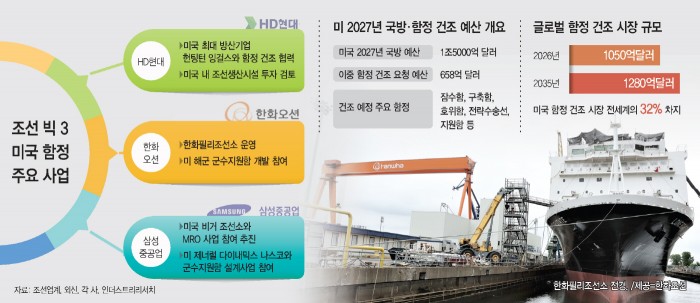
According to the United States Navy and related reports, the U.S. has requested $65.8 billion (about 99 trillion won) in its fiscal 2027 defense budget for ship construction, part of a broader $1.5 trillion defense spending plan.
The scale of the request is considered one of the largest since 1962, when the U.S. expanded its nuclear submarine fleet, and is comparable to the “600-ship Navy” vision of the 1980s.
The plan includes building approximately 41 vessels, including 18 combat ships and 16 non-combat ships. Notably, a significant portion consists of logistics and support vessels such as transport ships, fleet oilers, and supply ships.
Industry analysts say South Korean shipbuilders could benefit, particularly in the non-combat vessel segment, where collaboration with U.S. partners is more feasible than in core combat ship production.
Major Korean shipbuilders — HD Hyundai, Hanwha Ocean, and Samsung Heavy Industries — have already established cooperation with the U.S. Navy through maintenance, repair, and overhaul (MRO) projects and design partnerships.
Hanwha Ocean is seen as being in a particularly advantageous position, having secured a local production base and participating in conceptual design for the Navy’s next-generation logistics support ship (NGLS), which could lead to future contracts.
HD Hyundai is also expected to expand its role through cooperation with Huntington Ingalls Industries, especially as the U.S. Navy shifts toward ship designs based on Ingalls Shipbuilding.
Meanwhile, Samsung Heavy Industries is collaborating with General Dynamics NASSCO on logistics support ship design and is seeking to expand into MRO projects at U.S. shipyards.
Experts note that U.S. policymakers have increasingly emphasized the need to leverage allied shipyards to enhance productivity and technological capacity. If the budget is approved, Korean shipbuilders — with both domestic production capabilities and global experience — are expected to be well positioned to benefit.
#US Navy #shipbuilding #Korea shipbuilders #HD Hyundai #Hanwha Ocean
Copyright by Asiatoday
Most Read
-
1
Kia Sportage outperforms Mazda CX-5 in German auto..

-
2
Houthis launch successive attacks on Saudi airport..

-
3
Saudi Arabia, Iran hold first diplomatic talks to..

-
4
U.S. deploys carrier, 10,000 more troops to Middle..

-
5
Saudi airport in Riyadh struck again, leaving at l..

-
6
Putin's ally visits China on the 8th ahead of APEC..

-
7
Chinese military support and training center opens..

PEOPLE






HEADLINE NEWS

-
Address : In-Young Bldg., 34, Uisadang-daero 1-gil, Yeongdeungpo-gu, Seoul
Copyright by ASIATODAY CO., LTD. All rights resereved