



Exports top $80B but Middle East risks loom
Apr 01, 2026, 10:13 am


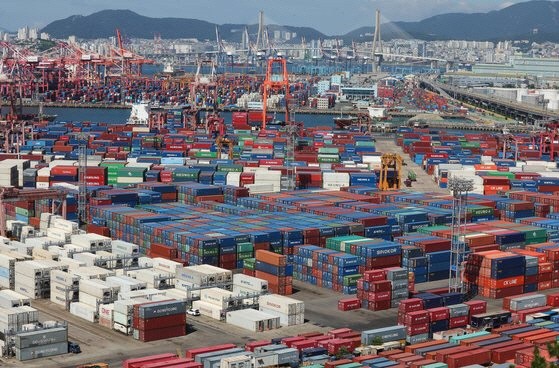 |
| A view of Busan Port, South Korea’s largest trade gateway. / Yonhap News |
South Korea’s exports surpassed $80 billion for the first time in March, marking a record high, but concerns are growing that escalating tensions in the Middle East could soon weigh on trade conditions.
According to the Ministry of Trade, Industry and Energy on April 1, exports rose 48.3% year-on-year to $86.13 billion in March. Imports increased 13.2% to $60.4 billion, resulting in a trade surplus of $25.74 billion—the largest monthly surplus on record.
Exports have now hit record highs for the same month for 10 consecutive months, while average daily exports also reached an all-time high of $3.74 billion. Both exports and the trade balance are seen as entering a “super cycle.”
Semiconductors led the surge, with exports jumping 151% year-on-year to $32.8 billion, surpassing $30 billion for the first time. The increase was driven by rising memory prices, expanded investment in AI servers, and growing demand for general-purpose servers.
Automobile exports rose modestly by 2.2% to $6.37 billion. While logistics disruptions tied to the Middle East conflict affected shipments, strong demand for eco-friendly vehicles helped offset declines. Exports of hybrid and electric vehicles increased by 38% and 32%, respectively, while internal combustion engine vehicle exports declined.
Petroleum product exports climbed 54.9% to $5.1 billion, boosted by higher oil prices. However, export volumes declined due to supply restrictions. Petrochemical exports posted only slight growth, with shipment volumes increasingly shrinking toward the end of March.
Computer exports surged 189% to a record high, driven by rising demand for enterprise SSDs amid expanding AI infrastructure investment. Secondary battery exports also increased, supported by recovering lithium prices and new projects. Other promising sectors—including electrical equipment, cosmetics, and agricultural and fishery products—also recorded their highest March performances.
By region, exports grew strongly in major markets, including China ($16.5 billion, +64.2%), the United States ($16.3 billion, +47.1%), and ASEAN ($13.7 billion, +34.3%). In contrast, exports to the Middle East plunged 49.1% due to logistics disruptions.
Despite rising energy prices, import growth remained limited as crude oil import volumes declined. Meanwhile, imports of non-energy items such as semiconductors and related equipment increased.
The government said it will intensify efforts to manage supply chain risks amid growing external uncertainties. Authorities plan to strengthen monitoring of energy, raw materials, and logistics, while supporting exporters through financial assistance, marketing, and logistics solutions, as well as promoting market diversification.
Industry Minister Kim Jung-kwan said, “As the Middle East conflict continues for over a month, rising oil prices and worsening supply chain instability are increasing uncertainty in export conditions,” adding, “The government will mobilize a comprehensive response system to stabilize supply chains and support exporters to sustain the upward export momentum.”
#South Korea exports #trade surplus #semiconductor exports #Middle East risk
Copyright by Asiatoday
Most Read
-
1
Kia Sportage outperforms Mazda CX-5 in German auto..

-
2
Houthis launch successive attacks on Saudi airport..

-
3
Saudi Arabia, Iran hold first diplomatic talks to..

-
4
U.S. deploys carrier, 10,000 more troops to Middle..

-
5
Saudi airport in Riyadh struck again, leaving at l..

-
6
Putin's ally visits China on the 8th ahead of APEC..

-
7
Chinese military support and training center opens..

PEOPLE






HEADLINE NEWS

-
Address : In-Young Bldg., 34, Uisadang-daero 1-gil, Yeongdeungpo-gu, Seoul
Copyright by ASIATODAY CO., LTD. All rights resereved