



Constitutional reform drive begins amid ruling party resistance
Apr 01, 2026, 09:07 am


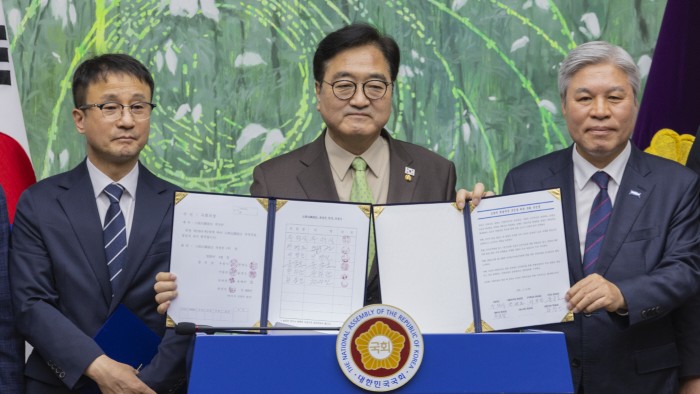 |
| National Assembly Speaker Woo Won-shik and floor leaders of political parties unveiled a joint declaration and signed agreement on constitutional revision at the National Assembly on March 31. / Yonhap News |
National Assembly Speaker Woo Won-shik has officially launched a push for constitutional revision in cooperation with six parliamentary parties, excluding the People Power Party.
With efforts to persuade PPP leader Jang Dong-hyeok failing, attention is now focused on whether enough dissenting votes can be secured from within the party to pass the amendment.
According to political sources on March 31, Woo and six parties—including the Democratic Party and others—announced a “Joint Declaration for Bipartisan Constitutional Revision” and began procedures to propose an amendment bill.
The declaration included provisions to enshrine the Bu-Ma Democratic Protests and the Gwangju Uprising in the Constitution’s preamble, strengthen parliamentary control over presidential emergency powers, and formalize balanced regional development.
Specifically, the amendment proposes requiring immediate National Assembly approval for any declaration of martial law. If rejected or not approved within 48 hours, it would automatically lose effect. It also includes provisions to ensure equal quality of life and opportunities across regions by mandating the state’s responsibility for balanced development.
The six parties aim to submit the amendment on April 6 and have it promulgated at a Cabinet meeting on April 7. This timeline is intended to enable a simultaneous constitutional referendum alongside the June 3 local elections.
Due to the tight schedule, there is little room for revising the proposal. “Amendments are possible but not easy. It is appropriate to proceed with the current draft as it is,” a senior National Assembly official said.
However, strong opposition from the PPP raises uncertainty about whether the amendment can pass the National Assembly. Constitutional amendments require approval by two-thirds of all lawmakers, meaning at least 10 votes from PPP members would be necessary under the current composition.
To secure support, Woo has reportedly sent handwritten letters to all PPP lawmakers, seeking to persuade them individually. Officials suggested there may be some internal support within the party, though it has not been publicly unified.
Earlier in the day, Woo met privately with Jang to request cooperation, but failed to reach an agreement. Jang reiterated opposition, raising concerns about a potential move toward allowing President Lee Jae-myung to seek re-election.
Woo, however, argued that strengthening control over martial law powers has broad public consensus and should be prioritized as a starting point for constitutional reform. While he said “there is still time” for further discussion, the six parties are now moving forward with the amendment process without PPP participation.
#constitutional revision #Woo Won-shik #People Power Party #Jang Dong-hyeok
Copyright by Asiatoday
Most Read
-
1
Trump demands rates fall below 1% as Fed hikes for..

-
2
Celltrion seeks rheumatoid arthritis indication ex..

-
3
Chinese e-commerce giants AliExpress, Temu and She..

-
4
Trump warns countries not helping U.S. must pay re..

-
5
Turkish Airlines named main club partner of Liverp..

-
6
China expels No. 2 military official Zhang Youxia..

-
7
Houthi rebels release video claiming downing of Sa..

PEOPLE







-
Address : In-Young Bldg., 34, Uisadang-daero 1-gil, Yeongdeungpo-gu, Seoul
Copyright by ASIATODAY CO., LTD. All rights resereved