



Ruling party seals deal on prosecution reform
Mar 17, 2026, 10:20 am


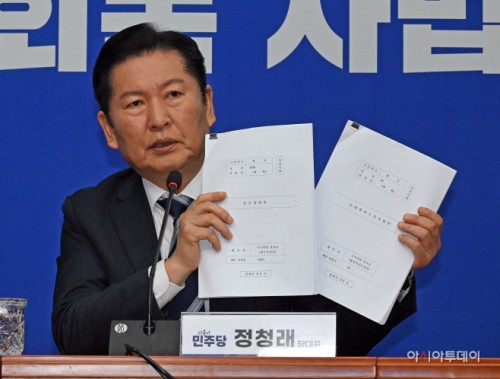 |
| Democratic Party leader Jung Cheong-rae holds a press conference on prosecution reform at the National Assembly on March 17. / Photographed by Song Eui-joo |
The Democratic Party of Korea on Tuesday finalized a party-government-presidential agreement on prosecution reform centered on the full separation of investigative and prosecutorial powers, vowing to push the bill through the National Assembly this week.
Party leader Jung Cheong-rae announced the agreement during an emergency press conference, saying the revised plan removes controversial provisions and eliminates any room for prosecutorial interference in investigations.
“We have cut off all bridges for prosecutorial intervention in investigations,” Jung said. “We also ensured that prosecutors relinquish their privileged status and are subject to principles equivalent to those applied to other public officials.”
Under the revised proposal, prosecutors will no longer have authority to direct or supervise special judicial police, preventing indirect control over investigations. Key powers—including warrant-related direction, suspension of investigations and requests for removal from duty—have been eliminated to establish a more equal relationship between prosecution and investigative bodies.
Lawmakers also removed Article 45 of the proposed Serious Crimes Investigation Agency Act, which had raised concerns about potential prosecutorial influence, and introduced a new offense aimed at preventing abuse of prosecutorial authority.
The transition period for the new system has been shortened from six months to 90 days to prevent delays in transferring cases and to block attempts to retain investigative powers during the transition.
The Democratic Party plans to adopt the revised bill as its official party position later in the day and move it through committee reviews before passing it at a plenary session scheduled for March 19.
Floor leader Han Byung-do warned that if the opposition attempts to block the bill through a filibuster, the ruling party will invoke procedures to end debate and proceed with a vote.
Addressing concerns about potential gaps in investigative capacity after removing prosecutorial oversight of special judicial police, Jung said such worries are based on misconceptions.
“The perception that prosecutors are more capable simply because they held concentrated power must be corrected,” he said, adding that distributing authority and clearly defining roles would ensure professional competence under the new system.
#Democratic Party of Korea #prosecution reform #separation of investigation and prosecution
Copyright by Asiatoday
Most Read
-
1
Trump shares map on social media labeling Strait o..

-
2
Kia Sportage outperforms Mazda CX-5 in German auto..

-
3
Houthis launch successive attacks on Saudi airport..

-
4
U.S. deploys carrier, 10,000 more troops to Middle..

-
5
Trump rejects Iran's offer to open Strait of Hormu..

-
6
N. Korea conducts first swarm attack drill with dr..

-
7
U.S.-China summit falls short on substance as Trum..

PEOPLE






HEADLINE NEWS
- Seoul dismisses Ukraine's claim of 'S. Korean support for Russia' as "inaccurate and inappropriate"
- S. Korea, Japan race to develop nuclear-powered submarines
- Henri Kagan, Kenso Soai win Nobel Prize in Chemistry for uncovering how mol..
- Vance says Alaska LNG cooperation will move forward with Seoul's current or..

-
Address : In-Young Bldg., 34, Uisadang-daero 1-gil, Yeongdeungpo-gu, Seoul
Copyright by ASIATODAY CO., LTD. All rights resereved