



Korea parties set March 12 vote for U.S. investment act
Mar 05, 2026, 09:07 am


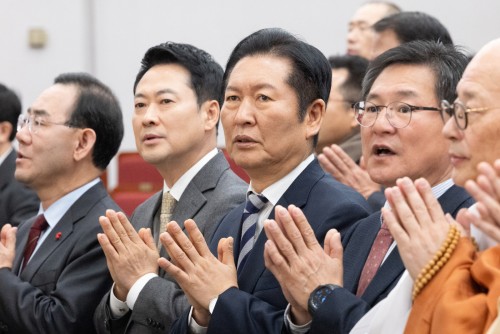 |
| Leaders of the Democratic Party and the People Power Party attend a Buddhist spring ceremony at the National Assembly in Seoul on March 4. / Song Eui-ju |
South Korea’s ruling and opposition parties agreed Tuesday to pass a special bill on strategic investment in the United States during a National Assembly plenary session scheduled for March 12.
Cheon Jun-ho, senior floor deputy leader of the Democratic Party of Korea, and Yoo Sang-beom, his counterpart from the People Power Party, met at the National Assembly and reaffirmed their plan to complete committee deliberations by March 9 before sending the bill to a plenary vote.
The People Power Party had previously boycotted the special committee in protest of the Democratic Party’s push to pass three judicial reform bills, but returned to the negotiations Tuesday.
Yoo said the decision was made in consideration of national interests amid growing global uncertainty.
“With tensions rising due to the war between the United States and Iran, delays in processing the bill could raise concerns about potential U.S. tariff measures,” Yoo said. “We made this decision in a broader national interest.”
Cheon echoed the sentiment, saying the bill would help ease economic uncertainty.
“We will work to remove unstable economic factors and create an environment where citizens can feel secure,” he said.
Following the agreement, the National Assembly’s special committee on U.S.-bound investment held a plenary meeting to begin reviewing the legislation.
While both parties agreed on the need for swift passage, they remained divided over the creation of a dedicated investment body and the level of parliamentary oversight.
The Democratic Party argued that simplifying National Assembly approval procedures would help ensure faster investment decisions. Rep. Ahn Do-geol said requiring parliamentary review for every individual project would hinder speed and flexibility.
“We should consider requiring prior parliamentary approval only for investments exceeding $3 billion,” Ahn said.
Rep. Jin Sung-joon added that a memorandum of understanding on Korea-U.S. investment does not create legal rights or obligations and therefore does not require parliamentary ratification under the Constitution.
The People Power Party, however, insisted that parliamentary oversight must not be weakened given the scale of the investment.
Rep. Kang Min-guk warned that large capital outflows could leave South Korea sidelined in decision-making.
“The final authority to approve investment decisions lies with U.S. President Donald Trump,” Kang said. “We must ask whether Korea could be excluded from the decision-making process while investing 500 trillion won of taxpayers’ money.”
Rep. Kang Seung-gyu also criticized what he described as repeated attempts to bypass the National Assembly under the pretext of speeding up investment.
Deputy Prime Minister and Finance Minister Koo Yun-cheol, who attended the meeting, said the United States was closely monitoring the legislative process.
“It appears the U.S. is watching the situation until March 9,” he said.
Regarding the proposal to establish a new state-run investment entity, Koo explained that the Korea Investment Corporation primarily manages foreign assets and differs from the investment structure envisioned in the bill.
Meanwhile, the two parties remained at odds over whether to process separate special laws on administrative integration in the Daegu–North Gyeongsang region and the Daejeon–South Chungcheong region together, failing to reach a compromise.
#U.S. investment bill #Korea-U.S. strategic investment act #National Assembly
Copyright by Asiatoday
Most Read
-
1
Trump shares map on social media labeling Strait o..

-
2
Kia Sportage outperforms Mazda CX-5 in German auto..

-
3
Houthis launch successive attacks on Saudi airport..

-
4
U.S. deploys carrier, 10,000 more troops to Middle..

-
5
Trump rejects Iran's offer to open Strait of Hormu..

-
6
N. Korea conducts first swarm attack drill with dr..

-
7
U.S.-China summit falls short on substance as Trum..

PEOPLE






HEADLINE NEWS
- Seoul dismisses Ukraine's claim of 'S. Korean support for Russia' as "inaccurate and inappropriate"
- S. Korea, Japan race to develop nuclear-powered submarines
- Henri Kagan, Kenso Soai win Nobel Prize in Chemistry for uncovering how mol..
- Vance says Alaska LNG cooperation will move forward with Seoul's current or..

-
Address : In-Young Bldg., 34, Uisadang-daero 1-gil, Yeongdeungpo-gu, Seoul
Copyright by ASIATODAY CO., LTD. All rights resereved