



PPP chief digs in amid ‘break with Yoon’ calls
Mar 03, 2026, 09:28 am


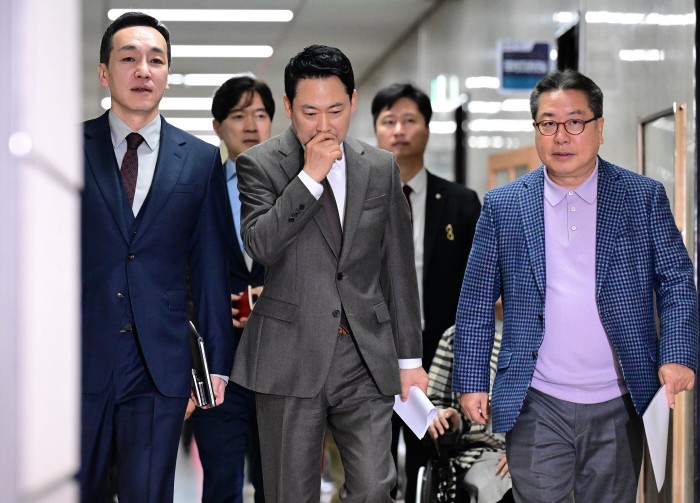 |
| Jang Dong-hyuk, leader of the People Power Party, attends a Supreme Council meeting at the National Assembly in Yeouido, Seoul, on March 2. / Photo by Lee Byung-hwa |
Jang Dong-hyuk, leader of the People Power Party, has firmly rejected calls within and outside the party to sever ties with former President Yoon Suk Yeol, describing the demand as a “frame set by the Democratic Party.”
Despite mounting reform calls from within the party and continued pressure from the ruling camp, Jang has maintained his independent course, drawing attention to his political calculations and leadership strategy ahead of local elections.
Political observers say Jang’s stance is aimed at blocking what he sees as a narrative pushed by the ruling Democratic Party of Korea. In a recent media interview, he dismissed demands to distance the party from Yoon as part of the opposition’s framing strategy.
Party insiders argue that Jang has already taken political responsibility by publicly apologizing over the Dec. 3 martial law controversy and that Yoon’s departure from the party has formally ended their institutional ties. Additional calls for a complete break, they say, amount to political attacks rather than substantive reform.
Jang must also weigh the sentiments of core party members. Having won the party leadership in the Aug. 26 convention with strong backing from conservative grassroots supporters, he risks alienating that base if he abruptly pivots ahead of the June 3 local elections.
According to party officials, Jang recently shared internal polling results indicating that 75 percent of surveyed party members favored maintaining alignment with Yoon. A separate Gallup poll conducted from Feb. 24 to 26 showed that 68 percent of PPP supporters did not view the Dec. 3 martial law episode as an insurrection.
Such figures underscore concerns that moving toward a clean break could cost the party its traditional supporters — often referred to as the “core base.”
At the same time, analysts expect Jang to intensify efforts to broaden the party’s appeal to centrist voters in the run-up to local elections. Having consolidated support among hardline conservatives, he is likely to accelerate outreach initiatives, including visits to real estate redevelopment sites and regular trips to the Honam region.
Jang is also expected to sharpen his attacks on President Lee Jae-myung and the ruling party, particularly over real estate policy.
Speaking at a Supreme Council meeting on March 2, Jang criticized Lee, saying, “The president is busy dividing the people over real estate.” He added that the presidency should not be a position to maintain power by dividing citizens, but one to protect the nation and its people from external threats.
As intra-party tensions simmer and electoral competition intensifies, Jang’s balancing act between safeguarding the party’s core base and expanding toward the political center will likely shape the PPP’s strategy in the months ahead.
#Jang Dong-hyuk #People Power Party #Yoon Suk Yeol #Lee Jae-myung #June 3 local elections
Copyright by Asiatoday
Most Read
-
1
Trump shares map on social media labeling Strait o..

-
2
Kia Sportage outperforms Mazda CX-5 in German auto..

-
3
Houthis launch successive attacks on Saudi airport..

-
4
U.S. deploys carrier, 10,000 more troops to Middle..

-
5
Trump rejects Iran's offer to open Strait of Hormu..

-
6
N. Korea conducts first swarm attack drill with dr..

-
7
U.S.-China summit falls short on substance as Trum..

PEOPLE




HEADLINE NEWS
- Seoul dismisses Ukraine's claim of 'S. Korean support for Russia' as "inaccurate and inappropriate"
- S. Korea, Japan race to develop nuclear-powered submarines
- Henri Kagan, Kenso Soai win Nobel Prize in Chemistry for uncovering how mol..
- Vance says Alaska LNG cooperation will move forward with Seoul's current or..

-
Address : In-Young Bldg., 34, Uisadang-daero 1-gil, Yeongdeungpo-gu, Seoul
Copyright by ASIATODAY CO., LTD. All rights resereved