



DPK, PPP trade blame over stalled merger laws
Mar 03, 2026, 09:26 am


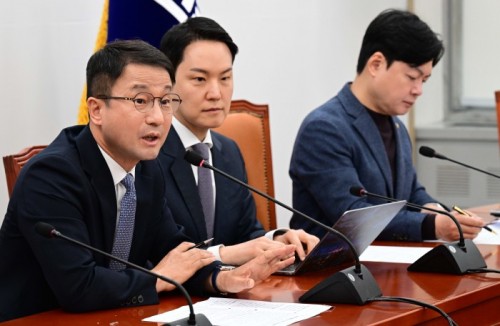 |
| Rep. Han Byung-do, floor leader of the Democratic Party of Korea, speaks during a press briefing at the National Assembly in Seoul on March 2. / Photo by Lee Byung-hwa |
The ruling Democratic Party of Korea and the opposition People Power Party clashed on March 2 over delays in legislation aimed at administrative integration in the Daegu–North Gyeongsang (TK) and Daejeon–South Chungcheong regions.
The dispute follows the Democratic Party’s unilateral passage of a special act on administrative integration for Gwangju and South Jeolla Province.
Rep. Song Eon-seok, floor leader of the People Power Party, criticized the ruling party for what he described as selective treatment.
“The Democratic Party argued that the Gwangju–Jeonnam, Daegu–Gyeongbuk, and Daejeon–Chungnam integration bills were twin laws that should be processed together. Why, then, was only the Gwangju–Jeonnam bill passed?” Song said during a Supreme Council meeting at the National Assembly. “From the beginning, the intent was to favor a specific region.”
PPP spokesperson Park Sung-hoon also accused the Democratic Party of blocking the TK integration bill despite what he called sufficient procedural legitimacy, noting that Daegu, North Gyeongsang Province and their respective local councils had expressed consent. He argued that halting the bill amounted to “blatant regional discrimination backed by a parliamentary majority.”
The Democratic Party rejected the accusations, defending its decision and criticizing the opposition’s move to halt its filibuster as politically motivated.
Kim Hyun-jung, floor spokesperson of the Democratic Party, said in a written briefing that the PPP’s suspension of its filibuster was not a grand compromise but rather a strategic calculation once its own TK integration bill became urgent.
Another Democratic Party official, Jeon Yong-gi, urged the opposition to clarify its official stance, saying the PPP’s position had been inconsistent and calling on its leadership to present a clear view on balanced regional development.
The Democratic Party further alleged that the PPP was intentionally obstructing the Daejeon–Chungnam integration plan to check Kang Hoon-sik, President Lee Jae-myung’s chief of staff and a potential local election candidate.
Cheon Jun-ho, senior deputy floor leader of the Democratic Party, claimed that opposition lawmakers were viewing the integration initiative through a political lens, questioning whether it was meant to bolster Kang’s profile.
“If Kang were to forgo a run, would they then support the Daejeon–Chungnam integration?” Cheon asked.
The escalating war of words underscores deepening partisan tensions over regional development and administrative restructuring ahead of local elections.
#Democratic Party of Korea #People Power Party #TK integration bill #Daejeon Chungnam integration
Copyright by Asiatoday
Most Read
-
1
Trump shares map on social media labeling Strait o..

-
2
Kia Sportage outperforms Mazda CX-5 in German auto..

-
3
Houthis launch successive attacks on Saudi airport..

-
4
U.S. deploys carrier, 10,000 more troops to Middle..

-
5
Trump rejects Iran's offer to open Strait of Hormu..

-
6
N. Korea conducts first swarm attack drill with dr..

-
7
U.S.-China summit falls short on substance as Trum..

PEOPLE




HEADLINE NEWS
- Seoul dismisses Ukraine's claim of 'S. Korean support for Russia' as "inaccurate and inappropriate"
- S. Korea, Japan race to develop nuclear-powered submarines
- Henri Kagan, Kenso Soai win Nobel Prize in Chemistry for uncovering how mol..
- Vance says Alaska LNG cooperation will move forward with Seoul's current or..

-
Address : In-Young Bldg., 34, Uisadang-daero 1-gil, Yeongdeungpo-gu, Seoul
Copyright by ASIATODAY CO., LTD. All rights resereved