



Allies set FS drills but differ on field training
Feb 26, 2026, 07:52 am


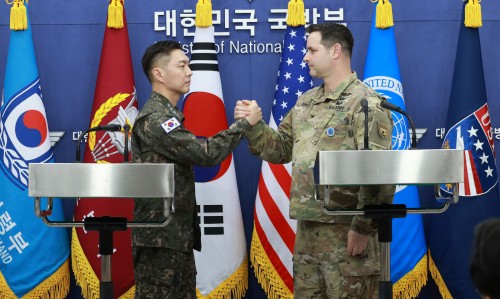 |
| Lt. Col. Jang Do-young, spokesperson of the Joint Chiefs of Staff (left), and Col. Ryan Donald, spokesperson for US Forces Korea, pose after announcing the 2026 Freedom Shield exercise plan at the Defense Ministry in Seoul on Feb. 25. /Joint Press Corp |
South Korea and the United States will begin their annual combined exercise, Freedom Shield (FS), on March 9, military authorities announced Tuesday, though differences remain over the scale of accompanying field training.
The exercise will run through March 19 and involve approximately 18,000 troops, similar to last year. It is designed as a defensive drill aimed at strengthening the allies’ combined readiness posture, including scenarios to deter North Korea’s nuclear threats.
While the overall schedule has been finalized, officials acknowledged that consultations are ongoing regarding the scope and scale of outdoor maneuver training.
A spokesperson for the Joint Chiefs of Staff said the two sides are “closely consulting” on details, including field training exercises (FTX), known as “Warrior Shield.”
However, US Forces Korea indicated that the drills would proceed as planned, highlighting a noticeable difference in tone.
The discrepancy suggests lingering coordination challenges between the allies over how extensively to conduct field maneuvers during the FS period. Traditionally, command post exercises (CPX) and field training exercises are linked to maximize operational effectiveness.
Reports indicate that Seoul requested adjustments to the scale and frequency of field drills, possibly to avoid provoking North Korea amid speculation about US President Donald Trump’s potential April visit to China and a renewed atmosphere for US-North Korea dialogue.
The US side, however, is said to have taken a cautious stance toward modifying the exercise plan, given that significant personnel and equipment have already been deployed.
The differing public messages follow recent controversy over explanations related to a West Sea air drill, underscoring occasional communication gaps within the alliance.
This year’s FS exercise is particularly significant as South Korea plans to complete the second-stage verification, known as Full Operational Capability (FOC), for the transfer of wartime operational control (OPCON).
Given that FS forms a core part of that verification process, observers note that consistent strategic messaging and close coordination will be critical for the future operation of combined forces after OPCON transfer.
In addition to South Korean and US troops, member states of the United Nations Command will participate in the exercise. The Neutral Nations Supervisory Commission will monitor compliance with the armistice agreement.
Despite visible differences over certain operational details, both sides reaffirmed their shared goal of reinforcing the combined defense posture across all domains.
#Freedom Shield #US Forces Korea #Joint Chiefs of Staff #Warrior Shield #FTX
Copyright by Asiatoday
Most Read
-
1
Trump shares map on social media labeling Strait o..

-
2
Kia Sportage outperforms Mazda CX-5 in German auto..

-
3
Houthis launch successive attacks on Saudi airport..

-
4
U.S. deploys carrier, 10,000 more troops to Middle..

-
5
Trump rejects Iran's offer to open Strait of Hormu..

-
6
N. Korea conducts first swarm attack drill with dr..

-
7
U.S.-China summit falls short on substance as Trum..

PEOPLE






HEADLINE NEWS
- Seoul dismisses Ukraine's claim of 'S. Korean support for Russia' as "inaccurate and inappropriate"
- S. Korea, Japan race to develop nuclear-powered submarines
- Henri Kagan, Kenso Soai win Nobel Prize in Chemistry for uncovering how mol..
- Vance says Alaska LNG cooperation will move forward with Seoul's current or..

-
Address : In-Young Bldg., 34, Uisadang-daero 1-gil, Yeongdeungpo-gu, Seoul
Copyright by ASIATODAY CO., LTD. All rights resereved