



Real wages grow just 0.2% over four years while productivity outside chip sector slips
Nov 16, 2026, 05:28 pm


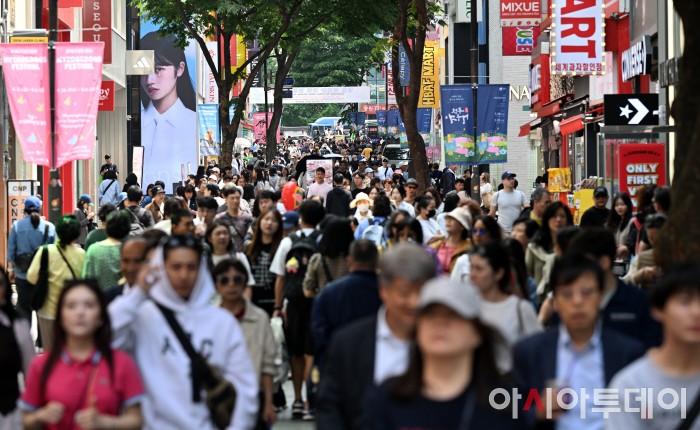 |
| A street in Myeong-dong, Seoul. /Photo by Song Ui-ju |
Despite a rebound in economic growth in the first half of this year, workers' average real wages rose by just 0.3 percent. While bonuses in certain high-paying industries, including semiconductors, drove overall wage growth, inflation-adjusted regular wages actually declined. The Korea Development Institute (KDI) identified sluggish productivity in non-semiconductor industries as a major factor behind the stagnation in real wages since 2021.
According to a KDI report titled "Background and Implications of Real Wage Stagnation: An Analysis of Firm Productivity," released on Nov. 16, average real wages per worker rose 0.3 percent year-on-year in the first half of this year. The increase remained below 1 percent, following gains of 0.5 percent in 2024 and 0.9 percent last year. Inflation-adjusted regular wages, which consist of basic pay and standard allowances, fell 0.3 percent.
Real wage stagnation became pronounced after 2021. Average real wages across all workers increased 24.0 percent between 2011 and 2021, but rose just 0.2 percent over the four years from 2021 to 2025. Annual growth in real hourly wages also slowed from 3.1 percent to 1.2 percent between the two periods. KDI attributed the limited improvement in real wages primarily to inflation in 2021–2022 and slowing growth in nominal regular wages from 2022 onward.
During this period, productivity trends diverged sharply between the semiconductor and non-semiconductor sectors. Based on an analysis of financial statements from companies subject to external audits, KDI found that revenue-based productivity in semiconductor manufacturing increased by an annual average of 8.5 percent from 2021 to 2025, while productivity in the non-semiconductor sector declined by 0.4 percent annually.
Revenue-based productivity measures how much value added a company generates from its labor and capital inputs. Even among the top third of non-semiconductor companies in terms of productivity, the productivity index rose just 0.8 percent over the four-year period. The indices for the middle and bottom thirds fell 2.5 percent and 9.7 percent, respectively.
Industries with weak productivity growth also recorded sluggish wage increases. Between 2021 and 2025, industries with cumulative productivity growth rates 10 percentage points higher recorded cumulative growth in real regular wages for permanent employees that was, on average, 0.9 percentage points higher.
KDI estimated that differences in productivity growth explained approximately one-third of the roughly 9-percentage-point gap in real regular wage growth between electronic components manufacturing, including semiconductors, and other industries. Both productivity and real regular wage growth were weak in industries such as petrochemicals, construction, and broadcasting and video production.
In the non-semiconductor sector, the share of value added generated by marginal firms—companies unable to cover their interest expenses with operating profits for three consecutive years—rose from 3.2 percent in 2021 to 6.2 percent last year.
KDI recommended promoting higher value-added activities in key industries and improving conditions for the entry and growth of businesses in emerging industries so that real wage increases can spread across the broader economy.
It also called for support for business restructuring in industries with weak productivity and for job transition and retraining programs that would help workers move into growing companies and industries.
Lee Ji-hoon
Most Read
-
1
AMD's Lisa Su floated as potential Nvidia successo..

-
2
U.S. links Myanmar peace efforts to rare earth acc..

-
3
Alice Huang, affair partner of Jensen Huang, repor..

-
4
Hegseth rejects calls for impeachment over Iran wa..

-
5
Xi secures fourth term as China reshuffles next-ge..

-
6
Democrats flip U.S. Congress in historic midterm s..

-
7
Nvidia executive Kimberly Powell at center of Jens..

PEOPLE







-
Address : In-Young Bldg., 34, Uisadang-daero 1-gil, Yeongdeungpo-gu, Seoul
Copyright by ASIATODAY CO., LTD. All rights resereved