



Can Australia's new Western Sydney International Airport withstand record summer heat?
Nov 16, 2026, 04:44 pm


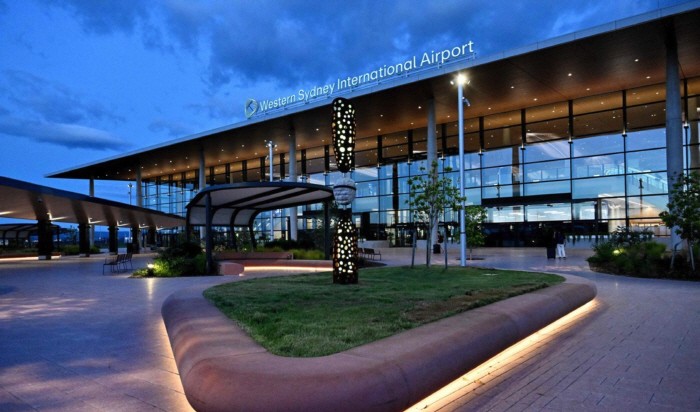 |
| Western Sydney International Airport in Australia. /AFP-Yonhap News Agency |
Academics and aviation experts have raised concerns over whether the newly opened Western Sydney International Airport (WSI) in Sydney, Australia, can withstand the extreme heat expected during the coming summer.
Australia's ABC News reported on Nov. 16 (local time) that large expanses of asphalt and concrete could create an "urban heat island effect," raising temperatures in surrounding areas and potentially affecting aircraft operational safety.
Western Sydney is a region where temperatures exceeding 40 degrees Celsius have become commonplace during summer. Badgerys Creek, where Nancy-Bird Walton Airport is located, has previously recorded a high of 50.1 degrees Celsius.
Sebastian Pfautsch, a professor of urban planning at Western Sydney University, warned that the airport's asphalt surfaces and other structures could act as a massive heat sink, raising temperatures in the surrounding area.
The urban heat island effect occurs when a particular area absorbs large amounts of solar radiation and then releases that heat, causing temperatures to rise above those of surrounding areas.
"The black asphalt covering large areas absorbs heat during the day and warms the surrounding air," Pfautsch said.
"This also reduces the cooling effect of the natural southerly winds that would otherwise blow toward Penrith, St Marys and Emu Plains during summer," he pointed out.
According to meteorologist Tom Saunders, the average maximum temperature at WSI in midsummer is around 30 degrees Celsius, higher than the 26.7 degrees recorded at the existing Sydney Kingsford Smith International Airport (SYD). Depending on wind direction, temperatures at WSI could be as much as 8 degrees higher.
Rising temperatures also have a direct impact on aircraft performance. Jason Middleton, a professor at the School of Aviation at the University of New South Wales, explained that high temperatures reduce air density, which in turn decreases engine thrust and aerodynamic lift, making takeoffs and landings considerably more challenging.
"For a large aircraft such as an Airbus A380 operating at its maximum takeoff weight, the available runway may not be long enough for takeoff when temperatures exceed 35 degrees Celsius and winds are light," Middleton warned.
"The aircraft may have to reduce its payload to take off safely," he added.
Middleton also warned that turbulence caused by strong southwesterly crosswinds could disrupt operations at WSI, forcing large numbers of flights to divert to the existing Sydney Airport and worsening overall air traffic congestion.
In response, WSI said climate risk assessments had been conducted throughout the airport's design and construction phases.
"We have mitigated all high and severe risks under climate change scenarios extending to 2090 and implemented measures to prevent heat-related disruptions to airport operations," an airport spokesperson said.
Experts agreed that additional measures, including applying reflective paint to runways, creating artificial lakes and planting more trees, were urgently needed to ensure the airport could function properly under Western Sydney's harsh climatic conditions.
Lee Dae-won
Most Read
-
1
AMD's Lisa Su floated as potential Nvidia successo..

-
2
U.S. links Myanmar peace efforts to rare earth acc..

-
3
Alice Huang, affair partner of Jensen Huang, repor..

-
4
Hegseth rejects calls for impeachment over Iran wa..

-
5
Xi secures fourth term as China reshuffles next-ge..

-
6
Democrats flip U.S. Congress in historic midterm s..

-
7
Nvidia executive Kimberly Powell at center of Jens..

PEOPLE







-
Address : In-Young Bldg., 34, Uisadang-daero 1-gil, Yeongdeungpo-gu, Seoul
Copyright by ASIATODAY CO., LTD. All rights resereved