



83% of SMEs cite domestic labor shortage for hiring foreign workers
Nov 16, 2026, 01:04 pm


 |
South Korean small and medium-sized enterprises (SMEs) are hiring foreign workers to address severe difficulties in recruiting Korean workers rather than to reduce labor costs, but a survey has found that their initial productivity is significantly lower despite high employment costs.
The Korea Federation of SMEs (KBIZ) announced on Nov. 16 the results of its "2026 Comprehensive Survey on Difficulties in Employing Foreign Workers," conducted among 1,204 SMEs that employ foreign workers.
The survey found that "difficulties recruiting Korean workers" was by far the most common reason for hiring foreign workers, cited by 83.6 percent of respondents. The proportion citing "labor cost savings," at 4.5 percent, fell sharply from last year.
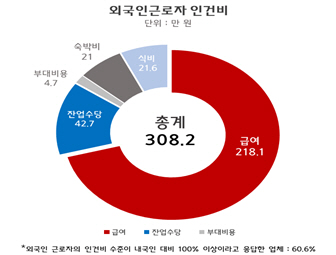
In fact, the average monthly employment cost per foreign worker reached 3.082 million won, including 426,000 won in accommodation and meal expenses.
By contrast, assuming the productivity of a Korean worker under the same conditions to be 100 percent, foreign workers' productivity stood at just 41.1 percent during their first three months after arriving in South Korea and 68.1 percent during their first year.
Employers said foreign workers needed an average probationary period of 4.3 months to learn their jobs and adjust to the workplace.
The biggest challenge in managing foreign workers on-site was "communication difficulties due to limited Korean-language proficiency," cited by 60.2 percent of respondents. Among problems arising from communication difficulties, the proportion reporting "production disruptions caused by misunderstandings of work instructions" increased to 70.6 percent.
Respondents also expressed concerns that any future easing of restrictions on changing workplaces could lead to lower productivity and staffing shortages as skilled workers leave. They agreed that supplementary measures, including prompt referrals of replacement workers and incentives for long-term employment, were urgently needed.
"SMEs are employing foreign workers to address difficulties in recruiting Korean workers, but they face the burden of low initial productivity and high employment costs," said Yang Ok-seok, head of the Workforce Policy Division at KBIZ.
"We hope the Employment Permit System will be operated in a stable manner so that foreign workers in the manufacturing sector can acquire skills and achieve productivity levels comparable to those of Korean workers," Yang added.
Oh Se-eun
#SME #Immigration #Visa #Lobor
Copyright by Asiatoday
Most Read
-
1
AMD's Lisa Su floated as potential Nvidia successo..

-
2
U.S. links Myanmar peace efforts to rare earth acc..

-
3
Alice Huang, affair partner of Jensen Huang, repor..

-
4
Hegseth rejects calls for impeachment over Iran wa..

-
5
Xi secures fourth term as China reshuffles next-ge..

-
6
Democrats flip U.S. Congress in historic midterm s..

-
7
Nvidia executive Kimberly Powell at center of Jens..

PEOPLE







-
Address : In-Young Bldg., 34, Uisadang-daero 1-gil, Yeongdeungpo-gu, Seoul
Copyright by ASIATODAY CO., LTD. All rights resereved