



Temu helps 47% of Korean sellers gain new customers and diversify sales channels
Nov 12, 2026, 05:52 pm


 |
Global e-commerce platform Temu is establishing itself as a sales channel that helps small and medium-sized Korean sellers attract new customers. The platform is seen as helping sellers reach customer groups they have struggled to access through existing online platforms, while also increasing sales and expanding their distribution channels.
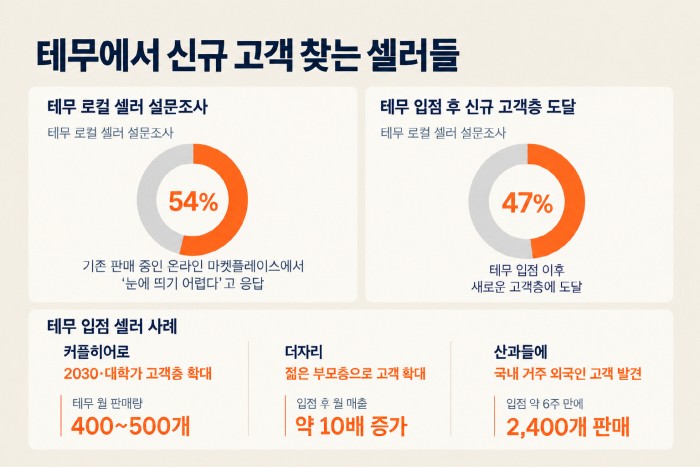
According to Temu on Nov. 12, a survey of approximately 100 sellers participating in its Local Seller Program found that 47% of respondents had reached new customer groups since joining the program. Another 58% reported increases in sales volume and revenue, while 82% described Temu as either an important complement to their existing sales channels or a key driver of growth.
Attracting new customers is one of the major business challenges facing small business owners in South Korea. According to the "2025 Survey on the State of Self-Employment" conducted by the National Assembly Futures Institute among 3,088 self-employed business owners nationwide, 65.9% of respondents cited attracting new customers as a major business difficulty.
Many sellers also struggle to gain product visibility on their existing online sales channels. In a survey conducted by Temu in August, 54% of respondents who also sold products on other online platforms said they found it difficult to make consumers aware of their products through those channels.
Temu is being used as an alternative sales channel to address these difficulties. In addition to consumers searching for and purchasing specific products, some are discovering new products while browsing the platform and going on to make purchases.
Couple Hero, a card game brand designed to foster emotional connections, is one example. Since joining Temu in May last year, Couple Hero has reached monthly sales of 400 to 500 products within several months. Heo Pil-gyeong, CEO of Couple Hero, said, "On existing domestic platforms, consumers often search for a specific product before purchasing it. But on Temu, many customers come across products by chance while browsing and then make a purchase." He added, "It has helped us reach new customer groups with whom we previously had little contact."
Bedding brand The Zari has also improved its sales performance by reaching new consumer groups. Having operated in the bedding business for 25 years, The Zari traditionally catered mainly to women in their 40s and 50s, but it has seen new demand on Temu, particularly among young parents. Since joining Temu in June last year, The Zari's monthly revenue has increased approximately tenfold. Its purchase conversion rate on Temu has also reached around 10%, higher than the 3% to 4% recorded on other sales channels. A the Zari official said, "Temu's customer base spans a wide age range, from people in their 20s to those in their 50s. We have been able to introduce our products to consumers who were difficult to reach through our existing sales channels."
Nut brand Mountain & Field has also identified new consumer demand after joining Temu. It sold approximately 2,400 products in its first six weeks after joining the platform in June last year. Purchases by foreign consumers living in South Korea were particularly notable. These consumers showed relatively greater interest in convenient snack-style nuts and granola than in existing products that emphasize health benefits. Mountain & Field is using this consumer feedback to inform future product development and assess the potential for entering overseas markets.
Temu has been expanding its recruitment of Korean sellers since introducing its Local Seller Program in South Korea in May last year. A Temu official said, "We plan to support Korean sellers in attracting new customers and increasing sales beyond their existing distribution channels." The official added, "Based on the cases of new customer acquisition and sales growth identified in this survey, we plan to strengthen cooperation with small and medium-sized Korean sellers."
Choi Jeong-a
Most Read
-
1
AMD's Lisa Su floated as potential Nvidia successo..

-
2
Ukraine halts strikes on Russian oil refineries un..

-
3
Southeast Asian auto parts makers hit hard by Chin..

-
4
U.S. links Myanmar peace efforts to rare earth acc..

-
5
Hegseth rejects calls for impeachment over Iran wa..

-
6
Democrats flip U.S. Congress in historic midterm s..

-
7
USFK commander cites interoperability gaps, urges..

PEOPLE







-
Address : In-Young Bldg., 34, Uisadang-daero 1-gil, Yeongdeungpo-gu, Seoul
Copyright by ASIATODAY CO., LTD. All rights resereved