



With Shenzhen APEC five days away, China poised to match U.S. standing
Nov 12, 2026, 04:21 pm


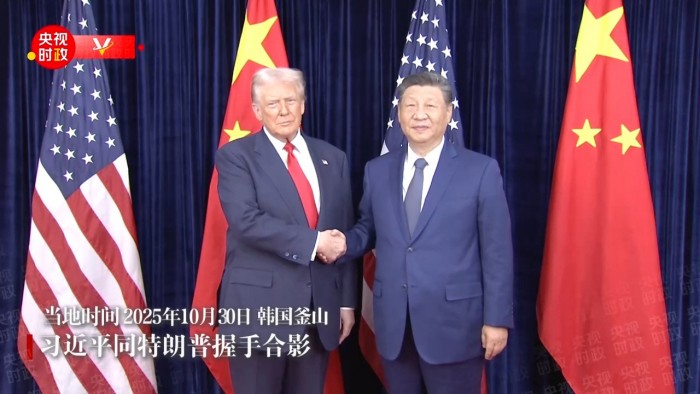 |
| U.S. President Donald Trump and Chinese President Xi Jinping, who also serves as general secretary of the Communist Party of China, hold talks on the sidelines of the Asia-Pacific Economic Cooperation (APEC) summit in South Korea on Oct. 30 last year. The two leaders are expected to meet again in Shenzhen, Guangdong Province, this year. /CCTV Online |
China is expected to use the Asia-Pacific Economic Cooperation (APEC) Economic Leaders' Meeting, scheduled to take place over two days from Nov. 18 in Shenzhen, Guangdong Province, as a turning point in its rise to a status approaching that of the United States, the world's dominant superpower. The gathering could mark a defining moment for China as it elevates its international standing by several notches in its dealings with Washington, a country to which Beijing could scarcely say "no" just over a decade ago.
Like many other Asia-Pacific economies, China has already hosted the APEC leaders' meeting twice this century, in Shanghai in 2001 and Beijing in 2014. In that sense, the upcoming summit is hardly an unprecedented event. Yet a look at how much China's global influence has changed since the 2014 Beijing summit makes it clear that this gathering is anything but ordinary.
According to China's National Bureau of Statistics, the country's economy has grown enormously since then. Twelve years ago, its gross domestic product (GDP) stood at just 65 trillion yuan ($9.74 trillion), but this year it is estimated to approach 150 trillion yuan. The economy has more than doubled in size, reaching a level that puts China in an entirely different weight class from the one it occupied during the Beijing APEC summit. Add to this the fact that China's future technologies, including artificial intelligence (AI) and semiconductors, have reached a level comparable to those of the United States, and it would be fair to say that China today is a fundamentally different country from the one it was 12 years ago.
China's international standing is also virtually incomparable to what it was then. Even leaving aside the United States, Western leaders, including those from European Union (EU) member states, have competed to visit China this year, seemingly almost ready to pay tribute. It is therefore hardly surprising that some diplomatic sources in Beijing familiar with U.S.-China relations have jokingly suggested that the threshold of Zhongnanhai, China's leadership compound, may have been worn down by more visiting foreign leaders this year than that of the White House.
China is well aware of this. It is therefore making every effort to prepare for the approaching summit, driven by its ambition to further enhance its international stature through a stronger presence at APEC. Reports in foreign media that residents not only of Shenzhen but across Guangdong Province are experiencing inconvenience from various government restrictions speak volumes about the scale of the preparations.
China is also preparing a series of major events during the two-day gathering that are expected to draw global attention. A possible trilateral summit involving the leaders of China, the United States and Russia, which would be the first of its kind since the end of the Cold War, stands out among them. Although the three countries have different strategic calculations and last-minute coordination appears to be proving difficult, the meeting nevertheless seems certain to take place.
Nor has China entirely extinguished the possibility of a U.S.-North Korea summit between Trump, who has found himself in a difficult position following his defeat in the midterm elections, and North Korean leader Kim Jong-un, a meeting the U.S. president is eager to secure. Given China's considerable influence over both Washington and Pyongyang, it should be entirely possible for Beijing to broker such a meeting through active mediation, provided it has the will to claim credit for the achievement.
A summit between Trump and Xi, meanwhile, is almost a foregone conclusion. Although the two leaders have already met twice, in May and September, the sheer number of outstanding issues makes another encounter virtually certain. According to diplomatic sources in Beijing on Nov. 12, Trump is reportedly unlikely to bring up the controversy involving Nvidia CEO Jensen Huang, who had an extramarital affair with Alice Huang (Huang Le), a woman suspected of being a Chinese spy. This could be interpreted as a sign that Trump intends to show considerable consideration for China's position.
China, for its part, is expected to refrain from taking an excessively aggressive approach out of consideration for Trump and the United States, having grown accustomed to dealing with the American president and now regarding him as a relatively manageable counterpart. Japan, by contrast, appears certain to be sidelined, having become one of China's most difficult counterparts following Prime Minister Sanae Takaichi's remarks a year ago about possible Japanese intervention in a Taiwan contingency. Reports circulating widely in Beijing diplomatic circles that Japan has been persistently lobbying behind the scenes to secure even a handshake between Xi and Takaichi at the summit are hardly without reason. It seems fair to say that China is no longer the country it was 12 years ago.
Hong Soon-do
Most Read
-
1
AMD's Lisa Su floated as potential Nvidia successo..

-
2
Ukraine halts strikes on Russian oil refineries un..

-
3
Southeast Asian auto parts makers hit hard by Chin..

-
4
U.S. links Myanmar peace efforts to rare earth acc..

-
5
Hegseth rejects calls for impeachment over Iran wa..

-
6
Democrats flip U.S. Congress in historic midterm s..

-
7
USFK commander cites interoperability gaps, urges..

PEOPLE







-
Address : In-Young Bldg., 34, Uisadang-daero 1-gil, Yeongdeungpo-gu, Seoul
Copyright by ASIATODAY CO., LTD. All rights resereved