



Chip boom lifts Korea's tax revenue by 95 trillion won
Nov 12, 2026, 10:43 am


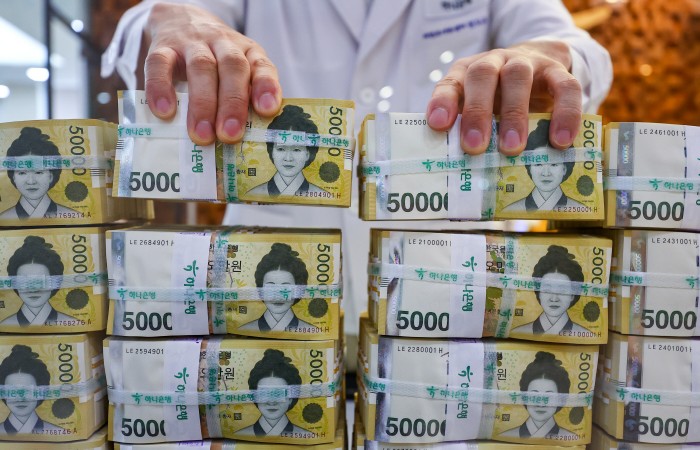 |
| An employee sorts 50,000-won banknotes at Hana Bank's Counterfeit Detection Center in Jung District, Seoul. /Yonhap News Agency |
South Korea's fiscal deficit narrowed to 32 trillion won in the first nine months of this year, its smallest level for the period in eight years. The deficit shrank by more than 70 trillion won as corporate tax revenue increased by nearly 52 trillion won, driven by a semiconductor industry boom.
According to the November issue of the "Monthly Public Finance" report released by the Ministry of Planning and Budget (MPB) on Nov. 12, the government's total revenue reached 605.4 trillion won from January to September this year, up 124.6 trillion won from a year earlier. Of this, national tax revenue rose by 95.4 trillion won to 385 trillion won. Corporate tax revenue, in particular, increased by 51.9 trillion won to 127.8 trillion won, accounting for more than half of the total increase in tax revenue. With installment payments of interim corporate tax prepayments by semiconductor companies such as Samsung Electronics and SK hynix reflected in the figures, corporate tax collections in September alone surged by 23.6 trillion won from a year earlier to 36.2 trillion won.
Income tax revenue increased by 15.7 trillion won, driven by higher performance bonuses and a recovery in real estate transactions. Value-added tax revenue rose by 7.4 trillion won as imports and private consumption increased. Securities transaction tax revenue climbed by 7.5 trillion won on increased securities trading volumes and the restoration of the securities transaction tax rate. Revenue from the special tax for rural communities also increased by 10.3 trillion won, partly due to higher trading volumes on the KOSPI market. Nontax revenue stood at 34 trillion won, while fund revenue reached 186.4 trillion won, up 9.3 trillion won and 19.9 trillion won, respectively.
Over the same period, total government expenditure increased by 40.7 trillion won to 584.9 trillion won. The budget execution rate stood at 77.7% of the annual budget. The consolidated fiscal balance, calculated by subtracting total expenditure from total revenue, swung to a surplus of 20.4 trillion won this year from a deficit of 63.5 trillion won in the January-September period last year. Both the size of the surplus and the improvement of 83.9 trillion won were the largest for the same period since the Monthly Fiscal Trends report was first published in 2014.
The managed fiscal balance, which excludes the balance of social security funds from the consolidated fiscal balance, recorded a deficit of 32 trillion won. It was the smallest deficit since 2018, when the shortfall stood at 17.3 trillion won. The deficit narrowed by 70.5 trillion won from 102.4 trillion won in the same period last year, marking the largest reduction on record.
Central government debt stood at 1,369.4 trillion won at the end of September, down 2.7 trillion won from the previous month. The MPB explained that government bond redemptions were concentrated at the end of the quarter, with repayments exceeding new issuance. Compared with the end of last year, central government debt increased by 101.3 trillion won.
Lee Ji-hoon
Most Read
-
1
AMD's Lisa Su floated as potential Nvidia successo..

-
2
Ukraine halts strikes on Russian oil refineries un..

-
3
Southeast Asian auto parts makers hit hard by Chin..

-
4
U.S. links Myanmar peace efforts to rare earth acc..

-
5
Hegseth rejects calls for impeachment over Iran wa..

-
6
Democrats flip U.S. Congress in historic midterm s..

-
7
USFK commander cites interoperability gaps, urges..

PEOPLE







-
Address : In-Young Bldg., 34, Uisadang-daero 1-gil, Yeongdeungpo-gu, Seoul
Copyright by ASIATODAY CO., LTD. All rights resereved