



[Exclusive] Two-thirds of Korean bank data center funding flows overseas to U.S. Big Tech
Nov 12, 2026, 09:43 am


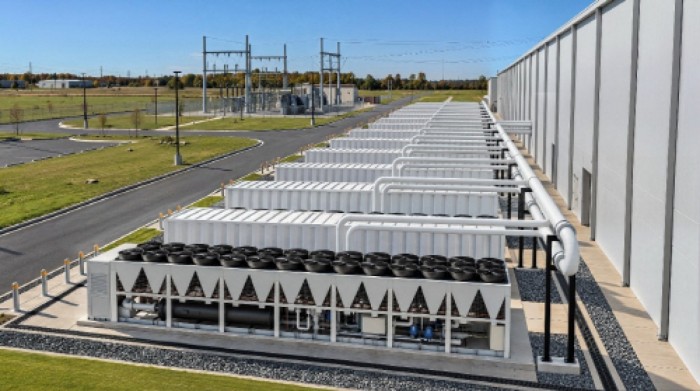 |
| An illustration of a hypothetical AI data center equipped with LG Electronics' cooling solutions, including high-performance chillers. /Yonhap News Agency |
About 66% of bank financing intended to support data centers has flowed overseas after failing to find domestic investment opportunities. Funds have been concentrated in overseas data centers where global Big Tech companies, including Amazon and Microsoft (MS), have signed long-term lease agreements.
In South Korea, data center projects face difficulties due to power shortages, permitting issues and other obstacles. Although the government has emphasized productive finance to expand artificial intelligence (AI) infrastructure, critics point out that banks are struggling to find viable domestic investment projects.
According to data on financially supported projects obtained from the Financial Supervisory Service (FSS) by Rep. Park Hong-bae of the Democratic Party (DP), a member of the National Assembly's National Policy Committee, on Nov. 11, 87 of the 131 data center financing projects involving commercial banks were overseas, accounting for 66.4% of the total. Domestic projects accounted for just 44 cases, or 33.6%.
The overseas projects were located in the United States, Germany, the United Kingdom, France, Australia, Japan, Malaysia and other countries. Many involved data centers used or leased by global Big Tech companies such as Amazon, MS, Meta and Google. Banks provided funding through project financing (PF), senior loans, secured loans, acquisition financing and refinancing.
KB Kookmin Bank participated in financing projects involving Amazon and Meta data centers in Northern Virginia, MS and Google data centers in Atlanta, and an Amazon data center in Frankfurt, Germany. Shinhan Bank provided financing for QTS and CyrusOne data centers in the United States, an Amazon data center in Germany and an MS data center in London, the United Kingdom. Woori Bank also participated in projects involving Amazon, MS and Meta data centers in the United States and an Amazon data center in Melbourne, Australia.
Overseas data centers can be expected to generate stable returns backed by long-term lease agreements with global Big Tech companies. An official at a commercial bank said, "Overseas projects offer favorable risk-adjusted returns and the advantage of being able to extend loans based on the creditworthiness of Big Tech companies." The official added, "In contrast, many domestic projects are difficult to finance because long-term tenants have not been secured, even when land and electricity are available."
Domestic projects were concentrated in the Seoul metropolitan area, including Gasan-dong in Seoul and Ansan, Goyang, Bucheon and Hanam in Gyeonggi Province. Representative projects included kt cloud's Gasan AI Data Center, the data center in Goyang's Samsong district and the data center in Choji-dong, Ansan.
The biggest obstacle to domestic data center development is electricity supply. Companies seeking to use data centers prefer the Seoul metropolitan area, but insufficient electricity is available for new facilities, prompting the government to encourage development outside the region. In other words, areas where electricity can be supplied differ from the locations companies actually want. An official in the financial investment industry said, "Although demand for data centers is high in South Korea, electricity supply plans are geared toward the semiconductor industry, leaving insufficient power for private data centers." The official added, "The government is encouraging data centers to locate outside the Seoul metropolitan area, but companies prefer the metropolitan area, creating a mismatch between supply and demand."
Complaints from local residents and delays in obtaining permits and approvals are also obstacles. Local governments are reluctant to issue permits and approvals due to residents' opposition to data center construction, and projects struggle to reach the financing stage if they have also failed to secure tenants. An official in the financial investment industry said, "Power supply and permitting issues are preventing projects from reaching a stage where they can secure financing."
Rep. Park Hong-bae said, "As financing demand for data centers, which are essential infrastructure for the AI industry, is growing rapidly, we need to create conditions that enable active investment by private financial institutions in South Korea as well." He added, "The government and financial sector should work together to improve investment conditions, including electricity supply and permitting, so that productive finance leads to stronger competitiveness in advanced industries and economic growth."
Lee Bo-ra
Most Read
-
1
AMD's Lisa Su floated as potential Nvidia successo..

-
2
Ukraine halts strikes on Russian oil refineries un..

-
3
Southeast Asian auto parts makers hit hard by Chin..

-
4
U.S. links Myanmar peace efforts to rare earth acc..

-
5
Hegseth rejects calls for impeachment over Iran wa..

-
6
Democrats flip U.S. Congress in historic midterm s..

-
7
USFK commander cites interoperability gaps, urges..

PEOPLE







-
Address : In-Young Bldg., 34, Uisadang-daero 1-gil, Yeongdeungpo-gu, Seoul
Copyright by ASIATODAY CO., LTD. All rights resereved