



S. Korea ramps up energy and mineral reserves as AI boom lifts power demand
Nov 11, 2026, 10:40 am


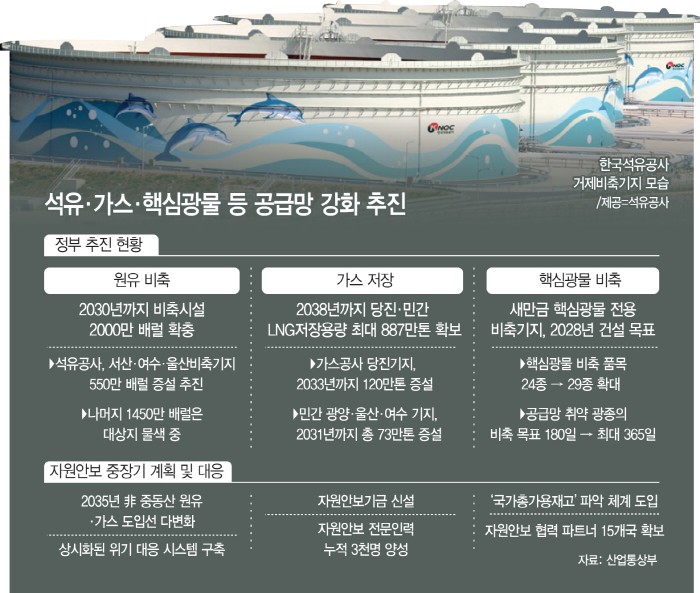 |
The importance of a stable power supply is once again coming into focus in the age of artificial intelligence (AI). Securing a stable supply of critical minerals essential for industrial production, as well as electricity needed for data centers and semiconductor factories, has also emerged as a major energy security challenge. With disruptions to shipping through the Strait of Hormuz adding to uncertainty over oil and gas supplies, the government is pursuing policies to diversify crude oil and gas import sources and expand storage facilities.
According to industry sources on Tuesday, the Korea National Oil Corporation (KNOC) recently established its "Mid- to Long-Term Management Goals (2027–2031)," adding and refining specific tasks related to oil stockpiling and development to strengthen energy security compared with the previous year. These include a project to expand oil storage capacity by 20 million barrels in line with government policy. "In response to changes in the operating environment, including the war involving Iran, we have set our mid- to long-term management goals to strengthen our core role as an agency responsible for energy security and expand our public functions," a KNOC official said.
KNOC currently operates nine oil stockpiling facilities across the country, including in Guri, Yongin, Pyeongtaek and Ulsan. Of these, the Seosan, Yeosu and Ulsan facilities have been selected as priority sites for the government's planned 20 million-barrel capacity expansion, and the projects have now entered the environmental impact assessment stage. A total of nine additional storage tanks will be built at these sites, increasing capacity by 5.5 million barrels. More broadly, KNOC is expanding oil stockpiling facilities, Korea Gas Corporation (KOGAS) is increasing gas storage tank capacity, and Korea Mine Rehabilitation and Mineral Resources Corporation (KOMIR) is building a dedicated national stockpiling facility for critical minerals. KOMIR's critical minerals stockpiling facility project has completed the design stage and is now proceeding with procurement for firefighting and electrical works.
In September, the government also expanded the list of critical minerals to be stockpiled, including lithium, graphite, gallium and cobalt, which are used in secondary batteries and semiconductors, from 24 to 29 types. It plans to apply different stockpiling periods to certain minerals with particularly high supply chain risks. The government is maintaining confidentiality over the specific minerals and quantities held in reserve, as such information could serve as an indicator of the scale of domestic industries. The Ministry of Trade, Industry and Resources (MOTIR) also plans to revise its "Notice on Securing National Resource Security" by the end of this year to designate 10 rare earth elements, including samarium, and 13 other minerals, including fluorspar, phosphorus and germanium, as critical minerals. This will expand the number of designated critical minerals from 38 to 51.
Experts stressed the need for public institutions to take a more active role in negotiations and investments involving overseas resource development. "The public sector should take on risks that private companies find difficult to bear alone, such as government-to-government negotiations with resource-rich countries, early-stage exploration, equity investments and stockpiling small quantities of minerals," said Park Jun-hyuk, a senior researcher at the Mineral Exploration and Mining Research Center of the Korea Institute of Geoscience and Mineral Resources (KIGAM). "The private sector should use its strengths in refining and materials technology to lead projects that integrate mines and processing plants, while securing demand through long-term supply contracts. Only when the public sector shares the risks and the private sector leads the business can Korea become a supplier rather than merely a customer in the global competition for minerals," he emphasized.
There are also calls to make greater use of overseas assets in which public institutions have already invested to secure energy supplies. "We need to actively consider importing natural gas from Mozambique," said Seo Sang-hyun, director of the Global South Institute. "As demand for natural gas is expected to grow much faster than demand for crude oil, cooperation with Mozambique, and eventually Tanzania, will be necessary to reduce our reliance on Qatar, our largest supplier." He added, "We need to make active use of KOGAS's 10% stake."
The energy industry believes that Mozambique's liquefied natural gas (LNG) projects could help South Korea diversify its gas import sources and strengthen energy security. However, some observers believe the share of crude oil imported from the Middle East could rise again after the war, despite policies to diversify import sources. Seo cited the availability and price competitiveness of Middle Eastern crude, as well as South Korea's refining infrastructure, which is configured to process heavy crude from the region. "In addition to expanding storage facilities, we need to increase the share of electricity generated from renewable energy and nuclear power, while also strengthening domestic refiners' capacity to process a wider range of crude oil grades through public-private cooperation," he stressed.
Bae Seok-won
Most Read
-
1
Ukraine halts strikes on Russian oil refineries un..

-
2
China's fifth plenum to conclude amid expectations..

-
3
Southeast Asian auto parts makers hit hard by Chin..

-
4
U.S. links Myanmar peace efforts to rare earth acc..

-
5
Hegseth rejects calls for impeachment over Iran wa..

-
6
Democrats flip U.S. Congress in historic midterm s..

-
7
USFK commander cites interoperability gaps, urges..

PEOPLE






-
Address : In-Young Bldg., 34, Uisadang-daero 1-gil, Yeongdeungpo-gu, Seoul
Copyright by ASIATODAY CO., LTD. All rights resereved