



Dutch cyber defenses lag behind AI-powered hackers
Nov 11, 2026, 09:30 am


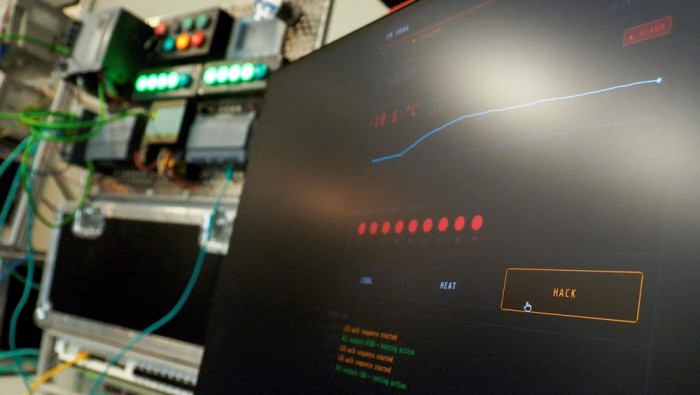 |
| A monitor at the Cyber 3 Lab of Howest University of Applied Sciences in Bruges, Belgium, displays a simulated hacking attack on a refrigeration system on Nov. 4, 2026. /Reuters-Yonhap |
The cybersecurity capabilities of the Dutch government and businesses are failing to keep pace with rapidly evolving cyber threats, Dutch news outlet NL Times reported on Nov. 7.
While hackers are using artificial intelligence (AI) to increase the speed, scale and efficiency of their attacks, government agencies and businesses remain vulnerable to cyber threats due to insufficient funding and staff shortages.
In its recently released Cybersecurity Assessment Netherlands 2026, the Netherlands' National Coordinator for Security and Counterterrorism (NCTV) found that while state-sponsored hacking groups and cybercriminals are steadily improving their offensive capabilities, the digital defenses of Dutch organizations are developing at a relatively slower pace.
The NCTV warned that this imbalance increases the risk of cyber espionage, data exfiltration, system destruction and digital service disruptions that could paralyze Dutch society.
The report identified inadequate management oversight, insufficient funding and staff shortages as major causes of cybersecurity vulnerabilities. It particularly highlighted the gap in cybersecurity capabilities between large corporations and small and medium-sized enterprises.
State-sponsored cyber threats are also expanding. China, Russia, Iran and North Korea are already operating cyber programs targeting the Netherlands.
Cybercriminals are also evolving their methods of attack. While they previously focused on disrupting systems, they have recently expanded their activities to stealing large amounts of personal data to extort companies, using stolen information to launch further attacks and reselling it to state-sponsored hacking groups.
One notable example is the cyberattack on Dutch telecommunications company Odido in February this year. The hacking group ShinyHunters stole the personal information of more than six million Odido customers and then demanded money from the company using the stolen data as leverage.
Ahold Delhaize, the parent company of major Dutch supermarket chain Albert Heijn, announced last month that it had suffered a cyberattack that was expected to cause losses of at least 200 million euros (approximately 300.8 billion won).
As AI technology advances, cyberattacks are becoming increasingly complex. According to the NCTV, hackers previously used AI mainly to select targets and write phishing emails, but they have recently begun using it to carry out cyberattacks directly.
To address these cyber threats, the NCTV advised governments and businesses to promptly fix security vulnerabilities and strengthen basic cybersecurity measures, including data backups and continuous monitoring.
Meanwhile, Dutch Minister of Justice and Security Van Weel was asked by news agency ANP on Nov. 6 whether effective defense was still possible even as AI made cyberattacks easier to carry out. He replied that it was possible, noting that AI could also be used as a defensive tool.
Park Hee-jin
Most Read
-
1
Ukraine halts strikes on Russian oil refineries un..

-
2
China's fifth plenum to conclude amid expectations..

-
3
Southeast Asian auto parts makers hit hard by Chin..

-
4
U.S. links Myanmar peace efforts to rare earth acc..

-
5
Hegseth rejects calls for impeachment over Iran wa..

-
6
Democrats flip U.S. Congress in historic midterm s..

-
7
USFK commander cites interoperability gaps, urges..

PEOPLE







-
Address : In-Young Bldg., 34, Uisadang-daero 1-gil, Yeongdeungpo-gu, Seoul
Copyright by ASIATODAY CO., LTD. All rights resereved