



AI data centers encroach on S. Korean schools
Nov 11, 2026, 10:25 am


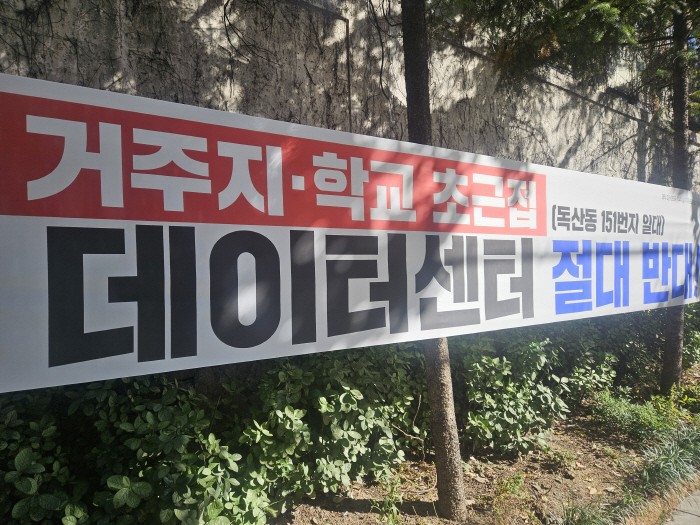 |
| A banner opposing the construction of a data center near a school hangs on a street in Doksan-dong, Geumcheon-gu, Seoul, on Nov. 10. /Photo by Kim Tae-hoon |
The expansion of the artificial intelligence (AI) industry is driving an increase in data center construction, but legal safeguards restricting their location near schools remain inadequate. Data centers are not classified as prohibited facilities within educational environment protection zones, and those below a certain size may also be exempt from educational environment assessments. Critics say there are insufficient institutional safeguards to assess in advance how large-scale power equipment and cooling facilities could affect students' learning environments.
According to legal sources on Tuesday, a lawsuit filed by residents seeking to invalidate a building permit for a data center in Doksan-dong, Geumcheon-gu, Seoul, is currently before the Seoul Administrative Court. Residents are also continuing to protest against plans to build data centers near schools and residential areas in Dohwa-dong, Michuhol-gu, Incheon; Gurae-dong, Gimpo, Gyeonggi Province; and Hogye-dong, Anyang.
Under the current Act on the Protection of Educational Environment, areas within 50 meters of a school entrance are designated as absolute protection zones, while areas within 200 meters of school boundaries are designated as relative protection zones, restricting the establishment of harmful facilities. However, data centers, which are classified as broadcasting and telecommunications facilities under the Building Act, are not included among the prohibited facilities. Despite being equipped with large-scale power and cooling systems, they are not subject to separate location restrictions near schools.
There are also gaps in educational environment assessments. Buildings with 21 or more floors or a total floor area of at least 100,000 square meters must undergo an assessment if constructed within an existing school's educational environment protection zone. Smaller data centers may be exempt from review unless they meet other assessment criteria. In other words, buildings that fall below these thresholds may not be required to undergo an assessment, even if they house large-scale cooling systems and power equipment.
Data centers operate cooling towers and air handling units around the clock to dissipate heat generated by servers. This process can produce noise and vibrations. Emergency generators installed to prepare for power outages also generate noise and exhaust emissions during testing or emergency operation. The fire safety of electrical equipment, including high-capacity batteries, is another concern that requires examination. Although the actual impact varies depending on a facility's size and design, there are growing calls for advance assessments when such facilities are located near schools where students spend extended periods.
"Even if data centers are not explicitly listed as prohibited facilities under current law, their potential impact on the educational environment must be assessed from the perspective of students and parents," said Park Nam-gi, professor emeritus at Gwangju National University of Education. "Since these facilities are being built near schools, institutional improvements must be made promptly, including the establishment of separate location criteria." He added, "Restrictions should be imposed on their construction if assessments of their size and actual harmful effects show that they would adversely affect the learning environment. Even before the law is amended, existing standards should be used to examine their impact on the educational environment."
Kim Tae-hoon
Most Read
-
1
Ukraine halts strikes on Russian oil refineries un..

-
2
China's fifth plenum to conclude amid expectations..

-
3
Southeast Asian auto parts makers hit hard by Chin..

-
4
U.S. links Myanmar peace efforts to rare earth acc..

-
5
Hegseth rejects calls for impeachment over Iran wa..

-
6
Democrats flip U.S. Congress in historic midterm s..

-
7
USFK commander cites interoperability gaps, urges..

PEOPLE





-
Address : In-Young Bldg., 34, Uisadang-daero 1-gil, Yeongdeungpo-gu, Seoul
Copyright by ASIATODAY CO., LTD. All rights resereved