



[Market Power] HD Hyundai faces 300 billion won repayment risk
Nov 11, 2026, 10:15 am


 |
 |
HD Hyundai Robotics, which HD Hyundai spun off with the aim of pursuing a dual listing, is expected to become a financial burden of more than 300 billion won for its parent company. This comes as the current government has adopted a policy of prohibiting dual listings in principle. The rationale is that listing a subsidiary after a physical spin-off, in which a listed parent company initially retains 100% ownership, undermines the value of the parent company's shareholders' investments. HD Hyundai Robotics was established as a wholly owned subsidiary in May 2020 through a physical spin-off from what was then Hyundai Heavy Industries Holdings, now HD Hyundai.
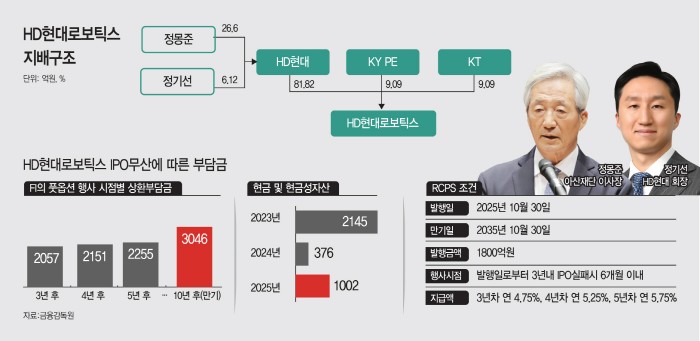
Last year, HD Hyundai Robotics entered into a 180 billion won redeemable convertible preferred stock (RCPS) agreement with a financial investor (FI), on the condition that it complete an initial public offering (IPO) within three years. Under the agreement, if HD Hyundai Robotics fails to complete its IPO by 2028, it must repay the 180 billion won principal plus a redemption premium of approximately 120 billion won, calculated on the basis of holding the securities to maturity. The RCPS carries a compound annual return of 4.75% for the first three years after issuance, with the rate increasing gradually thereafter. If HD Hyundai Robotics successfully completes its IPO, the FI could recover its investment by converting its holdings into common shares and selling them after the listing. However, securing the support of HD Hyundai's shareholders is expected to be the biggest obstacle.
The market therefore views the prospects for an IPO as extremely slim. Analysts believe HD Hyundai Robotics is highly likely to have to pay investors hundreds of billions of won in cash, including the principal and a premium. The problem is the company's financial capacity. HD Hyundai Robotics had only around 100 billion won in cash and cash equivalents at the end of last year and has recorded net losses since 2023. Although roughly two years remain before investors can demand redemption, the company is unlikely to be able to raise the necessary funds on its own without an improvement in earnings. A recent case involving SK Ecoplant illustrates a similar situation. After raising 800 billion won from financial investors in 2022, SK Ecoplant abandoned its listing plans, prompting its parent company, SK Inc., to step in. As SK Ecoplant was unable to secure sufficient financing independently, its parent company is conducting a tender offer worth more than 1 trillion won to acquire the FI-held shares and make SK Ecoplant a wholly owned subsidiary. This explains why the market believes HD Hyundai will ultimately have to shoulder the repayment burden if its subsidiary HD Hyundai Robotics fails to go public.
According to the Financial Supervisory Service (FSS) on Nov. 9, HD Hyundai Robotics entered into a 180 billion won RCPS agreement in October 2025 with KDB KY Taekwon Co., Ltd. (KY PE). The agreement requires HD Hyundai Robotics to complete its IPO by October 2028. KY PE is a special purpose company (SPC) jointly funded by the Korea Development Bank (KDB) and private equity firm KY PE.
If the IPO falls through, KY PE can demand redemption of all its RCPS within six months of the IPO deadline. If it exercises its put option, HD Hyundai Robotics would have to pay 304.5 billion won in cash, comprising the 180 billion won principal and a 124.5 billion won redemption premium. This amount reflects all the returns contractually promised through maturity in 2035, based on compound annual rates ranging from 4.75% to 5.75%, in the event that the listing fails. The redemption amount also varies depending on when the put option is exercised. If exercised after three years, it would be 205.7 billion won, rising to 215.1 billion won after four years and 225.5 billion won after five years.
If HD Hyundai Robotics proceeds with an IPO, KY PE could convert its preferred shares into common shares and realize a capital gain following the listing. Since the investor acquired the shares at 202,500 won each, HD Hyundai Robotics would be relieved of its cash redemption burden if the shares were valued above that level in the market.
The key question is whether HD Hyundai Robotics has sufficient cash to meet its redemption obligations. Its cash and cash equivalents fell sharply from 241.5 billion won in 2023 to 37.6 billion won at the end of 2024, before reaching 100.2 billion won at the end of last year. The company has remained in the red for three consecutive years, recording net losses of 20.3 billion won in 2023, 11.8 billion won in 2024 and 22.9 billion won in 2025. Despite needing to generate net profits to increase investment and cash reserves, its finance costs alone reached 14.5 billion won last year. The company recorded an operating loss of 21.8 billion won last year and another loss of 5 billion won in the first quarter of this year, before barely returning to an operating profit of 1 billion won in the second quarter and 1.3 billion won in the third.
Despite these continuing losses, the valuation of unlisted HD Hyundai Robotics has increased approximately fourfold. In June 2020, the company conducted a third-party allotment of new shares to KT, issuing 888,889 common shares. The issue price was 56,250 won per share, raising 50 billion won in working capital from KT.
Five years later, the company applied an issue price of 202,500 won per share in another third-party allotment. HD Hyundai Robotics issued a total of 888,889 shares, raising 180 billion won in working capital from KY PE. The premiums over par value were approximately 1,025% in 2020 and 3,950% in 2025.
In effect, the company conducted a capital increase after raising its own valuation by more than threefold, despite failing to generate operating profits. Its financial burden is therefore expected to increase once the FI becomes entitled to demand redemption. This is why market observers believe HD Hyundai, as the largest shareholder, will likely have to provide financial support if HD Hyundai Robotics cannot secure the necessary redemption funds independently.
For HD Hyundai shareholders, HD Hyundai Robotics has remained a persistent headache for years since the physical spin-off. Pursuing an IPO is complicated not only by the government's tighter dual-listing regulations but also by a subdued market amid falling stock prices and difficulties in determining an acceptable valuation. Despite the growth potential of the robotics industry, deteriorating investor sentiment could prevent the company from securing its desired valuation, potentially delaying its listing timetable. Even if HD Hyundai Robotics withdraws its IPO plans, its worsening profitability and insufficient cash reserves make intervention by HD Hyundai highly likely.
Even if the listing goes ahead, the company would need to find a way to share a substantial portion of the benefits with ordinary shareholders of its parent company, HD Hyundai. In fact, DS Navcours, the first company granted an exception to the tighter dual-listing restrictions, went public on the condition that a portion of its shares would be distributed as an in-kind dividend to ordinary shareholders of its parent company, excluding the controlling shareholder. This followed an assessment by the parent company's board of directors of whether the listing would benefit ordinary shareholders. Concerns have also been raised that distributing shares to HD Hyundai shareholders other than its largest shareholder, Chairman Chung Mong-joon, could weaken the controlling shareholder's grip on the company.
"Although no decision has been made on listing HD Hyundai Robotics, it would be difficult to proceed with an IPO under the current circumstances," an HD Hyundai official said. "We will place the highest priority on protecting HD Hyundai's shareholder value in any future financing for HD Hyundai Robotics."
Yoon Seo-young
#Dual listing #HD Hyundai #IPO #Repayment
Copyright by Asiatoday
Most Read
-
1
Ukraine halts strikes on Russian oil refineries un..

-
2
China's fifth plenum to conclude amid expectations..

-
3
Southeast Asian auto parts makers hit hard by Chin..

-
4
U.S. links Myanmar peace efforts to rare earth acc..

-
5
Hegseth rejects calls for impeachment over Iran wa..

-
6
Democrats flip U.S. Congress in historic midterm s..

-
7
USFK commander cites interoperability gaps, urges..

PEOPLE







-
Address : In-Young Bldg., 34, Uisadang-daero 1-gil, Yeongdeungpo-gu, Seoul
Copyright by ASIATODAY CO., LTD. All rights resereved