



Takaichi and Xi unlikely to hold summit at upcoming APEC meeting
Nov 09, 2026, 01:12 pm


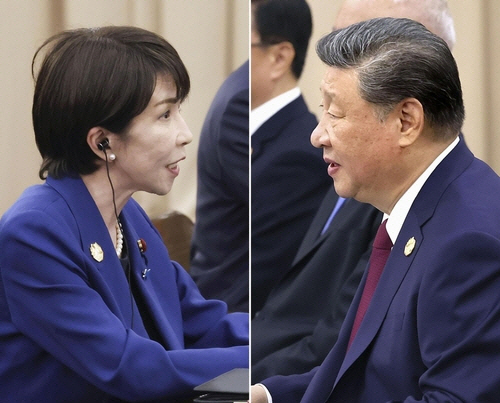 |
| Chinese President Xi Jinping and Japanese Prime Minister Sanae Takaichi speak during a bilateral summit in Gyeongju, South Korea, on Oct. 31, 2025. /Yonhap |
Attention is turning to whether Japanese Prime Minister Sanae Takaichi and Chinese President Xi Jinping will hold another bilateral summit during the Asia-Pacific Economic Cooperation (APEC) leaders' meeting in Shenzhen, China, on Nov. 18–19, following their first meeting in Gyeongju, South Korea, on Oct. 31 last year. For now, however, a separate meeting between the two leaders appears unlikely.
Japan's Jiji Press reported Saturday, citing Japanese government officials, that a summit would be difficult to arrange because China continues to take a hard line over Takaichi's parliamentary remarks concerning a possible Taiwan contingency.
During their approximately 30-minute meeting in Gyeongju last year, the two leaders agreed to expand their common interests and build stable bilateral relations. Takaichi also expressed concern over China's restrictions on rare earth exports, and the two sides agreed to strengthen communication between their export control authorities.
However, the atmosphere changed just one week later, on Nov. 7, 2025.
Speaking before the Budget Committee of Japan's House of Representatives, Takaichi cited a hypothetical Chinese naval blockade of Taiwan and said that the use of force in the Taiwan Strait could constitute a "survival-threatening situation" for Japan.
Under Japanese law, the term refers to a situation in which an armed attack against a country with close ties to Japan threatens Japan's survival and the fundamental rights of its people.
If the Japanese government determines that such a situation exists, the Self-Defense Forces may exercise the right to collective self-defense, subject to legal requirements.
China interpreted Takaichi's remarks as suggesting the possibility of Japanese military intervention and demanded that she withdraw them.
According to the Yomiuri Shimbun, Takaichi described China as an "important neighbor" on Nov. 6 and said Japan would continue dialogue to protect its national interests.
Chief Cabinet Secretary Minoru Kihara also said that Japan's position on Taiwan remained unchanged from the 1972 Japan-China Joint Communiqué.
In that communiqué, issued when the two countries normalized diplomatic relations, Japan stated that it "fully understands and respects" the Chinese government's position that Taiwan is an inalienable part of China's territory.
Chinese Foreign Ministry spokesperson Guo Jiakun, however, reiterated on Nov. 6 that Japan must promptly correct what Beijing regards as its erroneous statements and actions concerning Taiwan.
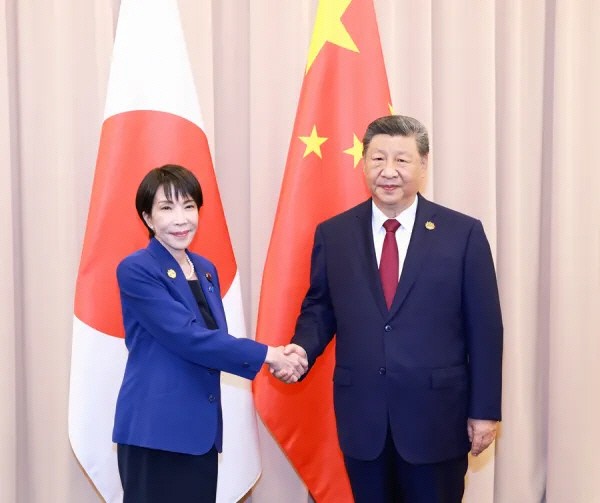 |
| Chinese President Xi Jinping and Japanese Prime Minister Sanae Takaichi shake hands during their meeting in Gyeongju, South Korea, on Oct. 31, 2025. /Courtesy of China's Ministry of Foreign Affairs |
According to Kyodo News, former Japanese Foreign Minister Takeshi Iwaya met Chinese Foreign Minister Wang Yi in Beijing on Sept. 28 and proposed that the two governments formally reaffirm the 1972 Japan-China Joint Communiqué.
Iwaya, who visited China as chairman of the Japan Association for the Promotion of International Trade, explained that withdrawing Takaichi's remarks would carry considerable domestic political costs for the Japanese prime minister.
Jiji Press also noted that such a withdrawal could disappoint conservative voters, who form a core part of Takaichi's support base.
Wang, however, repeated Beijing's demand that Takaichi correct her remarks concerning Taiwan.
The longer the confrontation continues, the greater the burden on Japanese companies seeking to secure rare earth supplies.
In January, China banned exports to Japan of dual-use items that could be used for military purposes.
According to Kyodo News, China's exports of yttrium oxide to Japan totaled just 18 metric tons from January through September this year, down 98% from 887 tons during the same period last year.
Yttrium oxide is a rare earth compound used in semiconductor manufacturing equipment and other industrial applications.
Japanese Foreign Minister Toshimitsu Motegi said Nov. 6 that Japan would accelerate efforts to diversify its sources of supply by cooperating with friendly countries on mine development and refining facilities.
There have been previous instances in which the foreign ministers of Japan and China exchanged brief remarks on the sidelines of multilateral meetings.
During meetings related to the Association of Southeast Asian Nations (ASEAN) in Manila, the Philippines, in July, Motegi encountered Wang while moving between meeting venues and conveyed the importance of maintaining dialogue.
Attention is now turning to whether Takaichi and Xi might similarly exchange words at a meeting venue or an official event in Shenzhen.
Even a brief conversation could provide an opportunity to resume working-level discussions, including the export control consultations agreed upon during their summit in Gyeongju last year.
Choi Young-jae
Most Read
-
1
Ukraine halts strikes on Russian oil refineries un..

-
2
China's fifth plenum to conclude amid expectations..

-
3
Southeast Asian auto parts makers hit hard by Chin..

-
4
U.S. links Myanmar peace efforts to rare earth acc..

-
5
Hegseth rejects calls for impeachment over Iran wa..

-
6
Democrats flip U.S. Congress in historic midterm s..

-
7
USFK commander cites interoperability gaps, urges..

PEOPLE






-
Address : In-Young Bldg., 34, Uisadang-daero 1-gil, Yeongdeungpo-gu, Seoul
Copyright by ASIATODAY CO., LTD. All rights resereved