



Nongshim's Noksan plant becomes new engine for overseas sales
Nov 09, 2026, 10:59 am


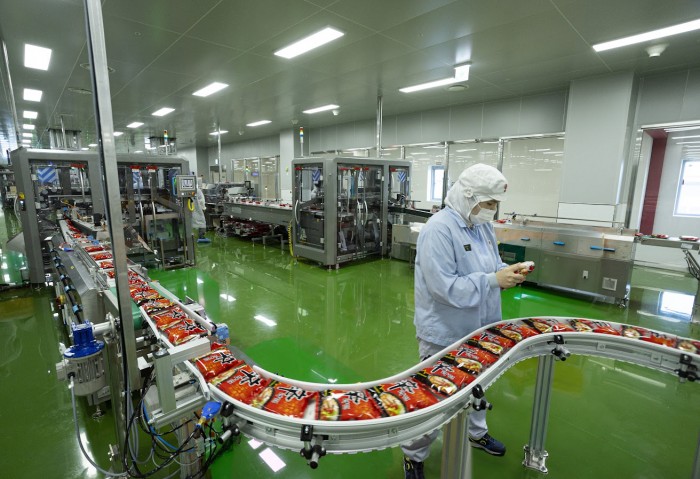 |
| Ramen products move along a production line at Nongshim's Noksan export-dedicated plant in Busan. /Courtesy of Nongshim |
Nongshim has established a new production base in Busan to strengthen its presence in global markets. The facility is designed to ease the production burden on the company's existing Busan plant, which has handled a substantial share of its exports, and meet growing overseas demand.
The new plant not only increases ramen production capacity but also introduces a flexible manufacturing system that reduces product changeover times, along with artificial intelligence (AI)-powered automation equipment.
Nongshim plans to develop its Noksan export-dedicated plant into a key production hub for its global business as it pursues its 2030 targets of 7.3 trillion won in revenue and an overseas sales share of more than 60%.
During a visit to the plant in Busan's Noksan National Industrial Complex on Nov. 5, ramen products were moving continuously along the production lines.
The plant's production capacity exceeds 600 packages per minute for bagged noodles and stands at approximately 500 units per minute for cup noodles. The equipment was designed with a particular focus on improving production efficiency compared with Nongshim's existing plants.
The facility, which began operations on Oct. 29, is Nongshim's first domestic manufacturing plant dedicated exclusively to exports.
It initially operates three production lines — two for bagged noodles and one for cup noodles — with a combined annual capacity of up to 500 million packages.
The building also has enough space to expand to as many as eight production lines as overseas demand increases.
The decision to build the Noksan plant was driven partly by the strain on Nongshim's existing manufacturing facilities.
"Previously, the Busan plant handled a substantial share of both domestic products and overseas exports," said Jeon Yun-yeol, head of the Noksan plant.
"With the new export-dedicated plant now operating, we can distribute the production burden and adjust supply volumes more flexibly in response to overseas demand."
The new facility has also significantly expanded Nongshim's global supply capacity.
The company's existing Busan and Gumi plants had a combined annual capacity of approximately 700 million packages for export. With Noksan adding another 500 million, Nongshim's domestic production capacity for exports has increased to approximately 1.2 billion packages annually.
Including production at its facilities in the United States and China and products manufactured for the domestic market, Nongshim says its total annual ramen production capacity has reached up to 6.2 billion packages.
The company now has a manufacturing network capable of responding to global demand through production bases at home and abroad.
The products manufactured at Noksan will be supplied to a wide range of markets.
Alongside established markets such as Europe, Japan and Australia, Nongshim plans to target regions with strong growth potential, including India, Southeast Asia and the Middle East.
The company's strategy is to use local production facilities for the Chinese and U.S. markets while supplying other regions from its domestic manufacturing bases, allowing it to respond more effectively to demand in each market.
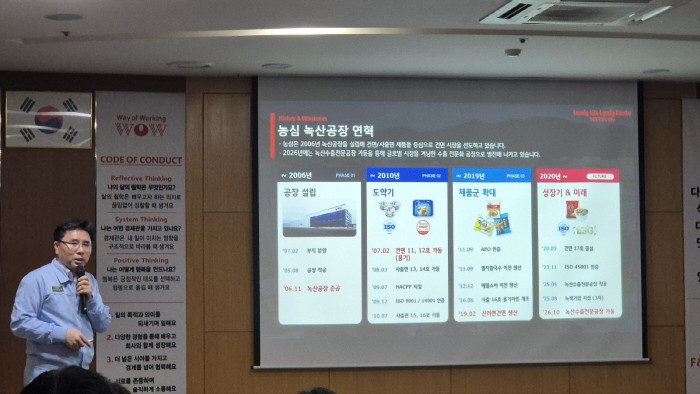 |
| Jeon Yun-yeol, head of Nongshim's Noksan plant, gives a briefing. /Photo by Lee Chang-yeon |
Faster product changeovers take priority over output volume
Production capacity is not the only feature that sets the Noksan plant apart.
As global demand becomes more diverse, the plant has been designed to switch quickly between different products on the same production line.
The variety of ramen products is expanding beyond traditional soup-based noodles to include stir-fried noodles and cup noodles, while flavor preferences also differ from country to country.
To address these demands, Nongshim has introduced automation technologies throughout the production process.
When work orders are issued through the Production Management System (PMS), equipment operating parameters are automatically adjusted to match the requirements of each product.
The plant has also introduced an AI-powered predictive maintenance system that analyzes vibration and electrical current data collected by sensors installed on equipment to detect potential abnormalities before failures occur.
The goal is to move away from responding to breakdowns after they happen and instead monitor equipment conditions in advance to minimize production disruptions.
Autonomous mobile robots (AMRs) handle internal logistics.
Using sensors to detect their surroundings, the robots navigate without floor-mounted guide lines, avoid obstacles and deliver necessary materials to production areas.
A magnetic conveyance system has been introduced in the packaging process, while an AI deep learning-based inspection system improves the accuracy of product quality checks.
One particularly notable improvement is the reduction in product changeover times.
Previously, preparing the water mixture used in noodle production took approximately 115 minutes. By installing storage tanks in parallel and simplifying the production process, the time has been reduced to around 30 minutes.
Packaging equipment has also been improved to allow components to be replaced through a one-touch mechanism, cutting preparation time from 120 minutes to 30 minutes.
Jeon said the process improvements were expected to increase productivity by approximately 17.6%.
He also emphasized that the introduction of AI was not intended to reduce the workforce.
"In the past, workers' experience and skills were major factors in production. Now, expertise in understanding and managing equipment and systems is becoming increasingly important," Jeon said.
"Rather than using AI to reduce staffing, we are focused on strengthening expertise on the production floor and maintaining consistent product quality."
Environmentally friendly equipment was also incorporated into the plant's design.
Solar power systems have been installed on the roof and exterior walls, while a Factory Energy Management System (FEMS) monitors energy consumption in real time.
The facility is therefore designed to manage not only production efficiency but also energy use.
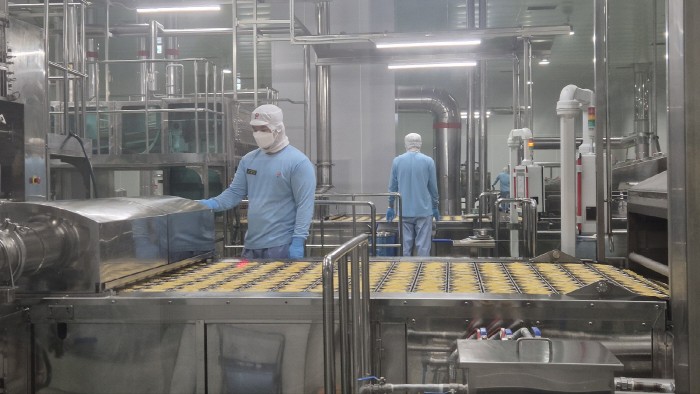 |
| Ramen products are manufactured at Nongshim's Noksan export-dedicated plant. /Photo by Lee Chang-yeon |
Additional investment creates room for expansion, but overseas demand remains key
The increase in the plant's construction costs from the original budget was largely intended to secure additional space for future production line expansion.
The initial investment was set at 191.8 billion won but subsequently rose by 12.5 billion won, or approximately 6.5%, to around 204.3 billion won.
The increase was largely attributable to changes in the building's structure to accommodate both the ground conditions in the Noksan area and plans for future production line expansion.
The plant was built with six floors, more than originally planned, with space allocated on each floor to allow production capacity to be increased.
Noodle production lines currently operate on the third and fourth floors, while soup seasoning production lines are located on the fifth floor.
Additional space has been left available for new manufacturing equipment as demand grows.
Nongshim plans to expand its production facilities in stages to meet rising global demand.
However, the company expects it will take time to recover its investment.
A Nongshim official estimated the investment payback period at approximately 15 to 20 years, while noting that the period could be shortened if overseas demand driven by the popularity of Korean food grows faster than expected.
Another key question is whether the expanded production capacity at Noksan will translate into higher exports.
With the opening of the new plant, Nongshim is also stepping up efforts to expand its presence in the non-soup noodle market.
The company aims to broaden its overseas customer base by extending the Shin Ramyun brand beyond soup-based noodles into products such as stir-fried noodles.
Next year, Nongshim plans to introduce a new stir-fried noodle product following Shin Ramyun Toomba and Shin Ramyun Rosé.
The company is developing a product that retains Shin Ramyun's signature flavor while incorporating distinctive Korean elements. It aims to launch the product in global markets as early as the first quarter of next year.
"The Noksan export-dedicated plant will become the beating heart of Nongshim's global business, enabling us to rapidly produce and supply large volumes of products tailored to the increasingly diverse needs of consumers around the world," said Nongshim CEO Cho Yong-chul.
"With our advanced smart factory technologies and strategic products for global markets, we will work toward generating more than 60% of our revenue overseas and achieving company-wide sales of 7.3 trillion won by 2030."
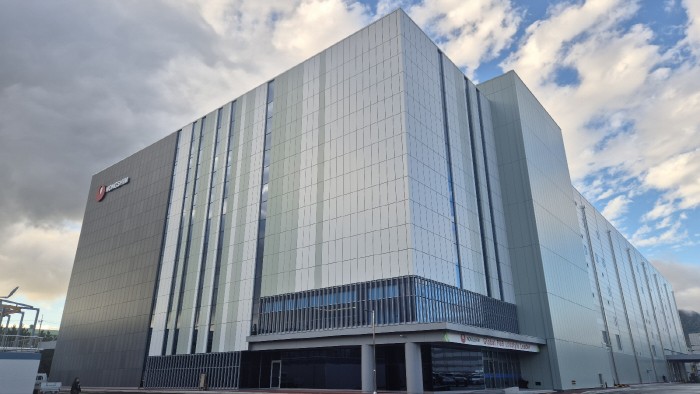 |
| An exterior view of Nongshim's Noksan export-dedicated plant. /Photo by Lee Chang-yeon |
Lee Chang-yeon
Most Read
-
1
Ukraine halts strikes on Russian oil refineries un..

-
2
China's fifth plenum to conclude amid expectations..

-
3
Southeast Asian auto parts makers hit hard by Chin..

-
4
Hegseth rejects calls for impeachment over Iran wa..

-
5
U.S. links Myanmar peace efforts to rare earth acc..

-
6
Democrats flip U.S. Congress in historic midterm s..

-
7
USFK commander cites interoperability gaps, urges..

PEOPLE







-
Address : In-Young Bldg., 34, Uisadang-daero 1-gil, Yeongdeungpo-gu, Seoul
Copyright by ASIATODAY CO., LTD. All rights resereved