



S. Korea mulls 2 trillion won package to ease local fiscal burden on firefighting
Nov 09, 2026, 10:39 am


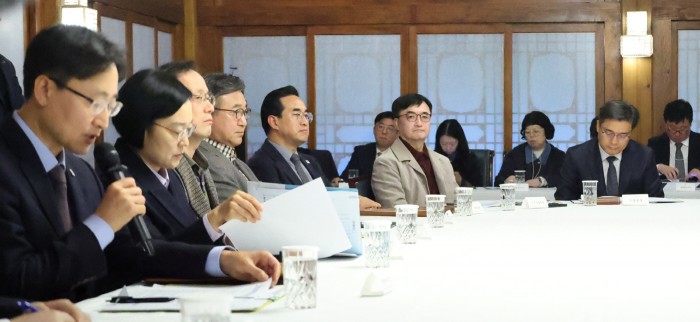 |
| Presidential Chief of Staff Lim Kwang-hyun speaks at a high-level meeting between the ruling party, the government and the presidential office at the prime minister's official residence in Samcheong-dong, Jongno District, Seoul, on Nov. 8, 2026. /Yonhap |
South Korea's central government is considering providing approximately 2 trillion won in financial support for essential investments in firefighting services.
Park Sung-joon, chief spokesperson for the ruling Democratic Party of Korea (DPK), said at a National Assembly briefing Sunday that measures to ease the financial burden of firefighting services on local governments had been discussed at a high-level meeting between the ruling party, the government and the presidential office at the prime minister's official residence in Samcheong-dong, Seoul.
Currently, central government funding accounts for only around 10% of firefighting budgets. Although firefighters became national civil servants in 2020, local governments continue to bear a substantial share of firefighting expenses.
The ruling party and the government also agreed to reflect the necessary funding for firefighting equipment, training facilities and expanded specialized medical services for firefighters in next year's budget deliberations.
"We will secure additional funding for firefighting services beyond the 2 trillion won, with further resources on top of that," Park said.
The two sides also discussed ways to increase the funds available to local governments next year by using excess tax revenue collected this year, taking into account the financial difficulties faced by local authorities.
"We agreed to finalize the specific amount of support through close consultations between the ruling party and the government during the National Assembly's budget review process," Park said.
He added, "The ruling party and the government agreed on the need for more fundamental measures to strengthen local government finances, including gradually transferring national tax revenues to local governments and redistributing administrative responsibilities."
"We also agreed to reactivate a government-wide task force on fiscal decentralization and move the discussions forward swiftly."
The ruling party and the government also discussed disaster response plans in preparation for severe cold and heavy snowfall this winter.
"The party cited traffic disruptions caused by heavy snowfall during the evening commute last winter, as well as casualties from heavy snow in central South Korea in November 2024, and called for thorough safety measures to prevent similar incidents," Park said.
He added that the government had reported plans to establish a 24-hour emergency monitoring and response system to prevent casualties while implementing tailored measures for different population groups, with particular emphasis on protecting the health of vulnerable people.
"The ruling party and the government agreed to work closely together to develop detailed plans based on today's discussions and ensure that follow-up measures are implemented without disruption," Park said.
Kim Dong-min
Most Read
-
1
Ukraine halts strikes on Russian oil refineries un..

-
2
China's fifth plenum to conclude amid expectations..

-
3
Southeast Asian auto parts makers hit hard by Chin..

-
4
U.S. links Myanmar peace efforts to rare earth acc..

-
5
Hegseth rejects calls for impeachment over Iran wa..

-
6
Democrats flip U.S. Congress in historic midterm s..

-
7
USFK commander cites interoperability gaps, urges..

PEOPLE






-
Address : In-Young Bldg., 34, Uisadang-daero 1-gil, Yeongdeungpo-gu, Seoul
Copyright by ASIATODAY CO., LTD. All rights resereved