



U.S. Democratic sweep wipes 4,800 trillion won off global equities in one day
Nov 09, 2026, 10:22 am


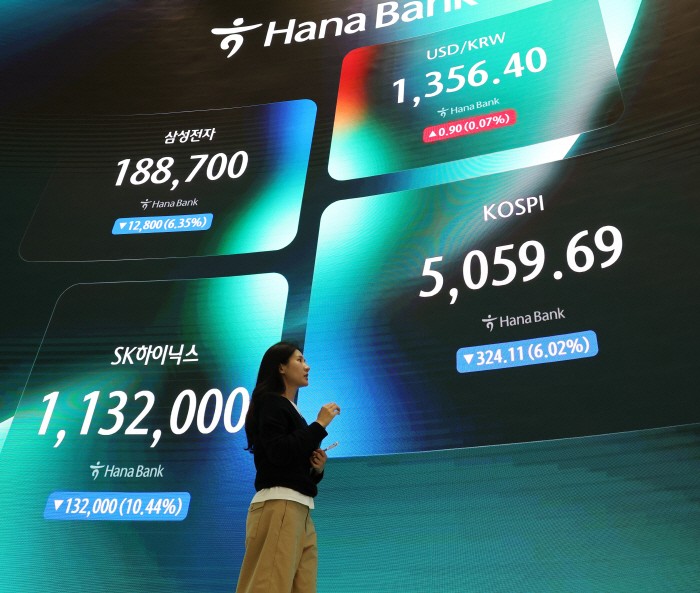 |
| The KOSPI closes just above the 5,000-point mark after plunging more than 6%. /Yonhap |
Global stock markets lost approximately 4,800 trillion won in market capitalization in a single day after the Democratic Party secured control of both chambers of Congress in the U.S. midterm elections.
The sell-off was driven by growing concerns that Democrats could tighten regulations on the artificial intelligence (AI) industry, triggering heavy selling in semiconductor and AI-related technology stocks that had previously led the market rally. The downturn began in the United States before spreading to major Asian markets, including South Korea, Japan and Taiwan.
According to an analysis published Saturday by Japan's Nikkei newspaper, based on data from financial information providers QUICK and FactSet, the total market capitalization of global equities stood at $154 trillion (approximately 210.25 quadrillion won) as of Nov. 5.
That represented a decline of $3.5 trillion (approximately 4,773 trillion won) from the previous day.
The sharp decline followed the Democrats' victory in the U.S. midterm elections, in which they secured control of both chambers of Congress as well as key state and local offices.
As expectations grew that Democrats would impose tighter regulations on AI data center construction and related industries, shares of companies in those sectors fell sharply.
All three major U.S. stock indexes plunged on Nov. 5.
The Dow Jones Industrial Average dropped 1,833.06 points, or 3.44%, to close at 51,523.06. The technology-heavy Nasdaq Composite fell 1,421.52 points, or 5.52%, to 24,315.00.
The S&P 500 also declined 334.89 points, or 4.36%, to finish at 7,353.73.
The combined market capitalization of Nasdaq-listed companies fell by approximately $2.5 trillion (about 3,400 trillion won) that day, marking the largest single-day decline on record.
However, U.S. stocks rebounded the following day, Nov. 6, as bargain hunters stepped in following the sharp sell-off.
The shock from Wall Street also rippled through Asian markets.
In Japan, approximately 77 trillion yen (about 663 trillion won) in market capitalization was wiped out from the Tokyo Stock Exchange's Prime Market on Nov. 6.
Taiwanese stocks also suffered steep losses.
On Nov. 6, Taiwan's benchmark TAIEX index plunged 3,736.67 points, or 8.99%, shortly after the opening bell, marking the largest intraday point decline in the market's history.
Shares of Taiwan Semiconductor Manufacturing Co. (TSMC), the world's largest contract chipmaker and Taiwan's most valuable listed company, fell as much as 9.82% in early trading.
The stock came close to its daily price decline limit, extending its losing streak to seven consecutive trading sessions.
South Korean stocks also faced heavy selling pressure, particularly among major semiconductor companies.
On Nov. 6, the KOSPI closed at 5,059.69, down 324.11 points, or 6.02%, from the previous session.
The KOSDAQ index also fell 34.14 points, or 5.03%, to 644.27.
With Samsung Electronics and SK hynix both posting sharp declines, the KOSPI's total market capitalization at one point fell by more than 3,000 trillion won from its previous peak.
Market analysts warned that stock prices may struggle to recover to their previous levels in the near term.
Takayuki Ishibashi, vice president at Goldman Sachs Securities, said, "Unlike during previous market downturns, it is difficult to expect catalysts that could drive a rapid rebound in stock prices."
Lee Seo-yeon
Most Read
-
1
Ukraine halts strikes on Russian oil refineries un..

-
2
China's fifth plenum to conclude amid expectations..

-
3
Southeast Asian auto parts makers hit hard by Chin..

-
4
Hegseth rejects calls for impeachment over Iran wa..

-
5
U.S. links Myanmar peace efforts to rare earth acc..

-
6
Democrats flip U.S. Congress in historic midterm s..

-
7
USFK commander cites interoperability gaps, urges..

PEOPLE







-
Address : In-Young Bldg., 34, Uisadang-daero 1-gil, Yeongdeungpo-gu, Seoul
Copyright by ASIATODAY CO., LTD. All rights resereved