



Netanyahu faces ouster as Israel president taps Eisenkot to form coalition
Nov 09, 2026, 09:55 am


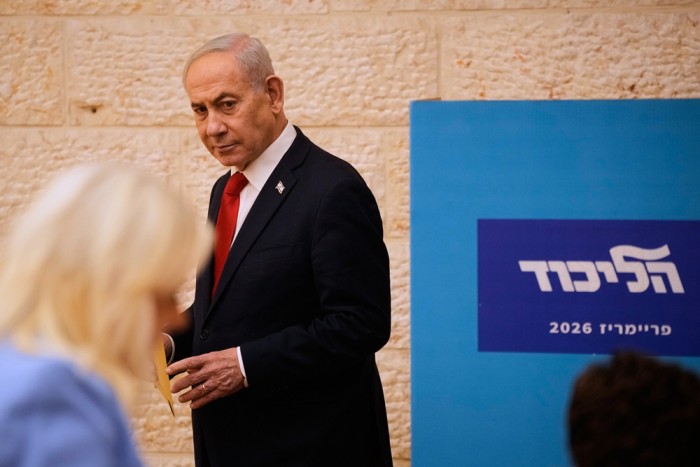 |
| Israeli Prime Minister Benjamin Netanyahu casts his ballot in the Likud party primary in Jerusalem on Aug. 17, 2026. /AP-Yonhap |
Israeli Prime Minister Benjamin Netanyahu is facing the prospect of losing power after opposition leader Gadi Eisenkot, a former chief of staff of the Israel Defense Forces, was chosen to form the country's next coalition government.
However, persistent disagreements among potential coalition partners and opposition to cooperation with Arab-led parties are expected to complicate efforts to establish a new government.
Israeli President Isaac Herzog announced Saturday that he would give Eisenkot, leader of the Yashar party, the mandate to form the next governing coalition, The Times of Israel (TOI) reported.
In the Oct. 27 general election, Netanyahu's governing bloc won 53 seats, while Eisenkot's opposition bloc secured 48. Neither side reached the 61 seats needed for a majority in the 120-member Knesset.
However, support for Eisenkot from the two Arab-led parties, Ra'am and the Joint List, which together hold 19 seats, shifted the initiative in coalition formation to the opposition.
Eisenkot was scheduled to formally receive the mandate at a ceremony at the President's Residence at 5 p.m. Sunday, after which he would have 28 days to form a government.
Herzog may extend the negotiating period by up to 14 days if necessary, giving Eisenkot until Dec. 20 at the latest. If he fails to form a coalition within that period, the president may assign the mandate to another member of the Knesset.
Herzog explained that he had consulted all parties represented in the Knesset on Nov. 4 and 5 before holding further discussions with key political figures, including Netanyahu and Eisenkot.
He informed both leaders of his decision Saturday evening.
The key question is whether Eisenkot can actually assemble a coalition capable of securing a parliamentary majority.
Hardliners within the opposition have publicly opposed forming a government that depends on support from Arab-led parties such as Ra'am and the Joint List.
In a social media post, Eisenkot said, "Now is the time to form a national emergency government. I will do everything to ensure we are worthy."
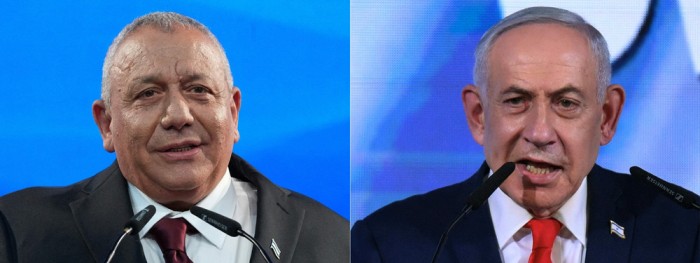 |
| Yashar party leader Gadi Eisenkot (left) and Israeli Prime Minister Benjamin Netanyahu. /AFP-Yonhap |
Another uncertainty is whether members of the outgoing governing bloc, including Likud, will join an Eisenkot-led coalition.
On Saturday, Yashar said Likud and its allies could potentially participate in a coalition headed by Eisenkot. However, the party made clear that the invitation was not directed at Netanyahu himself.
Eisenkot has repeatedly stated that he would not cooperate with Netanyahu in any coalition government.
He has also argued that all officials who held senior positions of power during the Hamas-led attack on Israel on Oct. 7, 2023, which triggered the war in the Gaza Strip, should step down from public office.
Netanyahu, meanwhile, sought to counter the opposition's efforts to form a new government.
In a video statement Saturday, he urged Eisenkot's camp to form what he called a "national unity government," but insisted that his allies from the outgoing coalition be included in any new administration.
Netanyahu also labeled the Arab-led parties "terror supporters," claiming that a government involving them would destroy Israel.
"Someone wants to hastily establish a government with terror supporters as early as next week," Netanyahu said, referring to Eisenkot and the Arab-led parties.
"They want to form a government with those who seek to eliminate the State of Israel," he added.
Netanyahu further claimed that "a government dependent on Hamas supporters will not fight Hamas," arguing that such an administration would fail to protect Israeli soldiers operating in the Gaza Strip and Lebanon.
Kim Hyun-min
Most Read
-
1
Ukraine halts strikes on Russian oil refineries un..

-
2
China's fifth plenum to conclude amid expectations..

-
3
Southeast Asian auto parts makers hit hard by Chin..

-
4
Hegseth rejects calls for impeachment over Iran wa..

-
5
U.S. links Myanmar peace efforts to rare earth acc..

-
6
Democrats flip U.S. Congress in historic midterm s..

-
7
USFK commander cites interoperability gaps, urges..

PEOPLE







-
Address : In-Young Bldg., 34, Uisadang-daero 1-gil, Yeongdeungpo-gu, Seoul
Copyright by ASIATODAY CO., LTD. All rights resereved