



KOSPI skids 6% after circuit breaker, clinging to 5,000 level
Nov 06, 2026, 04:58 pm


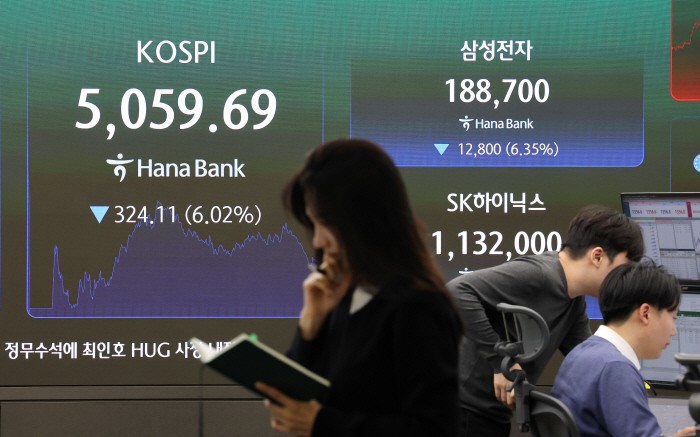 |
| Screens at Hana Bank's main dealing room in Jung District, Seoul, display the KOSPI index and share prices of Samsung Electronics and SK Hynix on Nov. 6, 2026, as the benchmark index closed down more than 6%, narrowly holding above the 5,000-point mark. /Yonhap |
South Korea's benchmark KOSPI plunged more than 8% during trading Friday, briefly falling below the 5,000-point mark before recovering some of its losses to close above 5,050. Foreign investors sold more than 2.7 trillion won worth of shares on a net basis amid a sharp sell-off in U.S. technology stocks, with semiconductor heavyweights Samsung Electronics and SK Hynix bearing the brunt of the selling pressure. Despite extreme volatility that triggered a circuit breaker shortly after the opening bell, buying by institutional and retail investors helped the index hold above 5,000 at the close.
According to the Korea Exchange (KRX), the KOSPI closed at 5,059.69, down 324.11 points, or 6.02%, from the previous session. The index posted steep losses for a second consecutive day after tumbling 5.28% Thursday.
The KOSPI opened at 5,263.26, down 120.54 points, or 2.24%, from the previous close, but intensified selling pressure sent it tumbling to an intraday low of 4,911.28.
As the index plunged more than 8%, a first-stage circuit breaker was triggered on the main stock market at around 9:03 a.m., suspending trading for 20 minutes. The index trimmed its losses after trading resumed but still ended the session more than 6% lower.
Foreign investors led the selling on the main market, recording net sales of 2.7686 trillion won. Institutional investors and retail investors, meanwhile, absorbed some of the selling pressure with net purchases of 1.6998 trillion won and 604.5 billion won, respectively.
Major large-cap stocks also declined across the board.
Samsung Electronics closed at 188,700 won, down 6.35% from the previous session. The stock fell as low as 179,200 won during trading, well below the 200,000-won mark.
SK Hynix also plunged 10.44% to close at 1,132,000 won. Other major decliners included Samsung Electronics preferred shares (-6.30%), SK Square (-10.51%) and LG Energy Solution (-5.20%).
The KOSDAQ index also fell 34.14 points, or 5.03%, to close at 644.27. It dropped as low as 629.17 during trading, triggering a sell-side sidecar mechanism.
On the KOSDAQ market, retail and foreign investors recorded net sales of 110.3 billion won and 99.9 billion won, respectively, while institutional investors were net buyers of 205.4 billion won.
Leading KOSDAQ stocks continued to lose ground. Alteogen closed at 200,500 won, down 5.20%, while EcoPro (-6.89%), EcoPro BM (-7.36%), Rainbow Robotics (-4.04%) and Jusung Engineering (-7.91%) also declined.
The sharp declines in major semiconductor stocks also dealt a heavy blow to related leveraged exchange-traded funds (ETFs).
The TIGER SK Hynix Single-Stock Leverage ETF plunged 20.96%, while the 1Q SK Hynix Futures Single-Stock Leverage ETF (-20.45%), ACE SK Hynix Single-Stock Leverage ETF (-20.23%) and KODEX SK Hynix Single-Stock Leverage ETF (-20.16%) all suffered losses of more than 20%.
Friday's sharp decline in South Korean stocks was largely attributed to a technology-led sell-off on Wall Street overnight.
On Nov. 5, the U.S. Nasdaq Composite plunged 5.52%, while the Philadelphia Semiconductor Index tumbled 12.25%. Analysts attributed the concentrated selling pressure on South Korean semiconductor stocks to concerns over potential regulations on artificial intelligence (AI) data centers following the U.S. midterm elections, coupled with deteriorating investor sentiment.
The government also announced measures to stabilize the market.
Deputy Prime Minister and Minister of Finance and Economy Lee Hyoung-il chaired a joint emergency market monitoring meeting with relevant agencies Friday, where officials decided to temporarily waive the requirement for securities firms to maintain a minimum collateral ratio of 140% on margin loans for three months.
The measure, which takes effect Nov. 9, is intended to prevent excessive forced selling of shares following sharp market declines from further amplifying market volatility.
Park Ju-yeon
Most Read
-
1
Ukraine halts strikes on Russian oil refineries un..

-
2
China's fifth plenum to conclude amid expectations..

-
3
ASEAN to discuss Myanmar's return next month

-
4
Southeast Asian auto parts makers hit hard by Chin..

-
5
Hegseth rejects calls for impeachment over Iran wa..

-
6
U.S. links Myanmar peace efforts to rare earth acc..

-
7
Democrats flip U.S. Congress in historic midterm s..

PEOPLE







-
Address : In-Young Bldg., 34, Uisadang-daero 1-gil, Yeongdeungpo-gu, Seoul
Copyright by ASIATODAY CO., LTD. All rights resereved