



Kakao releases open-source decision-making AI model
Nov 06, 2026, 10:44 am


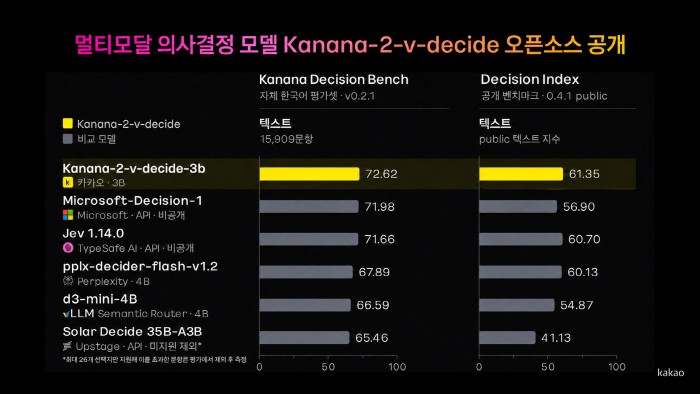 |
| Performance comparison of the Kanana-2-v-decide model. /Courtesy of Kakao |
Kakao has unveiled a multimodal decision-making model designed to help artificial intelligence (AI) agents quickly determine their next actions rather than generate natural-language responses. The model analyzes text and images together and produces results in the form of probabilities, choices and scores, allowing it to handle repetitive decision-making tasks such as classifying customer inquiries and selecting tools.
According to Kakao on Friday, the company has released its internally developed model, "Kanana-2-v-decide," as open source on the global AI platform Hugging Face. The model is available under the Kanana Open License, which permits both research and commercial use.
Unlike conventional large language models (LLMs), which respond to questions in natural-language sentences, the model provides structured decision-making outputs that can be used directly by applications. By reducing the need to extract conclusions from lengthy responses, it enables AI agents to move more quickly to their next tasks.
AI agents must make a series of decisions after understanding a user's request, including which tools to invoke, what information to use and which procedures to carry out next. Kakao explained that assigning these repetitive decisions to a dedicated decision-making model could improve processing speed and efficiency.
Kanana-2-v-decide was developed based on Kakao's multimodal language model, "Kanana-2-v-3b." It can process text and images simultaneously, making it suitable for applications such as classifying customer inquiries, identifying product images and selecting tools for AI agents.
The model provides outputs in three formats: probabilities, choices and scores. It can calculate the likelihood that a particular condition is met, select the most appropriate option from multiple candidates and generate scores that reflect the probabilities associated with different evaluation levels.
For example, when a customer submits a photograph of a damaged product along with an exchange request, the model can analyze both the image and the accompanying text to determine whether the product is damaged and classify the type of inquiry. Service providers can then connect these results to their internal processing rules to automate subsequent actions, such as transferring the customer to a support representative or providing instructions on the exchange procedure.
Kakao also highlighted the model's processing speed. According to the company, Kanana-2-v-decide recorded an average response time of less than 0.04 seconds using a single H200 graphics processing unit (GPU), making it approximately 43 times faster than GPT-6 Luna in Kakao's own comparison.
The company also said the model achieved the highest performance among those evaluated on both its proprietary dataset, "Kanana Decision Bench," and the publicly available "Decision Index" benchmark. The models compared included Microsoft's "Decision-1," TypeSafe AI's "Jev," Perplexity's "pplx-decider-v1.1-27B" and Upstage's "Solar Decide," among others.
Kakao plans to initially deploy the model in internal projects, including web search and automated product category classification, to further improve its performance in real-world applications. The company also intends to advance the technology by eventually integrating search and decision-making capabilities into a single model.
"The release is meaningful because it broadens the foundation for applying the latest AI technologies to real-world services," said Choi Dong-jin, performance lead for Applied AI Models at Kakao. "We will continue advancing and openly sharing our technology to deliver AI experiences that users can appreciate in their everyday lives."
Son Kang-hoon
Most Read
-
1
Ukraine halts strikes on Russian oil refineries un..

-
2
China's fifth plenum to conclude amid expectations..

-
3
Southeast Asian auto parts makers hit hard by Chin..

-
4
U.S. links Myanmar peace efforts to rare earth acc..

-
5
Hegseth rejects calls for impeachment over Iran wa..

-
6
Democrats flip U.S. Congress in historic midterm s..

-
7
USFK commander cites interoperability gaps, urges..

PEOPLE






-
Address : In-Young Bldg., 34, Uisadang-daero 1-gil, Yeongdeungpo-gu, Seoul
Copyright by ASIATODAY CO., LTD. All rights resereved