



Kazakhstan intercepts smuggling of 11 endangered falcons
Nov 06, 2026, 10:05 am


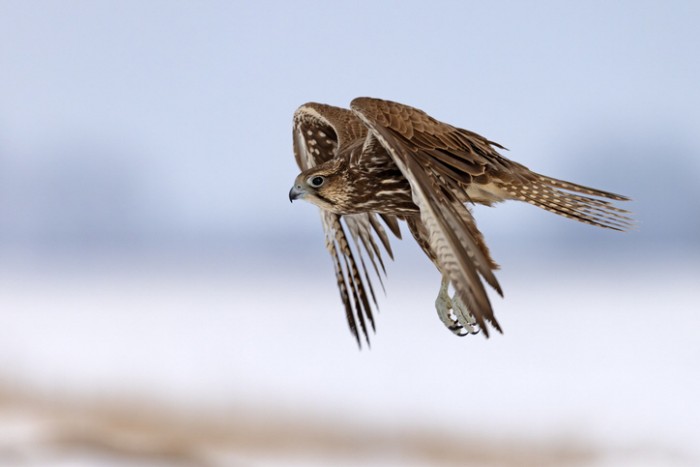 |
| A saker falcon. /Getty Images Bank |
A man has been caught attempting to smuggle 11 saker falcons, a rare bird species classified as endangered in Kazakhstan, out of the country. Growing demand for rare birds of prey native to the Central Asian steppes in the Middle East's traditional falconry market has made saker falcons targets of illegal capture and trafficking.
The Border Service of Kazakhstan's National Security Committee (KNB) said Wednesday that it was continuing systematic efforts to prevent the illegal export of rare and protected animal species. As part of these efforts, border guards apprehended a Kazakh national attempting to smuggle 11 saker falcons out of the country at the Tselinny border checkpoint in the southern Turkistan Region on Oct. 31.
Authorities estimated that the 11 confiscated falcons could be worth more than 100 million tenge (approximately 300 million won) on the black market.
The saker falcon is a large bird of prey found across a region stretching from Eastern Europe through Central Asia to Mongolia. Measuring approximately 45 to 55 centimeters in length, it primarily hunts rodents and small birds. Its high-speed flying ability has made it a prized bird in traditional falconry.
Falconry has a long cultural history in Gulf countries such as Saudi Arabia, the United Arab Emirates (UAE) and Qatar. Saker falcons and peregrine falcons are reportedly traded for as much as 1 million Qatari riyals (approximately 370 million won) per bird.
International wildlife conservation organizations and researchers have identified demand for falconry in Persian Gulf countries as a major driver of the illegal capture of wild saker falcons.
Local experts studying saker falcon conservation in Kazakhstan have also cited illegal trapping and smuggling to the Middle East as major factors behind the species' population decline.
A report on wildlife trade in Central Asia by TRAFFIC, an international wildlife trade monitoring organization, also documents illegal trading of saker falcons. The report includes a case involving the smuggling of live falcons from Tajikistan to the UAE.
The saker falcon is classified as Endangered on the International Union for Conservation of Nature (IUCN) Red List. It is also included in Kazakhstan's national Red Book of threatened species and listed in the appendices of the Convention on International Trade in Endangered Species of Wild Fauna and Flora (CITES) and the Convention on the Conservation of Migratory Species of Wild Animals (CMS).
Kazakhstan's saker falcon population is believed to have declined over an extended period. According to an analysis by local conservation organization Eurasian Wildlife and Peoples, the country's breeding population fell by approximately 73% to 79% between 1990 and 2012.
Kazakh authorities are pursuing efforts to restore the saker falcon population. In April this year, the Saudi Falcons Club worked with Kazakh institutions to release 34 saker falcons into Altyn-Emel National Park. The two sides plan to release an additional 35 to 45 birds annually over the next three years.
Kim Min-gyu
Most Read
-
1
Ukraine halts strikes on Russian oil refineries un..

-
2
China's fifth plenum to conclude amid expectations..

-
3
ASEAN to discuss Myanmar's return next month

-
4
Southeast Asian auto parts makers hit hard by Chin..

-
5
Hegseth rejects calls for impeachment over Iran wa..

-
6
U.S. links Myanmar peace efforts to rare earth acc..

-
7
Democrats flip U.S. Congress in historic midterm s..

PEOPLE







-
Address : In-Young Bldg., 34, Uisadang-daero 1-gil, Yeongdeungpo-gu, Seoul
Copyright by ASIATODAY CO., LTD. All rights resereved