



Japanese companies hope for tariff easing following U.S. midterm results
Nov 05, 2026, 01:22 pm


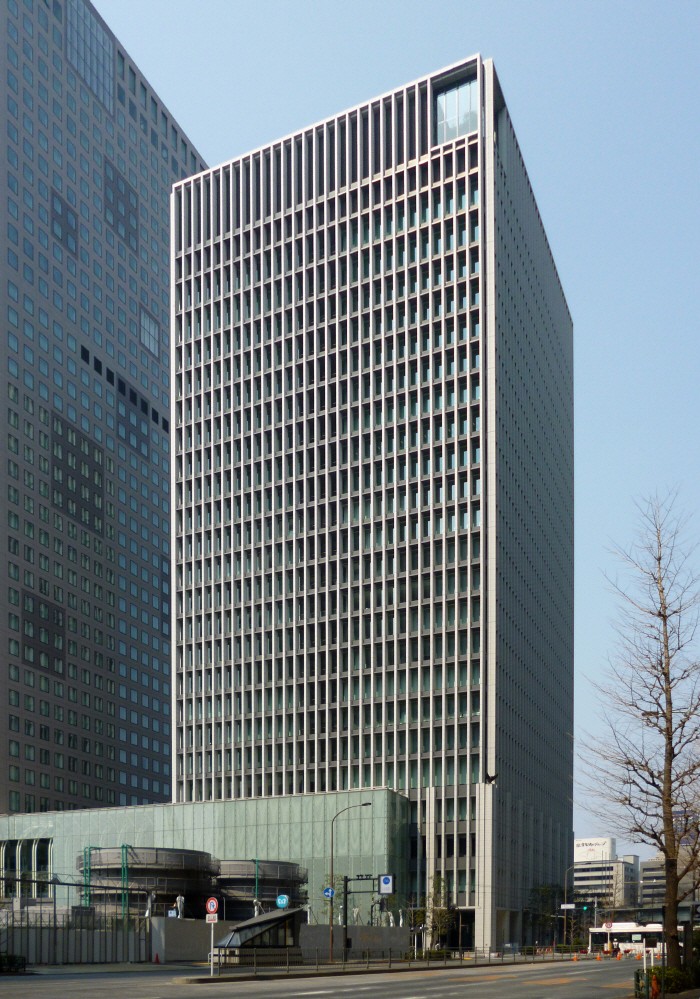 |
| The headquarters of the Japan Business Federation (Keidanren) in Chiyoda Ward, Tokyo, Japan. /RESPITE, Wikimedia Commons |
Japanese businesses are closely watching the future of U.S. President Donald Trump's high-tariff policies following a crushing defeat for his Republican Party in the U.S. midterm elections. The automobile industry hopes for relief from tariffs that have eroded profits. However, Japan's financial sector is concerned that Trump could intensify pressure on Japan to fulfill its investment commitments to the United States as he seeks to secure political achievements.
The Yomiuri Shimbun reported Thursday that Japanese companies were expressing both hopes for changes to U.S. trade policy and concerns about policy uncertainty after Democrats appeared certain to regain majorities in both chambers of Congress. Reactions among Japanese companies have varied depending on the industries in which they operate in the U.S. market.
Yoshinobu Tsutsui, chairman of Keidanren, one of Japan's leading business organizations, said in a statement Wednesday that it would be desirable to place some restraints on Trump's tariffs and that he would closely monitor developments in the United States, including Congress. However, he also warned that Trump's influence over foreign policy could become more pronounced during his remaining two years in office, adding that Japan should strengthen its alliance and economic relations with the United States.
The Japan Chamber of Commerce and Industry (JCCI) also said Wednesday that a major shift away from protectionism was unlikely, but called for a review of unilateral tariffs and excessive trade restrictions. Such measures place burdens not only on American businesses and consumers but also on Japanese small and medium-sized enterprises, it said. The chamber also expressed concern that confrontation between the administration and Congress could lead to policy gridlock or greater uncertainty.
The automobile industry is among the sectors most directly hoping for tariff relief. Japanese automakers have faced mounting pressure from declining profits caused by high tariffs, compounded by the elimination of U.S. electric vehicle (EV) purchase subsidies. Absorbing tariff costs reduces automakers' profits, while passing those costs on to consumers could weaken the price competitiveness of Japanese vehicles in the U.S. market.
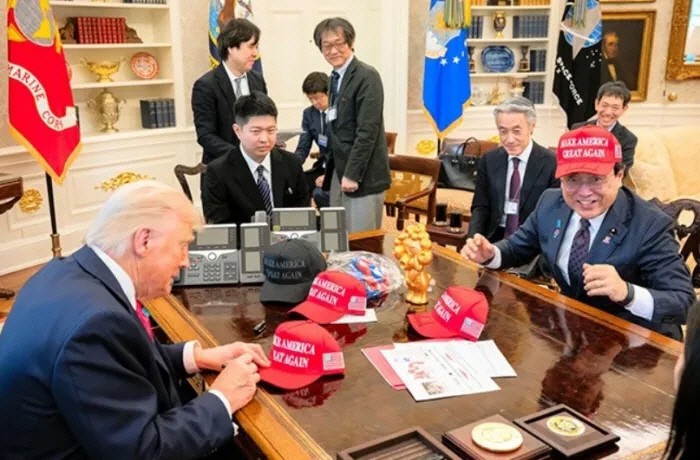 |
| Ryosei Akazawa, Japan's economic revitalization minister and chief negotiator in U.S.-Japan tariff talks, smiles while wearing a Make America Great Again (MAGA) cap during a meeting with U.S. President Donald Trump at the White House in Washington, D.C., on April 16, 2025. /Courtesy of the White House |
The Yomiuri Shimbun quoted an official at a major Japanese automaker as saying that although the president's extensive powers meant there was no room for complacency, the company hoped policies unfavorable to Japanese manufacturers might be revised. However, a Democratic victory does not automatically mean tariffs will be lowered or EV support policies restored.
Even if Democrats pass legislation to eliminate tariffs, Trump could veto it. Overriding a presidential veto requires the support of at least two-thirds of members voting in each chamber of Congress. In other words, a change in congressional control does not automatically change the Trump administration's trade policies.
AI, trading houses and financial firms remain cautious
Regulatory changes are a major concern for the artificial intelligence (AI) and data center industries. Opposition to data center construction emerged as an issue in the U.S. midterm elections, raising expectations that Democratic victories could slow business expansion in the sector. There are concerns that weaker investment in the United States could affect not only equipment and component suppliers but also data center operators and related service providers.
However, companies' assessments of the risks differed from the broader market's caution. Kazuhiko Nakayama, president and CEO of NTT DATA Group, which generates approximately 13% of its revenue in North America, said changes to AI-related regulations could affect the pace of development but were unlikely to have a major impact on the company's business.
Mitsubishi Corporation, a major Japanese general trading company, is closely monitoring U.S. foreign policy and commodity markets. At an earnings press conference Wednesday, President and CEO Katsuya Nakanishi said developments in foreign affairs and geopolitics required careful attention, warning that prolonged tensions in the Middle East and rising commodity prices could fuel inflation.
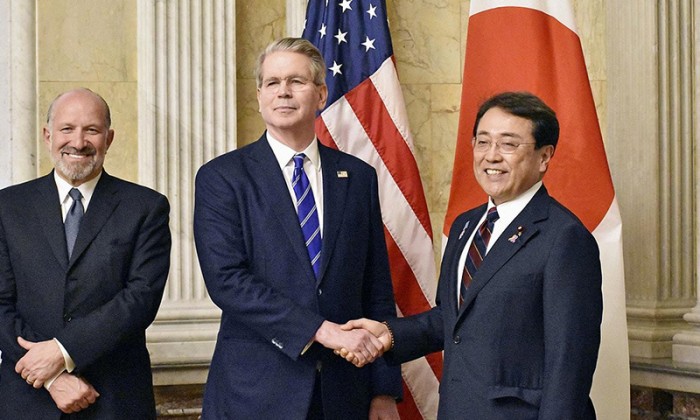 |
| U.S. Treasury Secretary Scott Bessent (center) shakes hands with Japan's Economic Revitalization Minister Ryosei Akazawa (right) during their second round of tariff negotiations in Washington, D.C., on May 1, 2025. At left is U.S. Commerce Secretary Howard Lutnick. /Yonhap News Agency |
Japan's financial sector is closely watching the implementation of an investment package worth up to $550 billion (approximately 737 trillion won) that the U.S. and Japanese governments have agreed upon. The amount does not represent a lump-sum cash payment by Japan. According to the Japanese government, it represents the maximum amount of support available through a combination of equity investments and loans from the Japan Bank for International Cooperation (JBIC) and loan guarantees from Nippon Export and Investment Insurance (NEXI), among other financing arrangements.
However, once individual projects move forward, participating financial institutions must secure the necessary funding. The Yomiuri Shimbun reported that Japan's three megabanks were struggling with the burden of raising large amounts of U.S. dollars. The financial sector is concerned that even after the midterm election defeat, Trump could continue pursuing existing policies through executive orders or press Japan to accelerate its investment commitments in an effort to demonstrate tangible achievements.
Takahide Kiuchi, an economist at Nomura Research Institute (NRI), also warned Wednesday that the United States could pressure Japan to accept investment projects favorable to American interests. The assessment suggests that even if Congress strengthens its scrutiny of tariff policies, Trump may continue demanding investments that he can present as political achievements.
What Japanese businesses want is a predictable policy environment. The Japan Chamber of Commerce and Industry urged the U.S. administration and Congress to maintain stable policymaking through constructive discussions, warning that political divisions within the United States must not spread into divisions across the global economy.
Choi Young-jae
Most Read
-
1
U.S., Israel plan to resume strikes on Iran after..

-
2
Ukraine halts strikes on Russian oil refineries un..

-
3
China's fifth plenum to conclude amid expectations..

-
4
ASEAN to discuss Myanmar's return next month

-
5
AI-discovered PHP flaw triggers global cybersecuri..

-
6
Southeast Asian auto parts makers hit hard by Chin..

-
7
U.S.-China-Russia summit increasingly likely to be..

PEOPLE







-
Address : In-Young Bldg., 34, Uisadang-daero 1-gil, Yeongdeungpo-gu, Seoul
Copyright by ASIATODAY CO., LTD. All rights resereved