



S. Korea to expand Cheonghae Unit's mission area near Strait of Hormuz
Nov 05, 2026, 01:10 pm


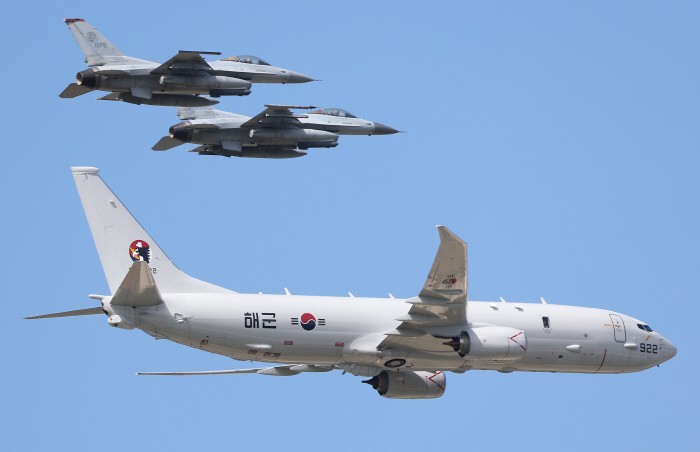 |
| The Ministry of National Defense announced Thursday that it plans to submit a revised motion to the National Assembly to extend the deployment of the Cheonghae Unit, expanding its operational area to the open waters south of Oman and deploying additional military assets, including a Navy P-8A Poseidon maritime patrol aircraft. The revised deployment plan is expected to be submitted to the National Assembly for approval following a Cabinet meeting and presidential authorization next week. The Cheonghae Unit is an overseas-deployed South Korean military unit that has conducted anti-piracy operations in the Gulf of Aden since 2009, escorting vessels and ensuring their safe passage. The photo shows a Navy P-8A maritime patrol aircraft flying under fighter jet escort during a rehearsal for the media day marking the 76th Armed Forces Day in 2024. /Yonhap News Agency |
The South Korean government has decided to nearly double the operational area of the Cheonghae anti-piracy unit, currently deployed in the Gulf of Aden off Somalia, extending it to waters approximately 650 kilometers (350 nautical miles) from the southern end of the Strait of Hormuz. The number of deployed personnel will also increase by nearly 20%, with additional assets including a maritime patrol aircraft, an explosive ordnance disposal (EOD) team and unmanned mine-clearing equipment.
According to the Ministry of National Defense on Thursday, the government has finalized a revised motion to extend the Cheonghae Unit's deployment and expand its operational area, with plans to submit it to the National Assembly by the end of this year. The deployment period would run from the date the revised motion is approved through Dec. 31, 2027. Since its first deployment in March 2009, the Cheonghae Unit has extended its deployment annually with parliamentary approval.
Under the revised plan, the unit's operational area will nearly double. Its existing area of operations, centered on the Gulf of Aden, will be extended to waters south of Oman, approximately 650 kilometers from the southern end of the Strait of Hormuz.
The wording of the motion defining the unit's mission will also be expanded to include "safeguarding freedom of navigation along international shipping routes," in addition to its existing mission of "protecting South Korean nationals and vessels." The ministry said it decided to expand the operational area to protect South Korean nationals and merchant vessels, as piracy off Somalia has more than tripled amid recent developments in the Middle East.
The revised plan raises the personnel ceiling by 75 to 395. In addition to the destroyer already operated by the Cheonghae Unit, the government will deploy one P-8A Poseidon maritime patrol aircraft, an EOD team and unmanned mine countermeasure equipment, including unmanned surface vehicles (USVs), unmanned underwater vehicles (UUVs) and remotely operated vehicles (ROVs). The chairman of South Korea's Joint Chiefs of Staff (JCS) will retain command authority over the unit.
The newly deployed maritime patrol aircraft and unmanned mine countermeasure assets are expected to operate from Djibouti in East Africa. Djibouti hosts Camp Lemonnier, a U.S. military base, while the United States, Japan, Spain and France have also deployed maritime patrol aircraft there.
The Defense Ministry emphasized that the expanded operational area would primarily support "non-combat missions." A ministry official outlined four principles: South Korea would neither take part in nor intervene in the war; the deployment would be intended to protect South Korean nationals and vessels; the maritime patrol aircraft would be restricted from conducting surveillance of Iranian territory, territorial waters or the inner reaches of the Strait of Hormuz; and the unit would operate under South Korea's independent military command structure.
The military has reportedly assessed that there are no naval mines in the proposed operational area. Nevertheless, the deployment of EOD personnel and unmanned mine-clearing equipment is also understood to be intended to help the military gain experience in preparation for possible participation in international mine-clearance operations in the Strait of Hormuz, should a so-called "permissive environment" emerge and the international community request assistance.
A "permissive environment" refers to conditions in which hostilities have ended or an agreement, such as a memorandum of understanding (MOU) between the United States and Iran, has been reached to ensure security in the region.
"We do not know how the situation in the Middle East will develop or when and under what circumstances our forces might be deployed," a ministry official said. "If a permissive environment is established and the international community requests assistance, we would have to deploy our forces in accordance with our commitments. Given our limited accumulated knowledge and experience with the new equipment, we assessed that deployment is also necessary for preparation."
In fact, a separate round of National Assembly approval would be required before the EOD team and unmanned mine countermeasure assets could participate in operations to ensure freedom of navigation in the Strait of Hormuz.
"The purpose of this revised motion is not to prepare specifically for deployment to the Strait of Hormuz," a Defense Ministry official said. "It is intended to ensure preparedness without ruling out unforeseen circumstances. However, that is not its primary objective."
Asked how South Korean forces would respond if attacked, given their closer proximity to the entrance of the Strait of Hormuz, the official said, "Our forces will remain more than 650 kilometers from the Strait of Hormuz in a straight line, and the patrol aircraft will not be permitted to fly beyond the Port of Duqm. The area is beyond Iran's physical detection range, and we plan to communicate with Iran and other major countries to prevent unnecessary misunderstandings."
"Although it would be inappropriate to speculate about such a scenario, our forces would respond in self-defense in accordance with the rules of engagement if attacked," the official added.
Lee Han-sol
Most Read
-
1
U.S., Israel plan to resume strikes on Iran after..

-
2
Ukraine halts strikes on Russian oil refineries un..

-
3
China's fifth plenum to conclude amid expectations..

-
4
ASEAN to discuss Myanmar's return next month

-
5
AI-discovered PHP flaw triggers global cybersecuri..

-
6
Southeast Asian auto parts makers hit hard by Chin..

-
7
U.S.-China-Russia summit increasingly likely to be..

PEOPLE







-
Address : In-Young Bldg., 34, Uisadang-daero 1-gil, Yeongdeungpo-gu, Seoul
Copyright by ASIATODAY CO., LTD. All rights resereved