



Hanwha expands beyond arms exports to build European rocket production hub in Poland
Nov 05, 2026, 10:52 am


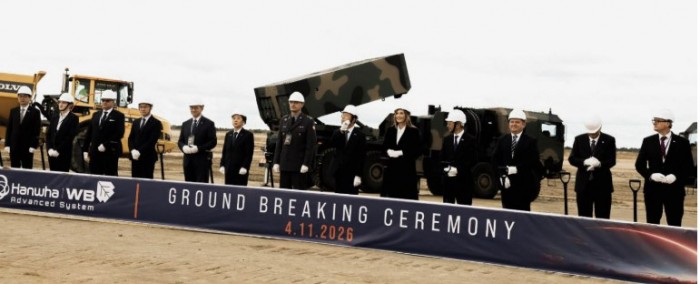 |
| Polish Deputy Defense Minister Magdalena Sobkowiak-Czarnecka attends the groundbreaking ceremony for a manufacturing plant of Hanwha WB Advanced System, a joint venture between Hanwha Aerospace and Poland's WB Group, in Gorzów Wielkopolski, a major city in Lubusz Voivodeship near the German border in western Poland, on Nov. 4, 2026. The plant will produce guided rockets and other munitions for the HOMAR-K, Poland's version of South Korea's K239 Chunmoo multiple launch rocket system. /Courtesy of Poland's Ministry of National Defence |
South Korea's defense industry has begun making a major push to establish ammunition production facilities on NATO's eastern flank, moving beyond the export of finished weapons systems. Hanwha Aerospace is building a factory in Poland, which borders Russia, to produce guided rockets for South Korea's Chunmoo multiple launch rocket system. As the war in Ukraine has highlighted the importance of ammunition stockpiles and reliable supply capabilities in determining the outcome of conflicts, South Korea's defense export strategy is expanding from weapons sales to local production and long-term logistical support.
Hanwha WB Advanced System (HWBAS), a joint venture between Hanwha Aerospace and Polish defense company WB Group, held a groundbreaking ceremony for a guided rocket production plant in Gorzów Wielkopolski, western Poland, on Wednesday. According to Poland's Ministry of National Defence, Deputy Defense Minister Magdalena Sobkowiak-Czarnecka attended the event.
The new plant will produce CGR-080 precision-guided rockets for the HOMAR-K, Poland's version of the Chunmoo multiple launch rocket system. According to Hanwha's plans, initial production will begin by the end of 2029, followed by full-scale mass production in 2030.
The CGR-080 is a 239-millimeter precision-guided rocket with a range of approximately 80 kilometers. It uses a guidance system combining the Global Positioning System (GPS) and an inertial navigation system (INS), and Hanwha Aerospace has disclosed a circular error probable (CEP) of 15 meters. The HOMAR-K is a modified version of South Korea's K239 Chunmoo multiple launch rocket system, adapted to meet the operational requirements of the Polish military.
The factory project is linked to a contract signed on Dec. 29 last year for the supply of CGR-080 guided rockets, worth approximately 14 billion Polish zlotys ($4 billion). A consortium comprising Hanwha Aerospace and HWBAS signed the contract with Poland's Armament Agency and is pursuing local production of the guided rockets, with deliveries scheduled to begin in 2030. However, the total contract value does not represent the investment cost of building the factory.
The strategic significance of the project lies in Poland's transition from a buyer of South Korean weapons to a defense partner sharing guided rocket production capabilities and supply chains.
In an official statement on Wednesday, Poland's Ministry of National Defence emphasized that the key to modern warfare is not simply possessing advanced weapons but also having the ability to manufacture and maintain them while continuously replenishing ammunition stocks. This reflects lessons from the war in Ukraine, which has demonstrated the importance of artillery firepower, precision-strike capabilities and reliable ammunition supplies.
In particular, Poland has focused on preparing for large-scale ground warfare and securing the ability to sustain prolonged military operations since Russia's invasion of Ukraine. The production facility is significant because it will establish a domestic industrial base capable of manufacturing essential guided rockets in an emergency, rather than relying solely on overseas supply chains.
Hanwha Aerospace is also pursuing technology transfer, the sharing of production expertise, the training of local specialists and the development of component supply chains. Poland's Ministry of National Defence has also raised the possibility of jointly developing next-generation ammunition and exporting products to allied countries, alongside building domestic production capabilities. The plant is expected to create more than 200 local jobs.
The project is also expected to open up new opportunities for South Korea's defense industry. Hanwha Aerospace has established a foothold in the European market by supplying K9 self-propelled howitzers and Chunmoo rocket systems to Poland. Local production of guided rockets will now allow the company to expand its business into ammunition supply, maintenance and repair services, and further technological cooperation.
However, guided rockets manufactured at the Polish facility will not automatically be supplied to all NATO members. Exports to third countries will require separate contracts and export control procedures. Expansion into the European market will therefore depend on production capacity, additional demand and approvals from the countries concerned.
The project illustrates how the criteria for assessing the competitiveness of South Korea's defense industry are expanding beyond weapons performance, price and delivery schedules to include wartime ammunition supply capabilities and local industrial cooperation. As security concerns persist across Europe, the ability of South Korean defense companies to establish reliable logistical support systems through local production and technological cooperation is likely to become a key factor in determining their future export competitiveness.
Koo Pil-hyun
Most Read
-
1
U.S., Israel plan to resume strikes on Iran after..

-
2
Ukraine halts strikes on Russian oil refineries un..

-
3
China's fifth plenum to conclude amid expectations..

-
4
ASEAN to discuss Myanmar's return next month

-
5
AI-discovered PHP flaw triggers global cybersecuri..

-
6
Southeast Asian auto parts makers hit hard by Chin..

-
7
Trump envoy says U.S. no longer guarantees Middle..

PEOPLE







-
Address : In-Young Bldg., 34, Uisadang-daero 1-gil, Yeongdeungpo-gu, Seoul
Copyright by ASIATODAY CO., LTD. All rights resereved