



Korea Eximbank to fund $170M AI institute in Tanzania via development loan
Nov 05, 2026, 10:47 am


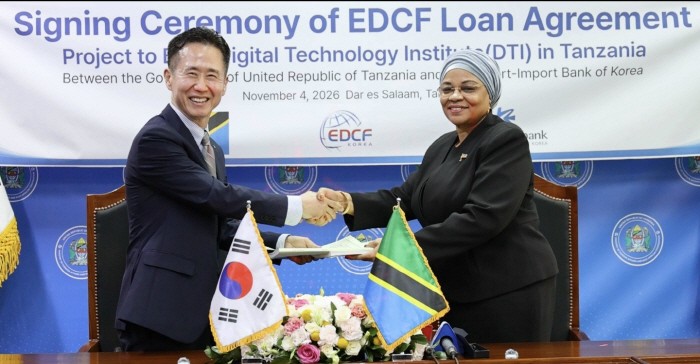 |
| Lee Dong-hoon (left), senior executive vice president of the Export-Import Bank of Korea (Korea Eximbank), shakes hands with Natu Mwamba, Tanzania's deputy minister of finance, after signing an Economic Development Cooperation Fund (EDCF) loan agreement in Dar es Salaam, Tanzania, on Nov. 4, 2026. /Courtesy of Korea Eximbank |
The Export-Import Bank of Korea (Korea Eximbank) announced Thursday that it had signed a $170 million loan agreement under the Economic Development Cooperation Fund (EDCF) to finance the construction of an artificial intelligence (AI) and digital technology training institute in Tanzania.
The EDCF is a government-established fund that provides long-term, low-interest loans to developing countries to support their economic development and promote economic cooperation with South Korea. Korea Eximbank operates and manages the fund on behalf of the Ministry of Finance and Economy.
Lee Dong-hoon, senior executive vice president of Korea Eximbank, signed the agreement with Natu Mwamba, Tanzania's deputy minister of finance, in Dar es Salaam on Wednesday.
The project marks both the EDCF's first investment in the AI sector and the first project under the "K-AI Package." The K-AI Package is a new government development cooperation model that combines infrastructure development and AI technology support for developing countries through concessional financing, including EDCF loans. It aims to support economic growth in developing countries while expanding overseas opportunities for Korean AI companies and technologies.
The project aims to establish a technical training institute for physical AI professionals on a 35,000-square-meter site, equivalent to five soccer fields, and to establish and operate four departments specializing in AI, robotics, data analytics and the Internet of Things (IoT).
The institute will be equipped with AI laboratories and high-performance AI training facilities. Korean AI technologies and educational models will also be applied to the institute's operations and the training of teaching staff.
Classes will incorporate a Korean-style AI and digital education model, including an online learning and assessment management system and a cloud-based system for sharing curricula in real time. The model is expected to become a standard for AI education in Tanzania.
Alongside the project, the Tanzanian government plans to build a large-scale AI data center nearby and establish an AI cluster to attract numerous AI companies.
"By providing EDCF financing to Tanzania, which is strategically developing its AI and digital industries, we will lay a stronger foundation for expanding our presence in Africa," Lee said. "We will make this project the first step toward establishing Korean AI technology in Africa and actively support Korean companies' expansion into overseas infrastructure projects in the EDCF's priority areas, including AI and digital technology, culture and supply chains."
Cho Eun-guk
Most Read
-
1
U.S., Israel plan to resume strikes on Iran after..

-
2
Ukraine halts strikes on Russian oil refineries un..

-
3
China's fifth plenum to conclude amid expectations..

-
4
ASEAN to discuss Myanmar's return next month

-
5
AI-discovered PHP flaw triggers global cybersecuri..

-
6
Southeast Asian auto parts makers hit hard by Chin..

-
7
U.S.-China-Russia summit increasingly likely to be..

PEOPLE







-
Address : In-Young Bldg., 34, Uisadang-daero 1-gil, Yeongdeungpo-gu, Seoul
Copyright by ASIATODAY CO., LTD. All rights resereved