



Ruling, opposition parties clash over 162 trillion won future fund
Nov 05, 2026, 10:37 am


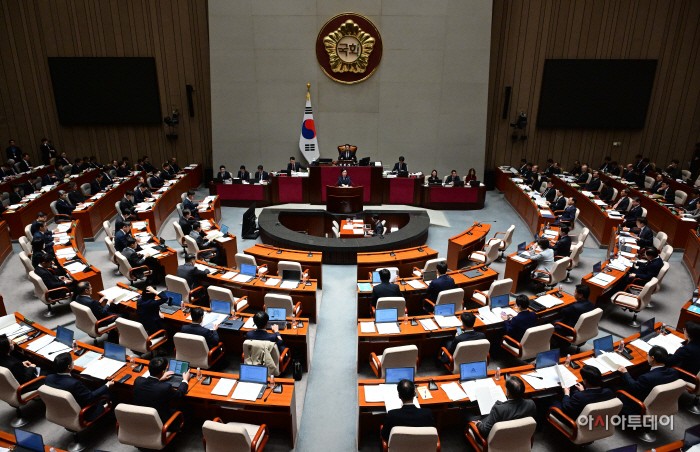 |
| Prime Minister Han Seong-sook delivers opening remarks at a plenary session of the National Assembly's Special Committee on Budget and Accounts on Nov. 4. /Photo by Lee Byung-hwa |
South Korea's ruling and opposition parties clashed over a 162 trillion won Future Response Fund on Wednesday as they began reviewing the government's 820.9 trillion won budget proposal for next year. The main opposition People Power Party (PPP) criticized the government for increasing national debt despite securing temporary excess tax revenue from the semiconductor boom, arguing that the move would shift the burden onto future generations. The government and ruling Democratic Party of Korea (DP), however, defended the fund as an investment designed to boost growth potential and prepare for fluctuations in tax revenue.
During a comprehensive policy questioning session of the National Assembly's Special Committee on Budget and Accounts, lawmakers sparred over whether excess tax revenue should be used primarily to repay national debt or set aside for future investment. The sustainability of funding for ongoing programs included in the fund and the government's approach to managing national debt also emerged as key points of contention.
PPP lawmaker Na Kyung-won attacked the Future Response Fund, calling it a "Future Destruction Fund." "The government is borrowing money in the people's name to create a 162 trillion won 'private slush fund for the general election' for President Lee Jae Myung," Na said. "Taking on national debt means passing the burden to our children. Interest payments alone amount to 40 trillion won a year." She added, "President Lee spoke of growth for all, but he has drawn up a budget that will leave us with 'debt for all,'" expressing concern about the burden on future generations.
Na also questioned the use of excess tax revenue to finance recurring expenditures. "A fundamental principle of fiscal management is to repay debt during economic booms and spend during downturns," she said. "It would be good if the Future Response Fund generated returns for the future and created a virtuous cycle. But if ongoing spending programs are included in the fund, what will happen when that source of funding dries up?"
Prime Minister Han Seong-sook countered that the fund was designed to support future growth and stable fiscal management. "We drew up the budget with future growth in mind," Han said. "Rather than taking on more debt, the aim is to ensure the stable operation of the government bond market." She added, "There are differing views on whether repaying all debt during an economic boom is necessarily the right answer. Our current level of debt is sufficiently manageable in terms of fiscal soundness."
The ruling DP backed the government, emphasizing a virtuous cycle in which investment drives growth and increases tax revenue. DP lawmaker Ahn Do-geol said, "We have created a virtuous cycle in which growth increases tax revenue, and the additional revenue, in turn, supports both future growth and fiscal soundness." He added, "Unless we invest now, it will be difficult to improve the fundamental structure and growth potential of South Korea's economy in the future."
Fellow DP lawmaker Lee Geon-tae emphasized the fund's role in reducing fiscal instability caused by fluctuations in tax revenue. "It is difficult to manage public finances stably if we increase spending whenever tax revenue rises and then cut spending again when revenue falls," Lee said. "The establishment of the Future Response Fund is therefore highly significant."
Kim Dong-wook
Most Read
-
1
U.S., Israel plan to resume strikes on Iran after..

-
2
Ukraine halts strikes on Russian oil refineries un..

-
3
China's fifth plenum to conclude amid expectations..

-
4
ASEAN to discuss Myanmar's return next month

-
5
AI-discovered PHP flaw triggers global cybersecuri..

-
6
Southeast Asian auto parts makers hit hard by Chin..

-
7
Trump envoy says U.S. no longer guarantees Middle..

PEOPLE







-
Address : In-Young Bldg., 34, Uisadang-daero 1-gil, Yeongdeungpo-gu, Seoul
Copyright by ASIATODAY CO., LTD. All rights resereved