



[Exclusive] Over 1,700 foreign patrol volunteers safeguard communities in S. Korea
Nov 05, 2026, 09:22 am


 |
The number of foreign nationals serving in volunteer crime prevention patrols across South Korea has surpassed 1,700, establishing them as partners in maintaining public safety in local communities. Their activities have expanded beyond nighttime patrols and crime prevention to helping police apprehend suspects in a group assault case. However, institutional support remains insufficient, with more than four in 10 patrol groups receiving no financial assistance from local governments.
Membership rises 25.7% in two years
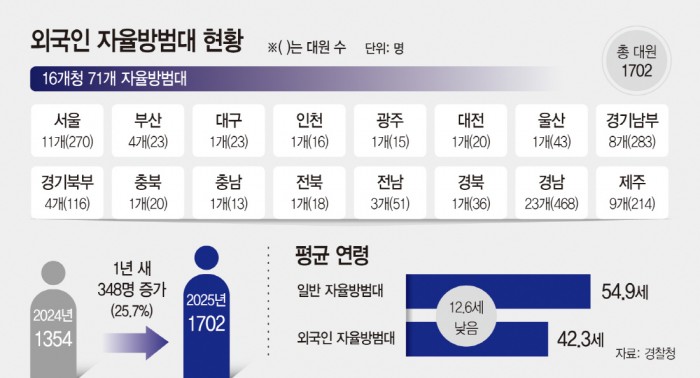
According to the Korean National Police Agency (KNPA) on Thursday, 1,702 foreign nationals were serving in 71 volunteer crime prevention patrol groups under the jurisdiction of 16 provincial and metropolitan police agencies nationwide as of August this year. Compared with 2024, when there were 61 groups with 1,354 members, the number of groups increased by 10 (16.4%) and membership rose by 348 (25.7%) over two years. By region, South Gyeongsang Province had the largest number of members at 468, followed by Gyeonggi Province with 399, Seoul with 270 and Jeju with 214. These four regions accounted for 79.4% of all foreign patrol members.
The average age of foreign members was 42.3, 12.6 years younger than the overall average of 54.9 for volunteer crime prevention patrol members. In particular, 696 members (40.9%) were in their 30s and 586 (34.4%) were in their 40s, with the two age groups accounting for 75.3% of the total. By occupation, self-employed workers made up the largest share of all patrol members at 33.2%, while company employees accounted for the largest proportion of foreign members at 33.5%.
From reporting a group assault to helping arrest suspects
At around 8 p.m. on Oct. 29, members of the Dogok-ri Blue Foreign Volunteer Patrol, wearing fluorescent safety vests and carrying illuminated traffic batons, began patrolling the streets of a shopping district near the Asan National Industrial Complex in Poseung-eup, Pyeongtaek, Gyeonggi Province. The members, who come from countries including Russia, Uzbekistan and Kazakhstan, divided into two groups responsible for parks and shopping areas, checking the surroundings of restaurants, convenience stores and foreign grocery stores.
Kim Seol-hee, 48, the group's secretary-general, used a flashlight to inspect even the ground-floor parking area of a building with a pilotis structure. She was concerned that vehicles left unattended in secluded corners could be used for criminal activities. Along a designated safe route for women returning home, she pressed an emergency call button to check whether it connected to the control center and whether the area could be monitored through closed-circuit television (CCTV).
About 30 minutes into their patrol, the members headed to Wonjeong Children's Park, where a group assault involving foreign nationals had occurred on Oct. 3. At the time, Kim Maksim, 46, a patrol member who was returning home after completing his patrol, noticed more than a dozen vehicles and a group of unfamiliar foreign nationals and alerted his colleagues. Kim Seol-hee then reported the situation to police through the 112 emergency number at around 11:07 p.m. The group initially dispersed but later gathered again at the park and carried out a group assault using wooden clubs.
"I heard the sound of someone being struck on the head with a blunt object, and people were screaming," Kim Seol-hee recalled. "When we approached, a foreign national who had been hit on the head collapsed in front of our members."
The patrol members immediately called the police and emergency services through 112 and 119, helped rescue the victim and began collecting evidence at the scene. They also helped police apprehend two suspects by blocking a fleeing vehicle and assisting in the pursuit. In recognition of their contributions, police presented commendations to the members involved on Oct. 29.
Older volunteers also took part in the patrol that evening, including Gan Anryuta, 67, from Uzbekistan, Ogai Zoia, 65, from Russia, and Tian Larisa, 80. Most of the members are third- or fourth-generation ethnic Koreans from the former Soviet Union who have settled in South Korea and voluntarily participate in patrols while balancing their jobs and daily lives.
"Since I've come to live here, I wanted to contribute to society, so I joined the volunteer patrol," Kim Maksim said.
Although the patrol ended at around 9 p.m., four members remained at their patrol post until 11 p.m. to continue the "Moonlight Companion" program, helping residents report incidents and return home safely at night. They also regularly inform foreign residents about Korean laws and social norms and help them communicate with police.
Four in 10 groups receive no funding
However, support for these voluntary public safety activities remains inadequate. According to KNPA data, foreign volunteer patrol groups conducted an average of 1.1 patrols per week, less than half the overall average of 2.8. As many as 31 groups (43.7%) showed minimal activity. Of the 71 groups nationwide, 30 (42.3%) received no financial support from local governments, while annual funding per member stood at 113,000 won, approximately one-quarter of the overall average.
According to the Pyeongtaek City Volunteer Patrol Association, the Dogok-ri patrol group receives approximately 1.8 million won in operating funds per quarter. After paying electricity, heating and cooling costs, little money remains for actual patrol activities.
"There are times when we feel in danger while patrolling," Kim Seol-hee said. "I wish we had equipment to collect evidence, such as body cameras, or at least basic protective equipment to keep ourselves safe."
Lee Hee-ju, head of the Pyeongtaek City Volunteer Patrol Association, said, "Foreign volunteer patrol members voluntarily participate in local public safety activities while earning their livelihoods, but their operating budgets are far from sufficient after electricity, heating and cooling expenses are deducted."
"The central and local governments should provide more active support so that these members can continue their patrol and crime prevention activities in a stable manner," Lee added.
A KNPA official said, "We have provided some financial support and plan to establish and implement measures to promote foreign volunteer patrol groups."
Lee Yoon-ho, a professor in the Department of Police Administration at Dongguk University, said, "Given the limited number of police officers, foreign volunteer patrol members' understanding of different languages and cultures can be of great help to public safety activities."
"The legal basis for their activities, responsibilities and authority should be clearly defined within a cooperative relationship with police, and administrative and financial support should be strengthened," he added.
Seol So-young
Lee Ha-eun
Most Read
-
1
Ukraine halts strikes on Russian oil refineries un..

-
2
China's fifth plenum to conclude amid expectations..

-
3
Southeast Asian auto parts makers hit hard by Chin..

-
4
U.S. links Myanmar peace efforts to rare earth acc..

-
5
Hegseth rejects calls for impeachment over Iran wa..

-
6
Democrats flip U.S. Congress in historic midterm s..

-
7
USFK commander cites interoperability gaps, urges..

PEOPLE







-
Address : In-Young Bldg., 34, Uisadang-daero 1-gil, Yeongdeungpo-gu, Seoul
Copyright by ASIATODAY CO., LTD. All rights resereved