



N. Korea rejects talks with U.S. while keeping diplomatic door cracked
Nov 05, 2026, 09:11 am


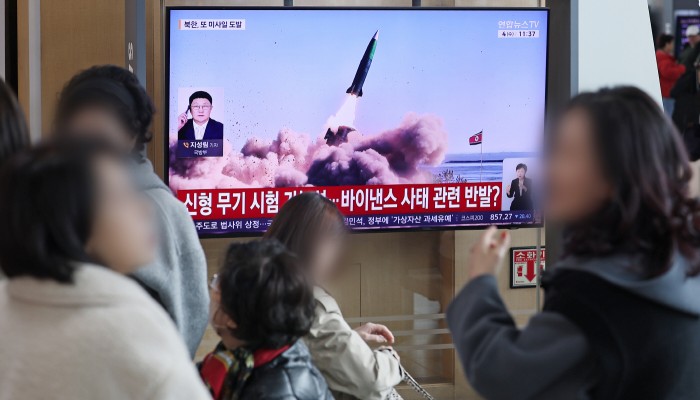 |
| A television at Seoul Station shows news coverage of North Korea's launch of an unidentified projectile toward the East Sea on Nov. 4, as announced by South Korea's Joint Chiefs of Staff. /Yonhap News Agency |
Kim Yo-jong, director of the General Affairs Department of North Korea's ruling Workers' Party of Korea (WPK), denounced the United States as "untrustworthy and hostile" on Wednesday, saying there was no need for dialogue under the current circumstances.
Her remarks marked an escalation of pressure on Washington, as North Korea, already angered by allegations that it was behind a cryptocurrency hacking incident involving more than 8 trillion won, took issue with sanctions against Pyongyang and trilateral cooperation among South Korea, the United States and Japan.
According to the Korean Central News Agency (KCNA), Kim said in a statement Wednesday, "The hostile signals that the United States continues to send toward our country are prompting us to reconsider the nature of the United States from various perspectives."
Regarding allegations of North Korea's involvement in cryptocurrency hacking, Kim claimed that the incident was "merely the tip of the iceberg revealing the true nature of the U.S. hostile policy toward North Korea." She also listed denuclearization discussions at a trilateral meeting of the foreign ministers of South Korea, the United States and Japan, joint military exercises, sanctions against North Korea and the release of the Trafficking in Persons Report as examples of "hostile U.S. actions against North Korea."
"The fundamental prerequisite for resolving all issues is the abandonment of the U.S. hostile policy toward North Korea," Kim stressed. "It is our clear position that there is no need to sit down with such untrustworthy and hostile people." She argued that Washington continued its confrontational policies, including military exercises and strengthening alliances, even while talking about dialogue.
Kim also hinted at the possibility of stepping up military responses. "We know no other way to respond to the hostile signals that the United States continues to send," she said, adding, "New records should also be set in our retaliatory responses."
However, Kim said, "Dialogue is certainly among the options for safeguarding peace, but for us, it does not necessarily align with our national interests."
Analysts say the remarks appear intended to pressure Washington to change its stance and gain the upper hand in negotiations while leaving open the possibility of dialogue.
Experts also interpreted the statement as both a negotiating message that raises the conditions for dialogue and a warning that North Korea could take new countermeasures if the United States does not change its approach.
Lim Eul-chul, a professor at the Institute for Far Eastern Studies of Kyungnam University, said, "By listing hostile U.S. actions against North Korea, she clearly expressed her refusal to engage in dialogue with Washington under the current circumstances."
He added, "By signaling continued tests of new weapons systems or high-intensity provocations, she warned that North Korea would reduce the possibility of resolving issues through dialogue and respond on a new level."
Others, however, said attention should be paid to the signal that North Korea could engage in dialogue if its conditions are met.
Yang Moo-jin, a distinguished professor at the University of North Korean Studies, explained, "The underlying message is that if the United States wants dialogue, it must abandon its hostile policy toward North Korea to provide a justification for aligning dialogue with national interests."
Regarding the timing of the statement, which coincided with the U.S. midterm elections, Yang said it also conveyed that dialogue would be possible regardless of the election results if prerequisites based on mutual respect were met.
Hong Min, a senior research fellow at the Korea Institute for National Unification (KINU), also said, "The rejection of dialogue is conditional, not an outright abandonment of it. She limited the targets of her rejection not to the United States itself, but to those who refuse to abandon confrontational policies."
Lee Han-sol
Most Read
-
1
Ukraine halts strikes on Russian oil refineries un..

-
2
China's fifth plenum to conclude amid expectations..

-
3
Southeast Asian auto parts makers hit hard by Chin..

-
4
U.S. links Myanmar peace efforts to rare earth acc..

-
5
Hegseth rejects calls for impeachment over Iran wa..

-
6
Democrats flip U.S. Congress in historic midterm s..

-
7
USFK commander cites interoperability gaps, urges..

PEOPLE







-
Address : In-Young Bldg., 34, Uisadang-daero 1-gil, Yeongdeungpo-gu, Seoul
Copyright by ASIATODAY CO., LTD. All rights resereved