



Nearly 60% of Korean CEOs plan M&A or divestitures, survey finds
Nov 03, 2026, 04:14 pm


 |
CEOs of South Korean companies are accelerating efforts to restructure their business portfolios through a strategy of focusing on core businesses while considering mergers and acquisitions (M&A) and divestitures, a survey showed.
EY Korea announced the findings on Nov. 3 in its EY-Parthenon CEO Outlook Survey. The survey covered 1,200 CEOs across 21 countries, including South Korea, and examined their growth strategies, transaction plans and strategies for creating future value.
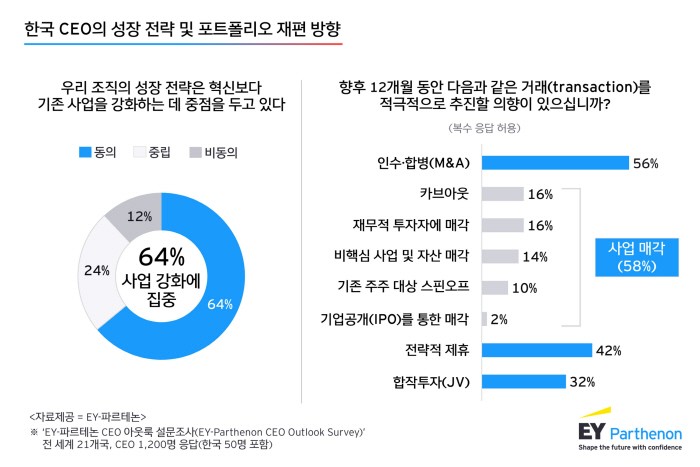
According to the survey, 56% of Korean CEOs said they planned to pursue M&A within the next 12 months. Another 58% said they planned to pursue divestiture transactions, indicating that they are seeking growth opportunities not only through business expansion but also by adjusting their business portfolios. Compared with the survey conducted in May, the proportion planning M&A rose by 12 percentage points, while the proportion planning divestitures increased by 16 percentage points.
In particular, 16% of Korean CEOs said they planned to pursue carve-outs, which involve separating and selling part of a business, or partial divestitures, more than double the global figure of 7%. The proportion increased eightfold from 2% in the May survey to 16%. This indicates a growing tendency to divest noncore businesses and concentrate capital and resources on core businesses with stronger growth potential.
The same trend was evident in growth strategies. Among Korean CEOs, 64% agreed that their growth strategies focused more on strengthening existing businesses than on innovation. Globally, 69% of CEOs agreed with the statement.
Among Korean CEOs, 40% identified preparing adequately for buyer due diligence as the biggest challenge they had faced in recent divestitures. Another 32% cited maximizing sale value while managing transaction speed and costs as a major challenge. As portfolio restructuring through divestitures expands, systematic management from transaction preparation through execution is becoming increasingly important.
The use of artificial intelligence (AI) is also expanding rapidly in the process of evaluating transactions such as M&A and divestitures. Among Korean CEOs, 96% said they were piloting AI or using it in actual transaction evaluation work. Of these, 32% said they had integrated AI into most transaction evaluation tasks, 20 percentage points higher than the global figure of 12%.
The most common area of AI use was financial analysis and business valuation (58%), followed by risk assessment and compliance reviews (48%), identifying synergies and developing value creation plans (42%), and market and competitive landscape analysis (42%).
In particular, 35% of Korean CEOs said they used AI for commercial due diligence, which involves assessing the business performance and market competitiveness of acquisition targets, compared with 25% globally, a difference of 10 percentage points.
Differences also emerged between Korean and global CEOs in their expectations for AI. Among Korean CEOs, 46% expected shorter transaction execution and due diligence periods to be the biggest change that AI and advanced data analytics would bring to divestitures. This was 11 percentage points higher than the global figure of 35%.
In addition, 52% of Korean CEOs said they reinvested the time and resources freed up through productivity improvements into growth or innovation.
By contrast, global CEOs' expectations focused more on direct value creation and strategic decision-making. They placed relatively greater emphasis on identifying and quantifying value creation opportunities in the early stages of divestitures (45%) and making faster and more accurate decisions (41%).
"As uncertainty increases, companies need to continuously review their portfolios so they can keep both acquisitions and divestitures as options and concentrate their capital and resources on core businesses and future growth," said Taemin Gil, partner at EY-Parthenon and leader of the M&A Solutions Group.
"AI should also be used for more than simply accelerating transactions. Companies need to expand its use to identify value creation opportunities early and improve the quality of investment decisions," he added.
Cho Eun-guk
Most Read
-
1
U.S., Israel plan to resume strikes on Iran after..

-
2
Ukraine halts strikes on Russian oil refineries un..

-
3
China's fifth plenum to conclude amid expectations..

-
4
ASEAN to discuss Myanmar's return next month

-
5
AI-discovered PHP flaw triggers global cybersecuri..

-
6
UK court orders worldwide asset freeze on Vietnam'..

-
7
Trump envoy says U.S. no longer guarantees Middle..

PEOPLE







-
Address : In-Young Bldg., 34, Uisadang-daero 1-gil, Yeongdeungpo-gu, Seoul
Copyright by ASIATODAY CO., LTD. All rights resereved