



Iran's president granted authority for U.S. talks
Nov 03, 2026, 09:15 am


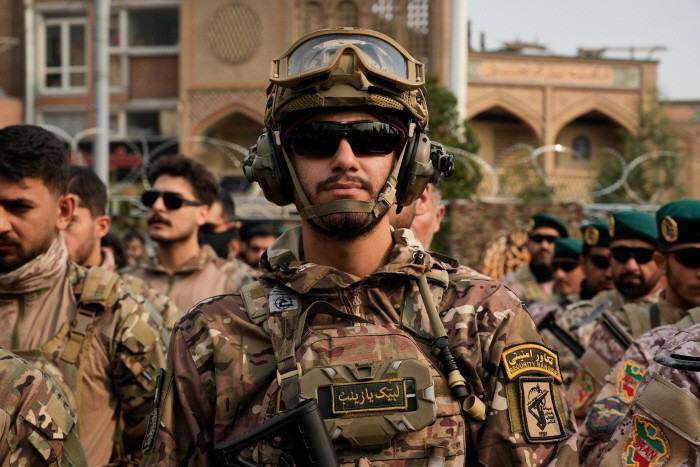 |
| Members of Iran's Islamic Revolutionary Guard Corps (IRGC) attend the inauguration of a military training center for civilian volunteers near the Imamzadeh Saleh shrine in Tajrish Square in Tehran, Iran, on Nov. 2 (local time). / AP-Yonhap |
[Article summary]
1. Iranian President Masoud Pezeshkian said the supreme leader had granted the government certain powers to negotiate with the United States.
2. Iran proposed that it could restore security in the Strait of Hormuz within two days if the United States accepted and implemented its demands.
3. U.S. President Donald Trump raised the possibility of reaching an agreement but did not rule out military action.
4. Israeli Prime Minister Benjamin Netanyahu called for the resumption of airstrikes against Iran immediately after the U.S. midterm elections.
5. International oil prices fell more than 7% on hopes for negotiations, while Gulf states prepared for retaliatory attacks.
Iranian President Masoud Pezeshkian said on Nov. 2 (local time) that Supreme Leader Mojtaba Khamenei had granted the government certain powers to negotiate with the United States, according to Iran's state-run IRNA news agency.
U.S. President Donald Trump also raised the possibility of reaching an agreement with Iran and said he would not rush a decision to resume attacks. However, Israeli Prime Minister Benjamin Netanyahu is pressing for airstrikes to resume, while the United States and Iran remain at odds over the nuclear issue and the order in which the maritime blockade should be lifted.
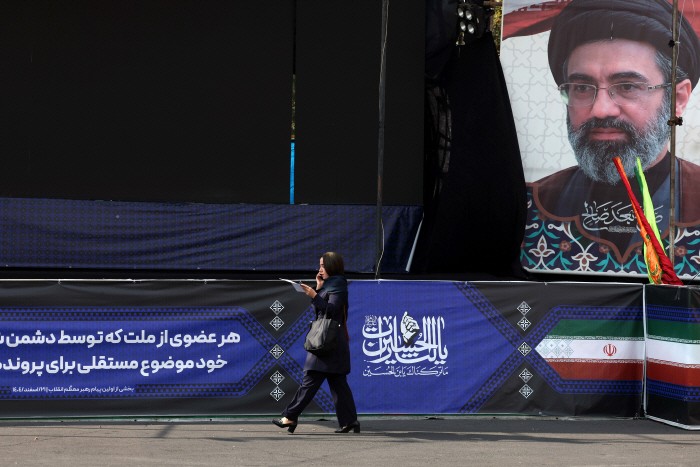 |
| An Iranian woman walks past a large billboard depicting Supreme Leader Mojtaba Khamenei in Tehran on Oct. 31 (local time). Iranian Army spokesperson Brig. Gen. Mohammad Akraminia warned on X that day that if the United States resumed military operations against Iran, the war would spread to a much wider region. Diplomatic efforts by mediating countries were continuing at the time. / EPA |
Pezeshkian says supreme leader granted government some authority to negotiate
At a meeting with provincial governors and mayors that day, President Masoud Pezeshkian said, "The government is working to resolve this issue through dialogue, and the Supreme Leader of the Revolution has granted the government certain powers in this regard."
He did not specify the scope of those powers or whether the conditions for negotiations had changed. Bloomberg reported that Ali Vaez, director of the Iran Project at the International Crisis Group (ICG), assessed that the supreme leader had granted limited authority with clear boundaries.
Iranian Foreign Ministry spokesperson Esmaeil Baghaei said Iran could restore security in the Strait of Hormuz within two days and begin negotiations if the United States accepted and implemented Iran's demands. He explained that a seven-point proposal presented in September remained the basis for negotiations and that the implementation period had been shortened from the original seven days to two days.
Iran is demanding that the United States lift its naval blockade of Iranian ports, allow Iranian crude oil exports and permit access to some of its frozen assets overseas.
Iranian Foreign Minister Abbas Araghchi said, "Everything depends on the political reasonableness of the United States," warning that Iran would respond more forcefully than before if Washington chose military operations over diplomacy.
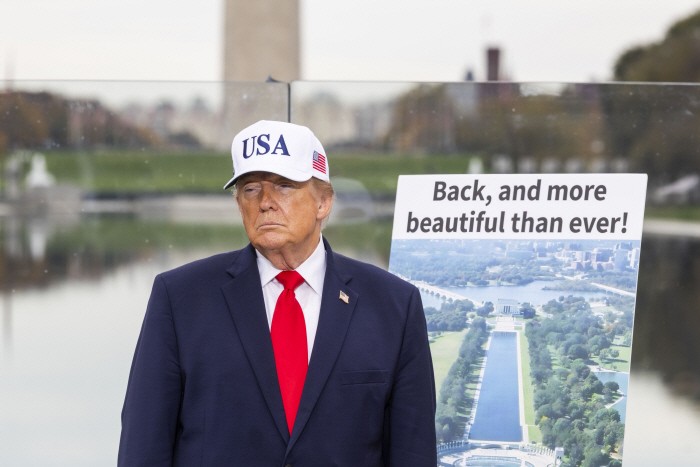 |
| U.S. President Donald Trump delivers his final campaign speech ahead of the midterm elections in front of the Reflecting Pool at the Lincoln Memorial in Washington, D.C., on Nov. 2 (local time), one day before the elections. During the speech, Trump also mentioned several renovation projects in Washington, D.C., including the Reflecting Pool. Some of the projects, including the Reflecting Pool renovation, have sparked controversy. / EPA-Yonhap |
Trump says "no need to rush"
As Iran presented its proposal for negotiations, Trump was asked that day in front of the Reflecting Pool at the Lincoln Memorial in Washington, D.C., whether he was considering attacking Iran after the midterm elections. He replied, "No."
"We will do something one way or another, but there is no need to rush," he told U.S. online news outlet Axios. "We are talking to Iran, and things are going well."
He added that although Iran wanted a deal more than ever, the actual urgency was lower than expected.
Trump claimed on his social media platform Truth Social that oil prices had fallen by nearly $10 (13,460 won) per barrel because people believed there would be no war with Iran.
U.S. Vice President JD Vance also expressed optimism about the possibility of reaching an agreement and said there was no deadline for resuming airstrikes. However, he stressed that Iran must make a "firm and verifiable commitment" not to rebuild its nuclear program.
At a campaign rally in Iowa the previous day, Trump also said, "At some point, we will have to bring the hammer down on them."
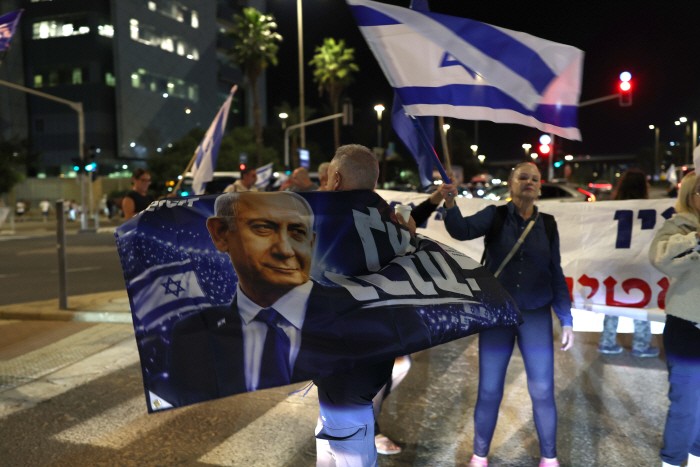 | |||||||||||||||||||||||||
Israeli right-wing activists and supporters of Prime Minister Benjamin Netanyahu stage a demonstration calling for new elections in Haifa, Israel, on Nov. 1 (local time). Israel's general election on Oct. 27 resulted in a political deadlock, as neither political bloc secured the 61 seats needed to form a government in the 120-seat Knesset, Israel's parliament. / EPA-Yonhap
Netanyahu urges strikes immediately after midterms
Unlike U.S. President Donald Trump, who wants to give diplomacy more time, Israeli Prime Minister Benjamin Netanyahu urged Trump during a phone call on Oct. 31 to resume airstrikes against Iran immediately after the U.S. midterm elections.
Trump conveyed his intention to give diplomatic efforts a chance first, The Wall Street Journal (WSJ) reported. The WSJ also reported that the Israeli military had drawn up attack plans and heightened its state of alert.
A U.S. official also said Netanyahu wanted to resume hostilities, but Trump was "not there yet," according to the Financial Times (FT).
The Associated Press (AP) analyzed that a resumption of full-scale war with Iran could help Netanyahu form an emergency government after failing to secure a majority in the general election.
According to Axios, Vice President JD Vance and White House envoy Steve Witkoff favor reaching an agreement, while Netanyahu and U.S. Secretary of Defense (Secretary of War) Pete Hegseth advocate resuming airstrikes.
Treasury Secretary Scott Bessent, Central Intelligence Agency (CIA) Director John Ratcliffe and Secretary of State Marco Rubio recommend continuing economic pressure without either going to war or reaching an agreement.
|

Most Read
-
1
U.S., Israel plan to resume strikes on Iran after..

-
2
Ukraine halts strikes on Russian oil refineries un..

-
3
China's fifth plenum to conclude amid expectations..

-
4
ASEAN to discuss Myanmar's return next month

-
5
AI-discovered PHP flaw triggers global cybersecuri..

-
6
UK court orders worldwide asset freeze on Vietnam'..

-
7
Trump envoy says U.S. no longer guarantees Middle..

PEOPLE







-
Address : In-Young Bldg., 34, Uisadang-daero 1-gil, Yeongdeungpo-gu, Seoul
Copyright by ASIATODAY CO., LTD. All rights resereved