



SK spends double Samsung on US lobbying in Q3
Nov 03, 2026, 09:49 am


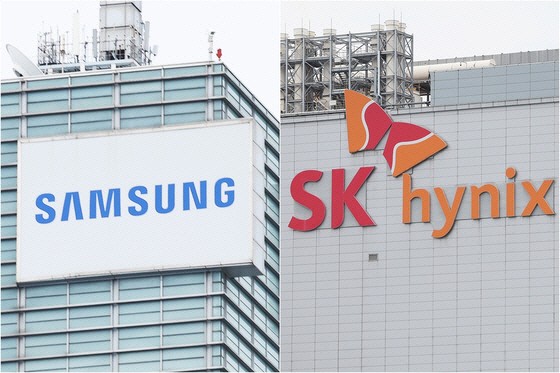 |
| Samsung Electronics and SK Hynix. / Yonhap News Agency |
SK Group spent approximately twice as much as Samsung Electronics' U.S. subsidiary on lobbying activities in the United States in the third quarter of this year. SK Group had already surpassed Samsung Electronics in annual U.S. lobbying expenditures last year. Analysts say Washington lobbying networks have become increasingly important for SK Group amid its semiconductor investments in the United States and operations at manufacturing facilities in China.
According to reports filed with the U.S. Congress under the Lobbying Disclosure Act (LDA) and other sources on Nov. 2, SK Americas, SK Group's U.S. government relations subsidiary, reported $1.75 million (approximately 2.352 billion won) in lobbying expenditures for the third quarter of this year.
By contrast, Samsung Electronics America, the U.S. subsidiary of Samsung Electronics, reported $870,000 (approximately 1.17 billion won). SK spent $880,000 more, or just over twice as much.
For the first three quarters combined, SK also spent more, reporting $4.9 million (approximately 6.59 billion won), compared with Samsung Electronics' $3.53 million (approximately 4.74 billion won), a difference of $1.37 million.
This reflects SK's substantial increase in lobbying expenditures over the past two years. In 2024, SK spent $4.32 million (approximately 5.8 billion won), less than Samsung's $5.45 million (approximately 7.32 billion won). However, SK increased its spending significantly to $5.77 million (approximately 7.75 billion won) last year, overtaking Samsung, and the gap has since widened.
SK has also been moving to strengthen its network of external lobbying firms. In August, it newly registered Ballard Partners as a lobbying firm, which reported $300,000 (approximately 400 million won) in fees in the third quarter alone. Fees paid to existing lobbying firms also increased.
The firms' main lobbying issues include semiconductor export controls and equipment export licenses, legislation related to artificial intelligence (AI) chips, and U.S. investment tax credits for advanced manufacturing facilities. Other issues include power supply for AI data centers and energy- and battery-related policies.
SK's growing demand for government relations activities stems from the challenges it faces in the United States.
SK Hynix is currently building an advanced packaging plant for high-bandwidth memory (HBM) in Indiana with an investment of more than $4 billion. The company plans to open its cleanroom in 2028 and begin mass production in the second half of 2029.
U.S. export restrictions are also reportedly posing challenges for its manufacturing facilities in China.
Solidigm, an SK Hynix subsidiary, is reportedly in discussions with the U.S. government to obtain approval to bring additional U.S.-made equipment into its NAND flash memory plant in Dalian, China.
The U.S. government is said to allow equipment needed to operate existing factories while maintaining restrictions on equipment required to expand production capacity or transition to advanced manufacturing processes.
Industry observers therefore believe SK inevitably has substantial lobbying needs, given that it must secure investment support in the United States while maintaining the competitiveness of its manufacturing facilities in China.
Some also expect SK to further strengthen its lobbying network. The Indiana plant is preparing for equipment installation and production, while the Dalian plant in China still faces the issue of obtaining U.S. government approval to bring in additional equipment.
"The semiconductor business is inevitably important to SK's activities in the United States, and as SK Hynix's importance continues to grow, lobbying expenditures are naturally rising," an industry official said. "Given the current situation, spending could increase further from its present level."
Choi In-gyu
#SK #Samsung #Hynix #AI #Lobby
Copyright by Asiatoday
Most Read
-
1
U.S., Israel plan to resume strikes on Iran after..

-
2
Ukraine halts strikes on Russian oil refineries un..

-
3
China's fifth plenum to conclude amid expectations..

-
4
ASEAN to discuss Myanmar's return next month

-
5
AI-discovered PHP flaw triggers global cybersecuri..

-
6
UK court orders worldwide asset freeze on Vietnam'..

-
7
Trump envoy says U.S. no longer guarantees Middle..

PEOPLE







-
Address : In-Young Bldg., 34, Uisadang-daero 1-gil, Yeongdeungpo-gu, Seoul
Copyright by ASIATODAY CO., LTD. All rights resereved