



Laos expands cross-border wind power exports to Vietnam
Nov 03, 2026, 01:12 pm


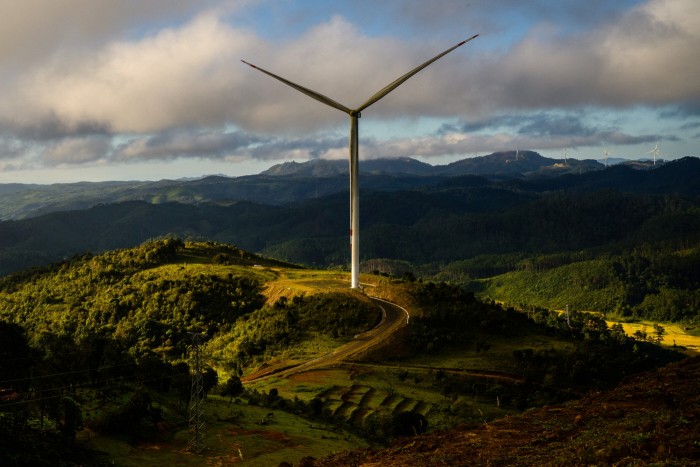 |
| Wind turbines at the 600-megawatt (MW) Monsoon Wind Power Project in Sekong Province, southern Laos. / AFP-Yonhap |
Southeast Asia, which has long relied on hydropower, is turning to Asia's first cross-border wind power project as a way to overcome declining electricity generation during the dry season, Channel News Asia (CNA) reported on Nov. 3 (local time).
In the Sekong region of southern Laos, 133 wind turbines operate across an area roughly the size of Singapore. All the electricity generated is transmitted across the border to Vietnam's national power grid.
The facility is Laos' 600-megawatt (MW) Monsoon Wind Power Project, the largest of its kind in Southeast Asia. It began operations in August last year and has been supplying electricity to Vietnam through dedicated transmission lines. Owned by a Thai-led consortium, the project features turbines built by a Chinese state-owned company and cost a total of $700 million (approximately 936.5 billion won).
Laos has turned to wind energy because hydropower, its traditional mainstay, is reaching its limits. Although hydropower generation has expanded rapidly across Southeast Asia, declining output during the dry season and its impact on ecosystems have raised concerns. Laos alone already has 90 hydropower plants, leaving fewer suitable sites for new projects.
"The economics are shifting in favor of wind power," said Tristan Bellingham, technical program director at nonprofit EnergyLab Asia. "There is a race to secure wind development rights, much like what happened with hydropower 20 to 30 years ago."
According to a Lao government official, between 10 and 15 wind power projects are currently under development across the country.
Vietnam, which is buying electricity generated by Laos' wind resources, faces an urgent situation. As Southeast Asia's fastest-growing manufacturing hub, Vietnam has long imported hydropower from neighboring Laos. However, a drought in 2023 reduced hydropower generation and caused widespread blackouts.
In September, the Vietnamese government also warned that the country could face electricity shortages starting in 2027 because of delays in power plant construction and rising demand.
Price competitiveness has also attracted Vietnam. Although authorities have not disclosed the exact electricity rate, Thomas Jakobsen, managing director of Indochina Energy Partners, estimated that Monsoon Wind supplies electricity at around 6 cents (approximately 80 won) per kilowatt-hour (kWh), or 2 to 4 cents (approximately 27 to 54 won) less than the price of domestically generated wind power in Vietnam.
With the interests of both countries aligned, the project is expected to expand further.
Ninh Xuan Hiep of the National Power Transmission Corporation under Electricity Vietnam (EVN) said the project is also crucial to achieving Vietnam's goal of carbon neutrality by 2050. He predicted that by 2030, electricity imported from Laos would account for approximately 10% of Vietnam's total installed power generation capacity.
Narut Boakajorn, general manager of Monsoon Wind, said, "We are pursuing an additional 1,000 MW expansion and plan to supply some of the additional electricity within Laos."
He said the Lao government is expected to earn a total of $180 million (approximately 240.8 billion won) over the 25-year contract period, including taxes and funds for regional development and environmental protection.
"Not many countries have such good renewable energy resources, including wind, hydropower and solar power, all in one place. Laos is in a unique position," he emphasized.
Jeong Ri-na
Most Read
-
1
U.S., Israel plan to resume strikes on Iran after..

-
2
Ukraine halts strikes on Russian oil refineries un..

-
3
China's fifth plenum to conclude amid expectations..

-
4
ASEAN to discuss Myanmar's return next month

-
5
AI-discovered PHP flaw triggers global cybersecuri..

-
6
UK court orders worldwide asset freeze on Vietnam'..

-
7
Trump envoy says U.S. no longer guarantees Middle..

PEOPLE






-
Address : In-Young Bldg., 34, Uisadang-daero 1-gil, Yeongdeungpo-gu, Seoul
Copyright by ASIATODAY CO., LTD. All rights resereved