



Catholic priest warns pseudo-religions use Bible as bait for pyramid schemes
Nov 03, 2026, 10:29 am


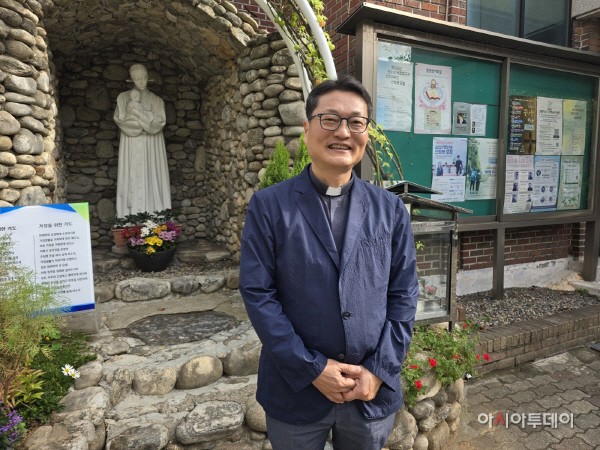 |
| Father Andrew Yongkwon Lee, chairman of the Catholic Church in Korea's Committee on Pseudo-Religious Groups, speaks during an interview at Daehwadong Catholic Church in the Diocese of Uijeongbu. "For pseudo-religious groups, the Bible is merely a bait product. Ultimately, what they are selling is their leader," Father Lee warned. / Photo by Hwang Ui-joong |
South Korea is a country where more than half the population identifies as having no religion. Ironically, however, Korean society is suffering from the harmful effects of cults, or so-called "pseudo-religious groups." Why are these groups penetrating people's lives more deeply at a time when established religions are losing their influence?
Father Andrew Yongkwon Lee, chairman of the Catholic Church in Korea's Committee on Pseudo-Religious Groups, has given this issue serious thought. Father Lee works on preventive education about pseudo-religious groups and caring for those who have fallen into their traps within the Catholic Church.
He sees these groups as essentially operating like multilevel marketing scams. They use the Bible or spiritual practices as bait, but ultimately sell their religious leaders. He identifies modern people's anxiety and sense of alienation, along with their tendency to accept information blindly, as factors that make them vulnerable to such groups. His advice is to "take time to stop and ask questions."
The following is an interview with Father Lee.
Q. The number of people without a religion is growing in Korean society, yet pseudo-religious groups seem to be flourishing.
"We need to take a close look at how these groups approach people. Many assume that they approach people in large numbers to recruit them, but when approaching individuals, they operate strictly in small groups.
The first step is always to build personal connections and establish trust. They approach people under the guise of innocent cultural activities popular among young people, such as painting murals, organizing flash mobs and performing K-pop dances.
At the same time, they pretend to listen to people's concerns about employment or their future. As established churches have grown larger, individuals have increasingly experienced anonymity and alienation.
Pseudo-religious groups take advantage of this by providing personal connections within small groups, which makes it easy for people to become attracted to them."
Q. The practice of using deception to recruit followers, known as "moryak evangelism," has recently become widely known and shocked the public.
"In fact, the use of the word moryak, meaning 'scheme,' in the Bible originated from a translation error in the past.
During the Japanese colonial period, when Chinese-language and English-language Bibles were translated indirectly, the word gyeongnyun, referring to God's divine providence, was incorrectly translated as moryak (Scheme).
Pseudo-religious groups exploit this mistranslation to justify fraudulent practices by claiming that 'it is acceptable to lie for the sake of evangelism.'
Their methods are exactly like those of typical fraudsters. At first, they tell 99% of the truth. Then, once they have earned someone's trust, they subtly mix in 1% falsehood and gradually deceive the person."
Q. Even clergy members from established religions have sometimes fallen for the methods of pseudo-religious groups or been exploited by them.
"This actually happens quite often.
There have been cases where reporters affiliated with front organizations run by pseudo-religious groups approached Catholic priests or Buddhist monks and requested interviews on positive subjects such as 'peace' or 'purely cultural activities.'
The clergy simply agreed to the interviews in good faith, only to discover later that the interviews had been misused as tools for recruitment and publicity by pseudo-religious groups.
These groups establish countless organizations that completely conceal their religious nature and present themselves as promoting universal values such as 'world peace' or 'volunteer work.'
As a result, members of established religions and outside institutions that are unaware of what is really happening can easily be exploited."
Q. From what you have described, these groups sound more like massive business organizations than religions.
"That is exactly right. In essence, their methods are identical to those of multilevel marketing scams.
At first, they offer appealing 'introductory products,' such as the Bible or qi training. But as people progress through the educational process and become psychologically manipulated like puppets, they are eventually led to the final product: the religious leader.
They are pushed toward the idea that 'to attain salvation or complete your spiritual training, you must meet the leader.'
Once that single leader has been deified, a multilevel organizational structure is completed, with members exploited for the benefit of those at the top."
Q. How can we prevent our families or neighbors from falling into the traps of pseudo-religious groups?
"First, religious communities must deeply reflect on their failure to fulfill their responsibilities and embrace those who feel alienated, and they must reform themselves.
But a more fundamental solution is to develop individuals' 'philosophical independence' and 'discernment.'
Today, our society has a strong tendency to accept opinions that have been fed to us without questioning them. People become addicted to short videos on YouTube, Reels and Shorts, and simply believe what others say without thinking deeply.
When someone approaches us with excessive kindness or invokes their authority, we should not simply accept what they say. We must always be able to ask ourselves, 'Why?'
We need to develop the ability to question and judge for ourselves: 'Why is this person going to such lengths for me?' or 'Is what that person says really true?'"
Q. Finally, what preventive advice would you offer our readers?
"Pseudo-religious groups exploit the deep anxiety of modern people.
Modern society constantly demands that we add more to our lives. We are told to build up our qualifications, buy new things and continually fill our minds with information.
But because we are always trying to accumulate more, we end up feeling constantly rushed and anxious.
What we need now is 'time to stop.'
Put down your smartphone and take a slow walk, even if it is just through nearby nature or along a tree-lined street in your neighborhood. You need to make time for yourself.
Only when you gently clear your mind and stop can you truly see yourself and develop the independent ability to discern what is happening around you.
Slowing down and pausing for a moment is the most powerful defense not only against the temptations of pseudo-religious groups but also against emotional distress."
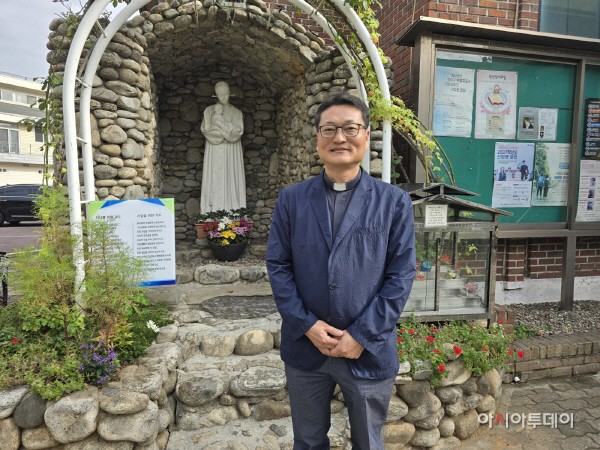 |
| Father Lee urged people to put down their smartphones, take slow walks and make time for themselves. He said taking time to pause could help people avoid falling into the traps of pseudo-religious groups. / Photo by Hwang Ui-joong |
Hwang Ui-joong
Most Read
-
1
U.S., Israel plan to resume strikes on Iran after..

-
2
Ukraine halts strikes on Russian oil refineries un..

-
3
China's fifth plenum to conclude amid expectations..

-
4
ASEAN to discuss Myanmar's return next month

-
5
AI-discovered PHP flaw triggers global cybersecuri..

-
6
UK court orders worldwide asset freeze on Vietnam'..

-
7
Trump envoy says U.S. no longer guarantees Middle..

PEOPLE







-
Address : In-Young Bldg., 34, Uisadang-daero 1-gil, Yeongdeungpo-gu, Seoul
Copyright by ASIATODAY CO., LTD. All rights resereved