



S. Korea private universities face revenue gap over 15-year tuition freeze
Nov 03, 2026, 09:58 am


 |
| Korean Educational Development Institute |
Private universities in South Korea were found to have missed out on approximately 30 trillion won in tuition revenue over 15 years of tuition regulations, compared with what they could have earned if they had raised tuition fees to the legal ceiling. More than 20 trillion won of that amount was not offset by government support, prompting calls for increased financial assistance to improve universities' educational and research conditions.
According to Issue No. 20 of the "KEDI Brief" published by the Korean Educational Development Institute (KEDI), the cumulative tuition revenue shortfall at private universities from 2011 to 2023 was estimated at 29.8977 trillion won. Of this amount, only 9.1854 trillion won, or 30.7%, was covered by government subsidies, leaving 20.7123 trillion won, or 69.3%, uncompensated.
The tuition revenue shortfall refers to the difference between the amount universities could have collected if they had raised tuition fees to the legal maximum each year and the amount they actually collected. It is an estimate of potential revenue forgone due to tuition regulations, not an actual accounting deficit.
Annual tuition fees per student at private universities declined from 7.69 million won in 2011 to 7.57 million won in 2023. However, had universities raised tuition fees to the legal ceiling, the amount was estimated to have reached 10.84 million won in 2023. The difference from actual tuition fees was 3.27 million won per student, of which 1.924 million won was not covered by government support.
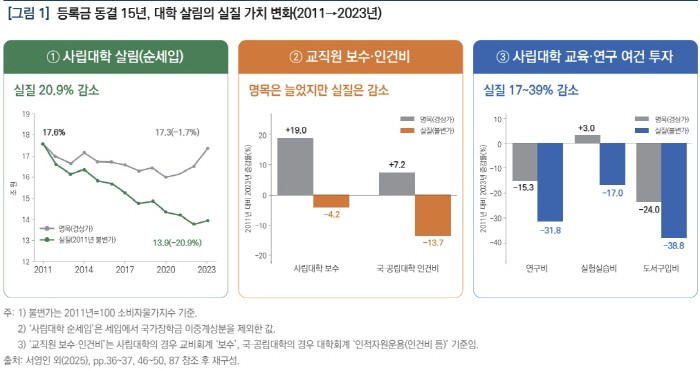
The prolonged tuition freeze also affected university finances. Excluding the amount of national scholarships counted twice, net revenue at private universities fell by 1.7% in nominal terms, from 17.5849 trillion won in 2011 to 17.2811 trillion won in 2023. In real terms, adjusted for inflation, it declined by 20.9%.
Over the same period, research expenditures at private universities fell by 31.8% in real terms, spending on laboratory and practical training by 17.0%, and spending on book purchases by 38.8%. Private universities also recorded operating deficits for 12 consecutive years, from 2012 through 2023.
Meanwhile, the burden on students and households has been growing as universities began raising tuition fees last year. Following tuition increases at 70.5% of four-year universities last year, 67.7% raised their fees this year.
The researchers estimated the cumulative additional burden per student over the two years at 701,000 won, or approximately 982.2 billion won for the country's 1.4 million enrolled students. However, these figures are nominal amounts before deducting scholarship support.
Government investment in higher education remained well below the average for the Organization for Economic Cooperation and Development (OECD). In 2022, South Korea's direct government expenditure per university student stood at $6,617, just 43.8% of the OECD average of $15,102.
The researchers concluded that the additional fiscal burden on the government resulting from tuition increases would not be substantial. Even if all universities raised tuition fees to the legal ceiling, the government's additional annual burden in 2030 was estimated at approximately 370 billion won. After deducting 340 billion won in national scholarship savings resulting from declining student numbers, the actual additional expenditure would be around 30 billion won.
Accordingly, the researchers proposed integrating the Type II National Scholarship program, which is linked to tuition freezes, into the Type I program without cutting the budget. They also recommended strengthening disclosure requirements and accountability regarding how universities use additional revenue from tuition increases.
In addition, they emphasized the need to gradually increase government higher education spending per student to the OECD average and reinvest national scholarship funds saved as a result of the declining school-age population into higher education.
Park Ji-sook
Most Read
-
1
Ukraine halts strikes on Russian oil refineries un..

-
2
Southeast Asian auto parts makers hit hard by Chin..

-
3
U.S. links Myanmar peace efforts to rare earth acc..

-
4
Hegseth rejects calls for impeachment over Iran wa..

-
5
Democrats flip U.S. Congress in historic midterm s..

-
6
USFK commander cites interoperability gaps, urges..

-
7
Xi secures fourth term as China reshuffles next-ge..

PEOPLE




-
Address : In-Young Bldg., 34, Uisadang-daero 1-gil, Yeongdeungpo-gu, Seoul
Copyright by ASIATODAY CO., LTD. All rights resereved