



S. Korean mortgage rates dip following decline in bank bond yields
Nov 03, 2026, 09:54 am


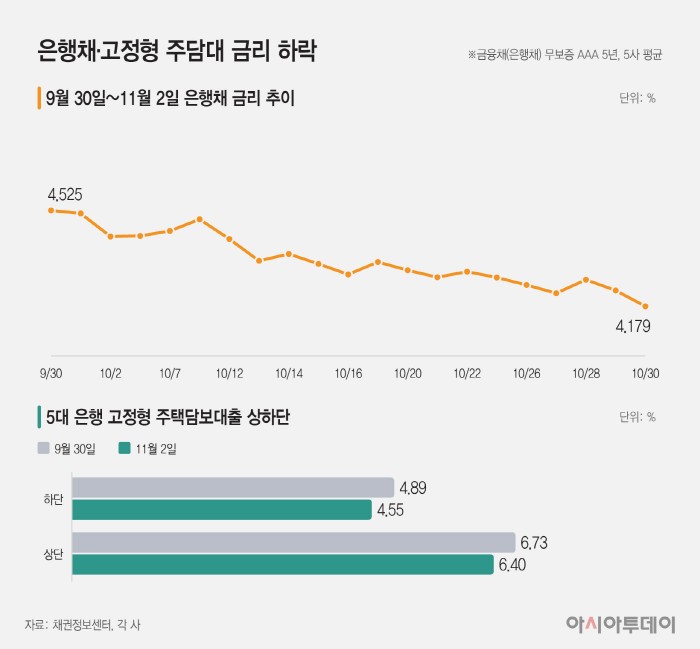 |
Fixed-rate mortgage rates at major commercial banks have fallen by as much as 0.61 percentage point over the past month. The decline came as yields on bank bonds, which serve as benchmark rates for mortgages, fell amid the government's reduction in Treasury bond issuance and growing global demand for safe-haven assets. Some banks have also resumed mortgage lending that they had previously suspended, making it easier to obtain loans toward the end of the year. However, it remains uncertain whether the decline in rates will continue, given the possibility of further benchmark interest rate hikes by the Bank of Korea (BOK) and the continued enforcement of limits on total household lending.
According to financial industry sources on Nov. 2, five-year hybrid mortgage rates at South Korea's five major banks — KB Kookmin, Shinhan, Hana, Woori and NH NongHyup — fell by 0.33 to 0.61 percentage point compared with the end of September.
The upper and lower ends of the interest rate range for KB Kookmin Bank's "KB Mortgage Loan" product each fell by 0.33 percentage point to 5.00%–6.40%. The minimum rates for Shinhan Bank's "Shinhan Home Loan (Apartment)" and Hana Bank's "Hana OneQ Apartment Loan 2" declined by 0.34 and 0.33 percentage point, respectively. The minimum rate for NH NongHyup Bank's "NH Mobile Mortgage Loan" fell by 0.48 percentage point to 5.15%, while the rate for Woori Bank's "Woori WON Mortgage Loan" dropped by 0.61 percentage point from 6.17% to 5.56%.
The simultaneous decline in mortgage rates at these banks was largely driven by falling bank bond yields. According to the Korea Financial Investment Association, the yield on five-year AAA-rated bank bonds fell by 0.346 percentage point, from 4.525% on Sept. 30 to 4.179% on Oct. 30. This marked the first time in about five months that the yield had fallen into the 4.1% range, since May 26, when it stood at 4.182%.
Notably, bank bond yields declined in October despite a sharp increase in net bank bond issuance from the previous month. Generally, an increase in bond issuance pushes bond prices down and yields up.
The decline in bank bond yields has been attributed to strength in the bond market, particularly in Korean Treasury bonds. The government previously decided to reduce competitive Treasury bond issuance in October by 5 trillion won from its original plan to 12 trillion won. It also decided to issue 12 trillion won in November, again cutting the amount by 5 trillion won from the original plan.
Analysts say the reduction in Treasury bond supply pushed up the prices of existing bonds, creating downward pressure on yields across the bond market.
Other contributing factors included market rates having already largely priced in expectations that the BOK would hold its benchmark interest rate steady in October, as well as growing demand for safe-haven assets in financial markets.
In particular, a global stock market correction driven by concerns over the profitability of artificial intelligence (AI) investments prompted investors to buy relatively safe government bonds.
"Government bonds have shown notable strength since late September," said Kim Chan-hee, chief researcher at Shinhan Securities. "This reflects a combination of expectations for improved supply and demand conditions, signs that overseas interest rates have peaked, and growing demand for safe-haven assets."
Alongside falling mortgage rates, banks have also been easing lending restrictions.
Starting Nov. 2, Hana Bank resumed accepting new applications for its non-face-to-face mortgage product, "Hana OneQ Apartment Loan 2," as well as mortgage refinancing products for residential properties and residential officetels.
Standard Chartered Bank Korea and BNK Kyongnam Bank also lifted restrictions on mortgage credit insurance (MCI) enrollment last month.
However, some analysts warn that the decline in lending rates could be short-lived. Markets see a strong possibility that the BOK will raise its benchmark interest rate this month, while banks are maintaining their policies to control total household lending.
In addition, year-end liquidity management and refinancing issuance to replace maturing bank bonds could put upward pressure on interest rates.
"Recently declining interest rates are likely to show downward rigidity going forward," said Kim Sang-in, a senior researcher at Shinhan Securities. "Attention should be paid to the possibility of a stock market rebound and growing caution ahead of the November Monetary Policy Board meeting."
Han Sang-wook
Most Read
-
1
U.S., Israel plan to resume strikes on Iran after..

-
2
Ukraine halts strikes on Russian oil refineries un..

-
3
China's fifth plenum to conclude amid expectations..

-
4
ASEAN to discuss Myanmar's return next month

-
5
AI-discovered PHP flaw triggers global cybersecuri..

-
6
UK court orders worldwide asset freeze on Vietnam'..

-
7
Trump envoy says U.S. no longer guarantees Middle..

PEOPLE







-
Address : In-Young Bldg., 34, Uisadang-daero 1-gil, Yeongdeungpo-gu, Seoul
Copyright by ASIATODAY CO., LTD. All rights resereved