



S. Korea consumer inflation slows to 2.8 percent in October
Nov 03, 2026, 09:45 am


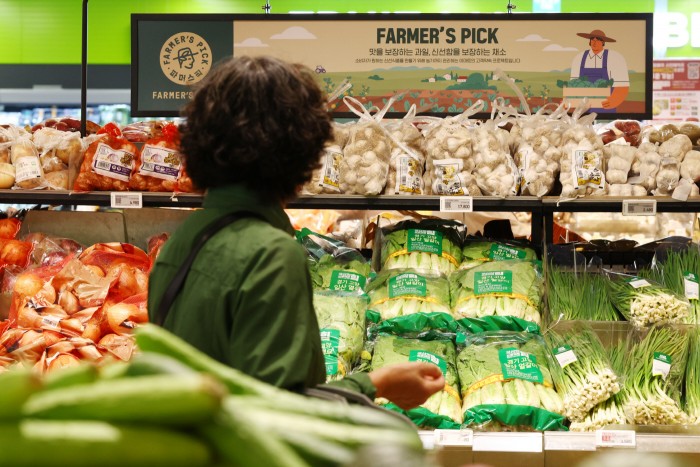 |
| Shoppers at a large supermarket in Seoul. / Yonhap News Agency |
Despite persistently high oil prices, South Korea's consumer inflation rate stood at 2.8% last month, slowing for the second consecutive month. Government measures to manage supply and demand for key products, including a price cap on petroleum products, helped ease overall inflation. However, with petroleum and processed food prices continuing to rise, the government plans to focus on managing prices during the winter.
According to the "Consumer Price Index for October" released by Korea's Ministry of Data and Statistics (MODS) on Nov. 3, the consumer price index stood at 120.73 (2020=100), up 2.8% from the same month a year earlier. The inflation rate fell by 0.1 percentage point from 2.9% in September to 2.8% in October, remaining below 3% for the second consecutive month.
By category, industrial products, which include petroleum products, drove inflation last month. Prices of industrial products rose 4.4% year-on-year. Among them, petroleum prices increased 14.9%, the highest rate since July's 15.5%. Diesel prices rose 19.7%, while gasoline prices climbed 11.6%.
Processed food prices also continued to rise last month. Their year-on-year increase accelerated by 0.8 percentage point from 2.1% in September to 2.9% in October, the highest rate in 11 months since November last year, when prices rose 3.3%.
While processed food and petroleum products drove consumer inflation last month, agricultural, livestock and fishery products exerted downward pressure on prices. Their prices fell 1.7% year-on-year, declining for the third consecutive month. This was largely due to a 7.5% drop in agricultural product prices, as vegetable prices fell 11.2%. In particular, lettuce and cucumber prices declined 44.3% and 39.5%, respectively, from a year earlier.
"Vegetable prices have fallen due to favorable crop conditions recently," said Lee Doo-won, a senior official responsible for economic statistics at MODS. "Fruit prices also declined 8.4% as fruit crops came onto the market, contributing significantly to keeping overall inflation in the 2% range."
The price cap on petroleum products, implemented since March, also helped ease inflation last month, according to officials.
According to the Ministry of Finance and Economy, gasoline and diesel prices remained in the 1,850 won and 1,840 won ranges, respectively, last month. The ministry estimated that the price cap reduced the inflation rate by approximately 0.8 percentage point.
The living necessities price index, which consists of frequently purchased items and is considered an indicator of inflation felt by consumers, rose 2.6% year-on-year. This was 0.1 percentage point higher than the previous month's rate.
"The rise in processed food prices and restaurant prices widened the increase in living costs compared with the previous month," Lee explained.
Despite persistently high oil prices and rising processed food prices, overall inflation eased slightly due to falling agricultural, livestock and fishery product prices and the effects of the petroleum price cap. The government plans to focus on stabilizing household living conditions during the winter.
As part of these efforts, it will implement a 64 billion won package of measures for the kimchi-making season and winter.
Under the package, the largest of its kind to date, the government plans to allocate 44 billion won to discounts on agricultural and livestock products, offering up to 40% off major ingredients used for making kimchi. It will also flexibly release stockpiled and contract-grown supplies according to market conditions.
In addition, the government plans to offer discounts of up to 50% on certain kimchi seasonings whose prices have risen, including salted shrimp, as well as major fishery products, through the 20 billion won "Korea Seafood Festival: Special Kimchi-Making Season Sale."
"With consumers still feeling the burden of high prices due to the cumulative effects of inflation, and upward price pressures and risks remaining, we will stay vigilant and concentrate all our efforts on managing prices," said Kwon Dae-young, first vice minister of finance and economy, while presiding over a vice-ministerial meeting on prices that day.
Seo Byeong-ju
Most Read
-
1
U.S., Israel plan to resume strikes on Iran after..

-
2
Ukraine halts strikes on Russian oil refineries un..

-
3
China's fifth plenum to conclude amid expectations..

-
4
ASEAN to discuss Myanmar's return next month

-
5
AI-discovered PHP flaw triggers global cybersecuri..

-
6
UK court orders worldwide asset freeze on Vietnam'..

-
7
Trump envoy says U.S. no longer guarantees Middle..

PEOPLE







-
Address : In-Young Bldg., 34, Uisadang-daero 1-gil, Yeongdeungpo-gu, Seoul
Copyright by ASIATODAY CO., LTD. All rights resereved