



Bank corporate lending posts largest surge in 28 months
Nov 03, 2026, 09:41 am


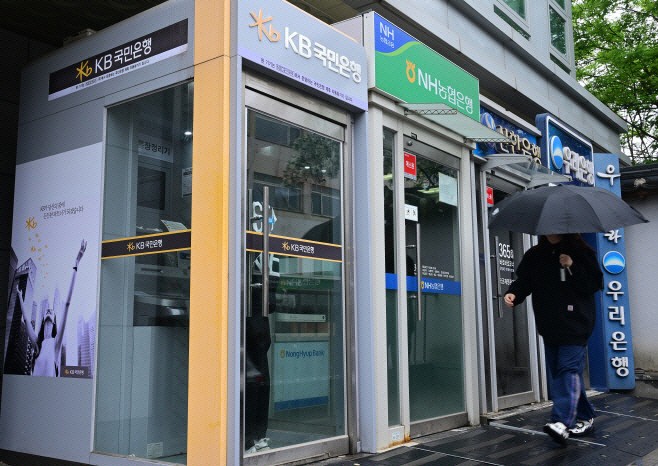 |
| Bank ATMs in downtown Seoul. / Lee Byung-hwa |
Corporate lending by South Korea's five major banks — KB Kookmin, Shinhan, Hana, Woori and NH NongHyup — increased by the largest amount in two years and four months, surpassing 900 trillion won amid a prolonged period of rising interest rates. Household lending, which declined in September, also returned to growth after just one month. With delinquency rates and non-performing loans at banks reaching their highest levels in years, particularly in corporate lending, concerns are growing that expanding loan assets could increase the burden of managing asset quality.
According to financial industry sources on Nov. 2, outstanding corporate loans at the five major banks stood at 900.4025 trillion won at the end of October, up 8.8659 trillion won, or 0.99%, from 891.5366 trillion won at the end of the previous month. This was the largest monthly increase in two years and four months, since June 2024, when corporate loans rose by 8.025 trillion won, or 1.00%.
By company size, lending to small and medium-sized enterprises (SMEs) showed a particularly large increase. Outstanding SME loans reached 695.0953 trillion won at the end of October, up 5.0222 trillion won, or 0.73%, from 690.0731 trillion won a month earlier. This was the largest increase in two years and six months, since April 2024, when SME loans grew by 4.7563 trillion won, or 0.74%. Over the same period, loans to large corporations increased by 3.8438 trillion won, from 201.4634 trillion won to 205.3072 trillion won.
Household lending also recorded a notable increase. Outstanding household loans at the five major banks reached 783.6057 trillion won at the end of October, up 2.7717 trillion won from 780.8340 trillion won a month earlier. The increase came just one month after household lending fell by 1.2852 trillion won in September, marking its first decline in six months.
Mortgage loans drove the growth in household lending. Outstanding mortgages at the five major banks totaled 623.0988 trillion won at the end of October, up 1.7005 trillion won from 621.3983 trillion won a month earlier. Compared with September's increase of just 125.2 billion won, the monthly increase was more than 12 times larger.
Unsecured personal loans also returned to growth. Outstanding unsecured personal loans stood at 108.8990 trillion won at the end of October, up 668.7 billion won from 108.2303 trillion won a month earlier. Such loans had declined for two consecutive months, falling by 181.5 billion won in August and 1.3415 trillion won in September, before rebounding in October.
"Considering that personal deposits have not increased much and unsecured personal loans have not declined easily, it appears that substantial funds remain tied up in the stock market following its strong performance last year and through the first half of this year," a banking industry official said.
The problem is that banks' asset quality indicators are deteriorating even as their loan assets expand. The simple average delinquency rate on won-denominated loans at the five major banks stood at 0.42% at the end of the third quarter this year, its highest level in nine and a half years, since the first quarter of 2017, when it reached 0.45%.
In particular, the corporate loan delinquency rate reached 0.49%, its highest level since the second quarter of 2017, when it stood at 0.58%. The SME loan delinquency rate was particularly high at 0.60%, its highest level since the first quarter of 2017, when it reached 0.65%.
Banks' capacity to absorb losses also appears to be weakening. Non-performing loans (NPLs) at the five major banks totaled 7.6133 trillion won at the end of the third quarter, up 1.2848 trillion won from 6.3285 trillion won a year earlier. This was the largest amount since the first quarter of 2018, when NPLs stood at 8.2143 trillion won.
Meanwhile, the NPL coverage ratio averaged 139.45%, down 28.15 percentage points from 167.60% a year earlier. It was also 4.17 percentage points lower than the previous quarter's 143.62%. In other words, while the volume of bad loans increased, the ratio measuring the level of provisions set aside to cover them declined.
"During periods of high interest rates, both the cost of sales and interest expenses increase, inevitably pushing up delinquency rates," said Son Jae-sung, a professor of accounting at Soongsil University. "Considering that banks are selling a substantial portion of their delinquent loans, the actual delinquency situation could be much more serious."
Some observers also warn that asset quality could deteriorate further, particularly among financially vulnerable companies, given the high likelihood of additional increases in the benchmark interest rate. The concern is that default rates could rise as SMEs already nearing the limits of their repayment capacity face simultaneous increases in interest expenses and outstanding loan balances.
"The reason corporate lending has increased sharply despite high interest rates is more likely that marginal companies unable to secure sufficient liquidity are borrowing to cover their expenses, rather than the effects of productive finance," Son said. "If interest rates rise further, default rates could increase significantly, particularly among marginal companies."
Chae Jong-il
Most Read
-
1
Ukraine halts strikes on Russian oil refineries un..

-
2
China's fifth plenum to conclude amid expectations..

-
3
Southeast Asian auto parts makers hit hard by Chin..

-
4
ASEAN to discuss Myanmar's return next month

-
5
Hegseth rejects calls for impeachment over Iran wa..

-
6
U.S. links Myanmar peace efforts to rare earth acc..

-
7
Democrats flip U.S. Congress in historic midterm s..

PEOPLE







-
Address : In-Young Bldg., 34, Uisadang-daero 1-gil, Yeongdeungpo-gu, Seoul
Copyright by ASIATODAY CO., LTD. All rights resereved