



[Market Power] LG Chem's 2.5 trillion won PRS weighs on LG Energy Solution shares
Nov 03, 2026, 09:39 am


 |
 |
For LG Chem, which has 40 trillion won in borrowings, the last resort was a 2.5 trillion won price return swap (PRS). Market attention is focused on why LG Chem pursued such large-scale financing despite the potential impact on its subsidiary's share price. Despite a series of business unit sales and disposals of stakes in other companies, its consolidated debt has increased, while the high proportion of short-term borrowings has added to the burden of liquidity management.
Against this backdrop, a direct sale of a large equity stake would require the company to find buyers while also dealing with a potential market backlash. LG Chem therefore turned to a PRS to proceed with its previously announced plan to reduce its stake while minimizing the immediate market impact.
However, unlike a conventional share sale, a PRS involves obligations to preserve the principal and pay interest. If the share price falls below the reference price, the company must compensate the securities firm that is its counterparty for the difference. Immediately after the contract announcement, LG Energy Solution's share price fell below the reference price, putting LG Chem in a position where it could face potential settlement losses of more than 170 billion won. Domestic and international credit rating agencies had previously downgraded LG Chem's credit ratings. As these agencies treat PRS arrangements as borrowings, the transaction is expected to have a limited effect on protecting its credit ratings.
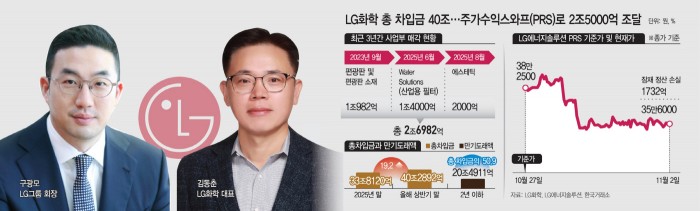
According to the Financial Supervisory Service's Data Analysis, Retrieval and Transfer System (DART) on Nov. 2, LG Chem sold four business units for a combined 2.6982 trillion won over the past three years as part of its portfolio restructuring.
In 2023, the company sold its polarizer and polarizer materials business, which produces a type of display material, for 1.0982 trillion won. Last year, it sold its Water Solutions business, which produces industrial filters, for 1.4 trillion won, and its aesthetics business for 200 billion won. Separately, in the first half of this year, the company raised a total of 595.3 billion won through transactions including the sale of its stake in Australian mineral developer Liontown and the exercise of a put option involving Volta Energy Solutions.
Despite these successive business unit sales, LG Chem's debt indicators deteriorated. Its total consolidated borrowings increased by 6.4772 trillion won, or 19.2%, in six months, from 33.8120 trillion won at the end of 2025 to 40.2892 trillion won at the end of June 2026.
Net debt, calculated by subtracting cash and cash equivalents of 11.0866 trillion won from total borrowings, rose by 5.2906 trillion won over the same period, from 23.9120 trillion won to 29.2026 trillion won.
Borrowings with relatively short repayment periods account for half of the total. In terms of debt maturities, 13.5048 trillion won is due within one year, while 6.9863 trillion won is due in more than one year but within two years. This brings the total amount of borrowings due within two years to 20.4911 trillion won.
In terms of operating performance, the company recorded a net loss of 977.1 billion won last year, followed by a net loss of 715.1 billion won in the first half of this year.
"LG Chem did not undertake any borrowing, financing or investment activities during the period in question, so the increase in debt appears to have resulted from borrowing or financing by our subsidiary LG Energy Solution rather than LG Chem itself," an LG Chem official said.
An LG Energy Solution official explained, "A major factor was the sale of a building in the United States to Honda in May, followed by its conversion into a lease and recognition as borrowings. We have not disclosed the specific amount of lease-related borrowings."
"The issuance of won-denominated and foreign currency bonds also contributed," the official added. "Capital expenditure (CAPEX) peaked last year and has continued to decline. We plan to keep generating earnings before interest, taxes, depreciation and amortization (EBITDA) to improve our financial structure."
The latest 2.5 trillion won in liquidity was secured through a PRS arrangement with a two-year maturity. On Oct. 28, LG Chem announced plans to enter into a PRS agreement to dispose of 6,535,939 common shares of LG Energy Solution at 382,500 won per share.
A PRS is not simply a means of raising equity capital. Under the arrangement, participating securities firms purchase shares, and the difference arising from subsequent share price movements is settled at a later date.
If the share price at maturity falls below the reference price, the company must compensate the securities firms for the loss. If the share price exceeds the reference price, the securities firms return the gains to the company. The company must also separately pay arrangement fees and interest expenses to the securities firms.
Although the transaction takes the form of an equity sale, its substance is closer to a borrowing arrangement combining regular interest payments with an obligation to preserve the principal.
From the securities firms' perspective, they can hold the shares for a certain period and collect predetermined interest without bearing the risk of an equity investment. This is why a PRS is often described as effectively a share-backed loan.
Six securities firms are reportedly participating in the transaction: Mirae Asset Securities, Korea Investment & Securities, NH Investment & Securities, Shinhan Securities, KB Securities and Daishin Securities.
On Oct. 29, the day after the PRS announcement, LG Energy Solution shares plunged 8.60% from the previous session to close at 356,000 won. The shares rebounded slightly to close at 359,500 won on Oct. 30 but ended the latest session back at 356,000 won.
This put the share price 26,500 won below the contractual reference price of 382,500 won, placing LG Chem in a position where it could face potential settlement losses of 173.2 billion won.
Domestic and international credit rating agencies have downgraded LG Chem's credit ratings, citing accumulating borrowings and weakening cash-generating capacity.
Korea Ratings downgraded the company from AA+ to AA in June this year. U.S.-based S&P lowered its rating from BBB+ to BBB in March last year, while Moody's downgraded it from Baa1 to Baa2 in November last year.
Credit rating agencies typically use quantitative indicators such as net debt to EBITDA and the debt dependence ratio as triggers for rating downgrades. When EBITDA, the denominator in the net debt-to-EBITDA ratio, declines amid weakening earnings, the company faces the possibility of further downgrades unless it can meaningfully reduce net debt, the numerator.
However, major credit rating agencies regard PRS arrangements involving settlement obligations as borrowings.
Asked about measures to reduce borrowings and protect its credit ratings, an LG Chem official said, "We plan to continue reducing our reliance on borrowings by strictly managing annual CAPEX at below 2 trillion won and improving our cash-generating capacity through the optimization of noncore assets."
Park I-sak
#LG Chem #LG Energy Solution
Copyright by Asiatoday
Most Read
-
1
U.S., Israel plan to resume strikes on Iran after..

-
2
Ukraine halts strikes on Russian oil refineries un..

-
3
China's fifth plenum to conclude amid expectations..

-
4
ASEAN to discuss Myanmar's return next month

-
5
AI-discovered PHP flaw triggers global cybersecuri..

-
6
UK court orders worldwide asset freeze on Vietnam'..

-
7
Trump envoy says U.S. no longer guarantees Middle..

PEOPLE







-
Address : In-Young Bldg., 34, Uisadang-daero 1-gil, Yeongdeungpo-gu, Seoul
Copyright by ASIATODAY CO., LTD. All rights resereved