



Lee, Merz agree to elevate strategic ties, expand defense cooperation
Oct 30, 2026, 09:29 am


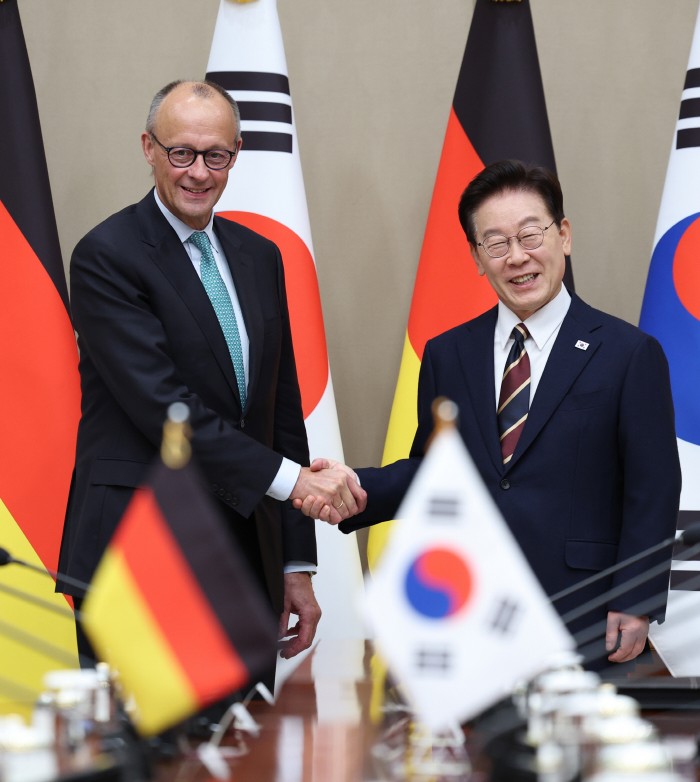 |
| President Lee Jae Myung shakes hands with German Chancellor Friedrich Merz ahead of their expanded summit at Cheong Wa Dae in Seoul on Oct. 29. / Yonhap News Agency |
President Lee Jae Myung agreed on Oct. 29 to upgrade relations between South Korea and Germany to an "Enhanced Strategic Partnership." In particular, the two countries agreed to pursue a military information protection agreement and expand cooperation in the defense industry through joint investments and joint development projects.
"Chancellor Merz and I have agreed to establish an Enhanced Strategic Partnership between our two countries based on deep trust and cooperation," Lee said during a joint press announcement following their summit at Cheong Wa Dae that afternoon.
According to the presidential office, the two countries agreed to strengthen strategic communication and establish an institutional foundation to support cooperation in defense and security.
"We will strengthen strategic communication between our defense authorities and promptly pursue the conclusion of a General Security of Military Information Agreement (GSOMIA) to reinforce the institutional foundation for defense and security cooperation," Lee said.
In the defense industry, the two countries agreed to explore long-term partnerships, including joint investments and joint development, moving beyond competition for individual contracts.
"I conveyed the strong interest of our defense companies in establishing long-term partnerships, including joint investments and joint development, with Germany, the world's third-largest economy and Europe's largest," Lee said. "We will actively identify opportunities for mutually beneficial cooperation between defense companies, building on the advanced defense technologies and industrial capabilities of both countries."
South Korea and Germany have both competed and cooperated in the global defense market. Recently, Germany's Thyssenkrupp Marine Systems (TKMS) and South Korea's Hanwha Ocean competed in the Canadian Patrol Submarine Project (CPSP), under which Canada plans to acquire up to 12 submarines.
With joint development and joint investment formally identified as areas for cooperation at the summit, attention is turning to whether the two countries can develop new cooperation models, including in third-country markets.
In the economic and industrial sectors, the two countries agreed to expand cooperation beyond traditional trade and investment to advanced technologies, supply chains and economic security.
They agreed to establish an Economic and High-Tech Partnership Framework to expand policy and technological cooperation in trade, industry and resources. Through bilateral consultative mechanisms, they will also review progress on existing cooperation projects and continue identifying new initiatives. The aim is to develop economic ties into a strategic partnership encompassing supply chains, economic security and advanced industries, going beyond conventional trade and investment.
The two countries also agreed to expand cooperation in industries where both possess competitive strengths, including automobiles, batteries and semiconductors, while pursuing joint research and technological innovation in emerging fields such as artificial intelligence (AI), quantum technology, biotechnology and space.
Lee also requested Germany's attention and cooperation to ensure that South Korea receives treatment equivalent to that of EU member states under the European Union's proposed Industrial Accelerator Act.
In the energy sector, the two countries agreed to renew their Joint Declaration of Intent on Energy Partnership and expand policy and technological exchanges in renewable energy and power grids. They also agreed to promote joint research between companies and research institutions to support the energy transition and ensure a stable supply of clean energy.
The two countries also agreed to expand people-to-people exchanges. In particular, marking the 60th anniversary of the dispatch of South Korean nurses to Germany this year, they pledged to broaden cooperation in education and culture and strengthen exchanges between younger generations.
"The dedication and hard work of our miners and nurses who went to Germany laid the foundation for the economic development of both countries and became the basis of friendship and trust between our nations," Lee said.
The two countries also agreed to strengthen strategic coordination on global security issues. The leaders shared the view that security in Northeast Asia and Europe is closely interconnected and pledged to cooperate to promote peace and stability in both regions.
The leaders also exchanged views on major international issues, including the war in Ukraine, developments in the Middle East, the free trade order and responses to the climate crisis, and agreed to work together for international peace and stability.
Meanwhile, approximately 60 people, including members of a German business delegation and executives from major South Korean companies, attended an official dinner following the summit.
South Korean attendees included Yoon Jin-sik, chairman of the Korea International Trade Association (KITA); Euisun Chung, executive chair of Hyundai Motor Group; Chang In-hwa, chairman of POSCO Group; Cho Hyun-joon, chairman of Hyosung Group; and Chung Mong-won, chairman of HL Group.
Park Young-hoon
Most Read
-
1
Ukraine halts strikes on Russian oil refineries un..

-
2
China's fifth plenum to conclude amid expectations..

-
3
Southeast Asian auto parts makers hit hard by Chin..

-
4
U.S. links Myanmar peace efforts to rare earth acc..

-
5
Hegseth rejects calls for impeachment over Iran wa..

-
6
Democrats flip U.S. Congress in historic midterm s..

-
7
USFK commander cites interoperability gaps, urges..

PEOPLE






-
Address : In-Young Bldg., 34, Uisadang-daero 1-gil, Yeongdeungpo-gu, Seoul
Copyright by ASIATODAY CO., LTD. All rights resereved